Sterlite Technologies Q2FY27 Concall Updates -
Sterlite Technologies is transitioning from a traditional optical fibre and cable manufacturer into a higher-value optical connectivity solutions provider.
The Q2FY27 concall highlighted 5 major growth drivers:
• AI data centres
• Higher connectivity attach rates
• Long-term customer contracts
• Next-generation optical technologies
• Capacity expansion
1/ Revenue Mix Transformation
STL is deliberately shifting towards high-value-added integrated connectivity solutions instead of standalone fibre and cable products.
Why does this matter?
• Data-centre products carry better margins than traditional telecom products.
• Connectivity accessories increase value per customer.
• Integrated solutions improve customer relationships.
• A richer product mix can support structurally higher profitability.
2/ Data centres are becoming a major growth engine
Data centres contributed 33% of STL's H1FY27 revenue.
Management is targeting a 50% contribution in FY27, with a longer-term ambition to maintain a 50–60% share while preserving customer and geographic diversity.
North America accounted for 61% of H1FY27 revenue, reflecting strong exposure to AI and cloud infrastructure.
3/ AI data centres need more fibre
AI infrastructure is increasing optical connectivity requirements across three dimensions:
=> Scale-out: Connecting GPU racks and switches inside data centres.
=> Scale-across: Linking multiple data centres into unified AI clusters.
=> Scale-up: Supporting higher transmission speeds as networks transition from 400G to 800G and eventually 1.6T.
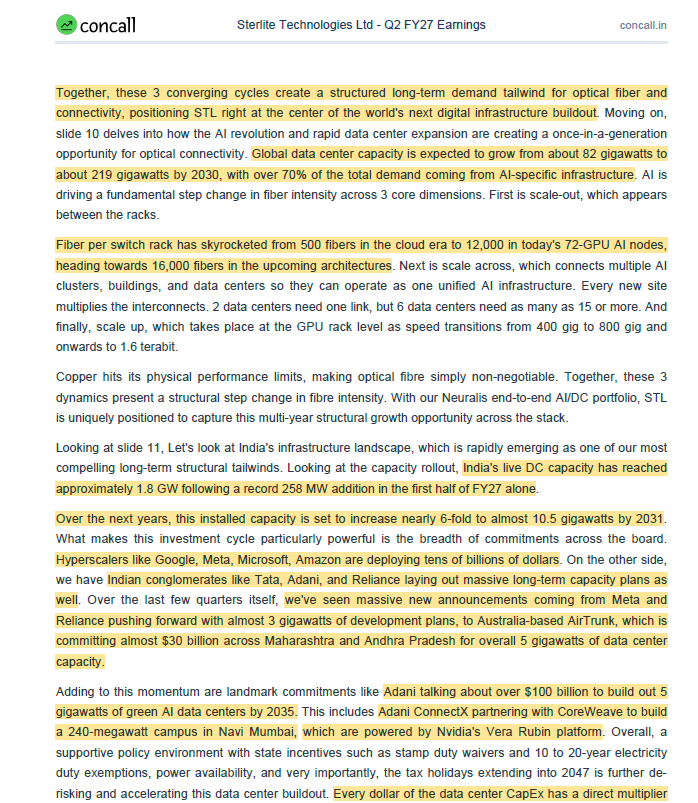
Management highlighted that fibre requirements per switch rack have risen from around 500 fibres in the cloud era to 12,000 in current 72-GPU AI nodes, with 16,000 possible in future architectures.
AI is increasing fibre intensity, not merely the number of data centres.
4/ Opportunity extends beyond data-centre buildings
STL can benefit from optical connectivity across:
=> AI server racks and data halls.
=> Data-centre interconnect (DCI).
=> Metro fibre networks.
=> Long-haul networks connecting multiple facilities.
=> Telecom infrastructure supporting cloud and AI traffic.
Management cited global data-centre capacity rising from approximately 82 GW to 219 GW by 2030.
India's live data-centre capacity was cited at approximately 1.8 GW, with a projection of nearly 10.5 GW by 2031.
The potential beneficiaries for STL are not limited to fibre installed inside the data-centre building. The opportunity also includes metro networks, data-centre interconnect (DCI) and long-haul optical networks linking facilities.
5/ Order book provides multi-year visibility
STL reported a record open order book of Rs. 35,274 CR, with H1FY27 order intake of Rs. 32,000 CR.
Two major hyperscaler announcements stand out:
• A five-year agreement with potential value of $1.2 billion for AI-ready optical solutions.
• A previously announced $1.11 billion product award letter for optical connectivity.
STL has also secured multi-year agreements with telecom operators, neutral fibre providers and an Indian telecom customer.
The strategic shift: moving away from short-cycle spot orders towards scheduled execution under long-term contracts.
Historically, a meaningful portion of STL's revenue came from orders won and delivered within the same quarter.
Management now says spot business has become negligible as multi-year contracts scale up.
Benefits include:
• Better demand visibility.
• More predictable production planning.
• Improved capacity utilisation.
• Greater stability in product realisation
However, a large order book creates value only when orders are executed on schedule and converted into cash.
6/ Connectivity attach rate: A critical growth lever
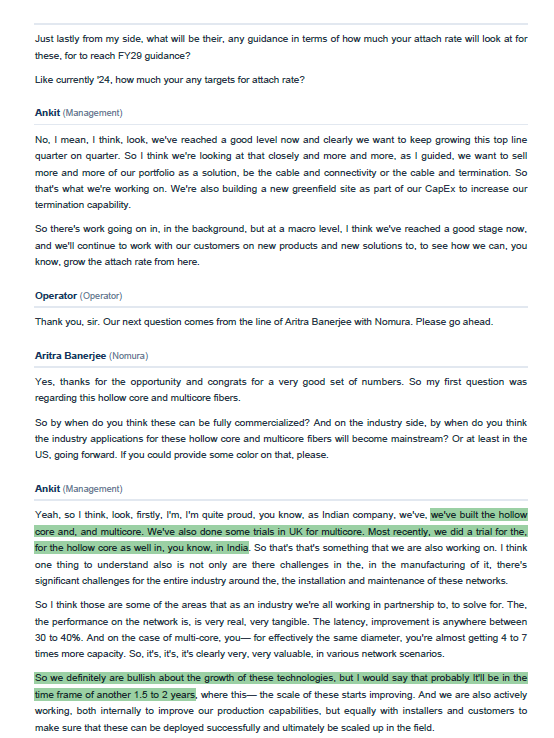
STL's connectivity attach rate increased to 24% in H1FY27, from 20% in H1FY26.
Management wants to exceed 25% in FY27 and continue increasing the rate thereafter.
Instead of selling only optical fibre cable, STL increasingly sells accessories, terminations and integrated connectivity solutions alongside it.
This can increase revenue per cable deployment and improve the overall product mix.
Importantly, management clarified that connectivity accessory revenue is included in the reported order book.
Global peers have substantially more established connectivity businesses. Management acknowledged that catching up requires more than expanding manufacturing capacity.
STL needs to invest in product innovation, customer specific co-development, termination and assembly capabilities, and Next-generation connectivity platforms.
The company is building a new greenfield facility for pre-terminated solutions to strengthen these capabilities.
7/ Next-generation optical technologies
STL is investing in technology beyond conventional optical fibre and cable. Its Neuralis portfolio is designed for AI data-centre connectivity and high-speed interconnects.
• G654E fibre: Fully commercialised; management cites approximately 30% lower signal loss.
• Hollow-core fibre: In the first commercial-pilot phase; designed to reduce latency.
• Multicore fibre: Designed to deliver 4–7 times the data capacity within the same footprint
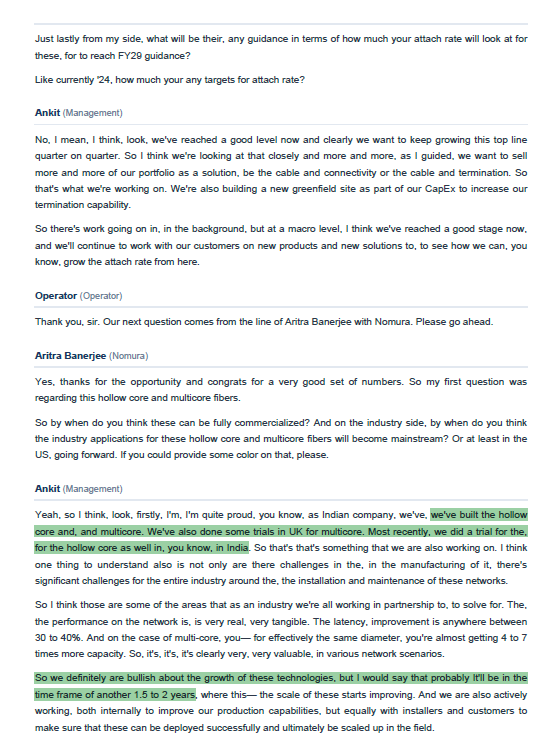
Management estimated that the scale of hollow-core and multicore technologies could begin improving over the next 1.5–2 years. Manufacturing, installation and maintenance challenges still need to be addressed before deployment can scale materially.
These should be viewed as future growth opportunities, not yet as established large-scale revenue drivers.
8/ Capacity expansion and raw materials
STL is planning a 50% expansion in preform fibre and cable capacities, alongside a new greenfield facility for pre-terminated solutions.
The company has committed around ₹1,000 crore of annual capex through FY29 and plans to invest 2% of annual revenue in R&D.
Meanwhile, management reported improving availability of critical raw materials such as germanium and helium, alongside greater supplier diversification.
Capacity utilisation is also improving quarter on quarter, although management did not disclose the exact utilisation percentage.
The challenge is to ramp existing capacity while commissioning new facilities without creating execution bottlenecks.
9/Working capital and receivables need monitoring
Management said net working-capital days increased slightly in Q2, while its objective is to maintain a net working-capital cycle of around 45–50 days.
Payable days have fallen because the supply-constrained market has changed payment terms for certain materials and expects payable days to normalize. Management is working to improve receivables and inventory levels, with the expected improvement to be reflected from the next quarter.
Management attributed the increase in finance costs to prepayment of certain loans ahead of their scheduled maturity, which resulted in prepayment penalties.
It said that most of the tariff refund process had been completed, with a small additional amount still subject to the ongoing process. Management expects net finance costs to decline from Q3FY27 onwards.
10/ Key risks to monitor
=> Hyperscaler capex slowdown
=> Raw material constraints
=> Working capital pressure
=> Capacity execution
=> Margin sustainability
=> New Technology adoption
Management acknowledged that hyperscaler projects can encounter delays arising from financing costs, land, power, water and local execution issues.
11/ Bigger Picture
STL's investment story is evolving across three layers:
=> Core business: Optical fibre and cable demand supported by telecom and broadband networks.
=> Higher-value growth: AI data-centre connectivity, pre-terminated solutions and rising attach rates.
=> Future optionality: Hollow-core fibre, multicore fibre and next-generation optical platforms.
Project Lakshya targets ₹20,000 crore in FY29 revenue, with the EBITDA margin ambition upgraded to above 30%.
The key question is whether STL can convert that demand into higher-value contracts, sustained margins and strong cash generation
Watch the data-centre mix, attach rate, order-book execution, capacity utilisation and working-capital discipline.
🟥Disclaimer: This post is for informational and educational purposes only.
Source: @concall_in@vishan_29@Dynamicinvstr
Fedbank Financial Services Q2FY27 Concall Updates –
1/ Gold loans – Growth Engine
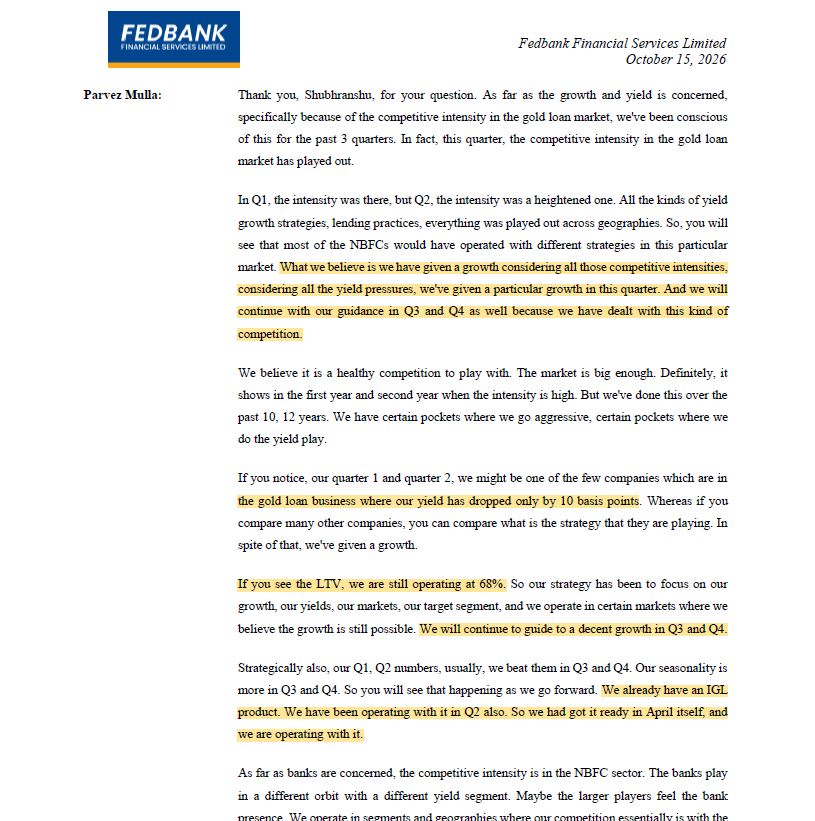
Management acknowledged that competition in gold loans intensified in Q2, with lenders using different pricing, yield and lending strategies across geographies.
Management said the company was among the few gold-loan players whose yield had fallen by only around 10 basis points across Q1 and Q2, although it did not provide a full peer-comparison table on the call.
The company intends to use multiple levers like yields, LTV, customer segment and geographical mix instead of commenting to a flat yield outlook. It explicitly declined to guarantee that yields would remain unchanged in Q3 and Q4.
FEDFINA reported an average LTV of 68%. Management said it varies lending practices by geography and competition, sometimes operating at lower LTVs where market conditions allow it
2/ Gold Loan – Asset Quality
Management attributed the rise in early-stage delinquencies to the shift from the earlier bullet-repayment structure towards a periodic interest-payment model.
Customers accustomed to pay at the end of the loan cycle are now being asked to make regular interest payments.
The behavioural adjustment could take another one or two quarters. It warned that Stage II numbers could fluctuate as business volumes and customer behaviour change.
Management emphasised that it had not incurred an auction loss on principal or interest in the preceding six years and said it intended to preserve that record. It also said gold loans are collateralised and recoverable through the auction process
3/ Mortgage Business – Early signs of Turnaround
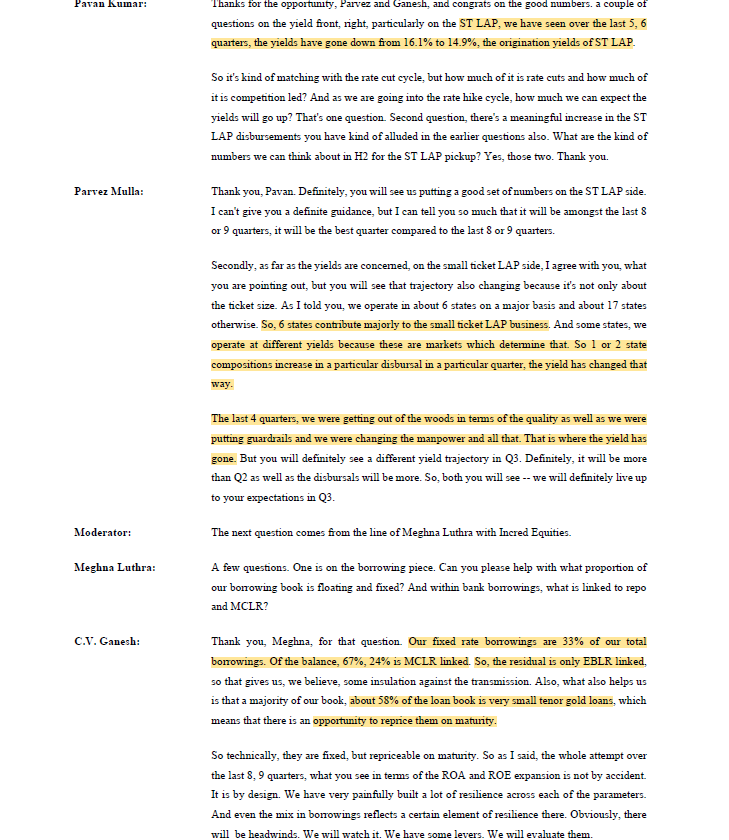
Management said the company had spent the previous three to four quarters strengthening underwriting, changing manpower and tightening its business rules engine.
Credit costs in small-ticket LAP have normalised sufficiently to allow it to push for growth in Q3 and Q4.
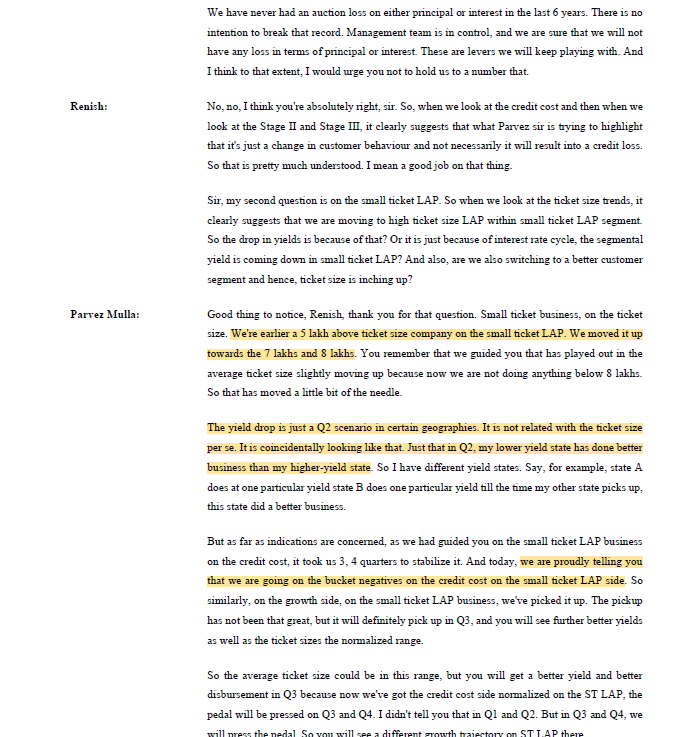
A decline in small-ticket LAP origination yields from 16.1% to 14.9% over the previous five to six quarters which the company attributed the Q2 yield mix partly to a higher contribution from lower-yield states, rather than solely to higher ticket sizes.
Management indicated that approval rates had recovered from around 30% to the low-to-mid-40% range.
The expected disbursements and yields to improve in Q3FY27 and anticipates one of the segment’s strongest quarters in around 8-9 quarters
Management also said it had moved away from very small loans and was no longer doing loans below Rs. 8 lakh in this small-ticket LAP segment.
Management described medium-ticket LAP as a profitable, partner-driven business with yields of approximately 11.5–12.5%, a stable delinquency profile and a mature operating team
4/ Funding Costs & Balance Sheet
The weighted-average borrowing cost remained around 7.8% for three consecutive quarters.
Borrowing mix:
• Fixed rate: 33%
• MCLR-linked: 24%
• EBLR-linked: 43%
Management believes this mix provides some protection from changes in interest rates. It also noted that around 58% of the loan book consists of short-tenor gold loans, which can be repriced when they mature
Management acknowledged that higher funding costs cannot always be fully passed on to customers. It plans to offset pressure through operating efficiency, product mix, credit-cost management and pricing.
Q2 direct assignments of around Rs. 700 CR in gold loans also supported balance-sheet efficiency, with debt/equity declining to 4.6x from 4.9x and CRAR improving to 21% from 20.7%.
5/ Management Guidance
Management reiterated its existing annual guidance of growing AUM at 20-25% despite the flat gold-price environment. It indicated that performance could be better if gold prices rise.
The aim is to reach ROA of 3% & ROE of 18% and then sustain a predictable return profile. It suggested Q1 and Q2 performance could create upside to its earlier ROE guidance, but it did not formally revise the guidance.
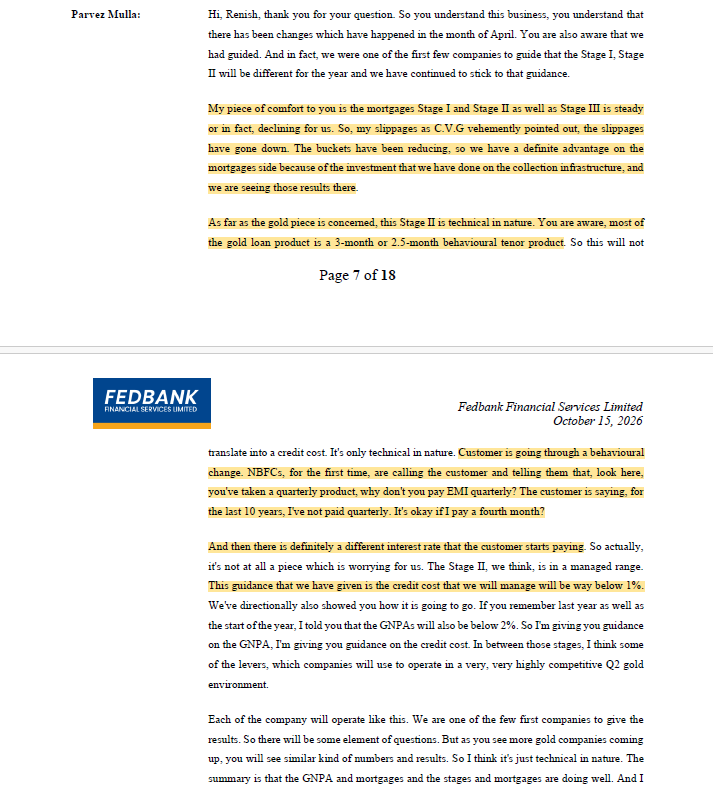
Credit Cost will be below 1% & GNPA below 2% acknowledging that Stage II and Stage III indicators could fluctuate as gold-loan customers adjust to the new repayment structure.
Management expects the second half to be seasonally stronger for gold-loan tonnage and plans to accelerate small-ticket LAP disbursements
6/ Risks
=> Gold-loan yield compression amid competition.
=> Persistent Stage II/Stage III deterioration.
=> Higher operating costs from rapid branch expansion.
=> Funding-cost pressure on spreads
=> A slower-than-expected small-ticket LAP recovery
=> Dependence on direct assignments to manage leverage
7/ Final Takeaway
Fedbank Financials’ Q2FY27 performance shows strong growth momentum and improving profitability.
The positives are rapid gold-loan expansion, 40.9% YoY core NII growth, 63.1% PAT growth and lower sequential credit costs.
But the next phase depends on three things:
1. Sustaining gold-loan growth without sacrificing yields.
2. Proving that rising delinquencies are manageable.
3. Converting small-ticket LAP recovery and branch expansion into profitable growth
The key metric to watch is whether Fedbank can reach its 3% ROA and 18% ROE targets while keeping credit costs under control.
The next two quarters should be particularly informative: they will show whether the gold-loan delinquency changes remain largely technical, whether small-ticket LAP delivers its expected recovery
🟥Disclaimer: This post is for informational and educational purposes only.
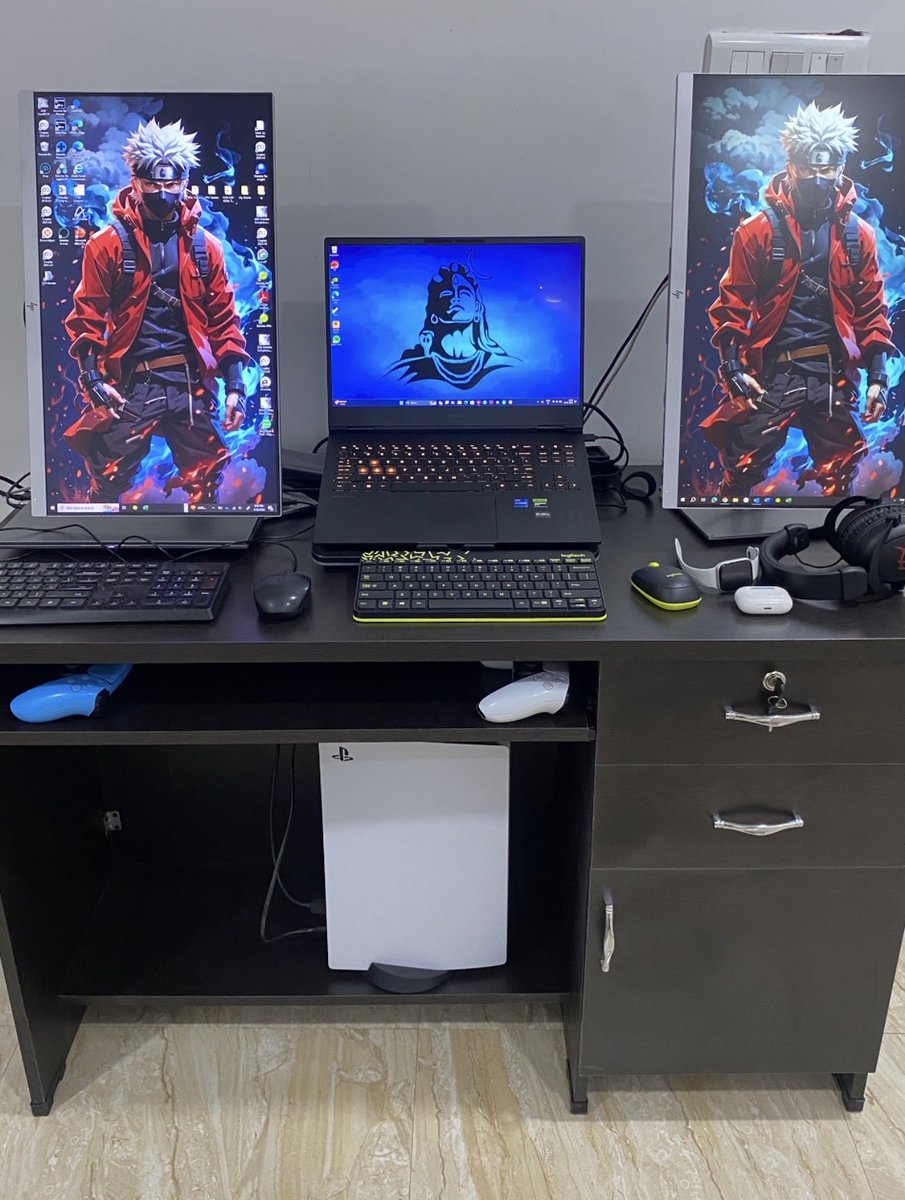
After a long time, my kid and I finally played PlayStation together. ❤️
Growing up, I represented my college and even competed at the national level in cyber gaming.
But I could never afford a PlayStation.
Once I started earning, I finally bought one. By then, work and responsibilities had taken over. I barely had time to play.
Today, my kid is my gaming companion.
Life has a beautiful way of giving you a second chance at the things you once couldn’t afford. This time, I get to experience it with him. ❤️
@DealsDhamaka Sometimes we can’t avoid it . In laws might want to gift something to their daughter and we can’t help it . End of the day money is a tool that transfers to near one .
Apart from that never take money from relatives
The problem is “posting “ neither the dowry nor the men .
Who cares if someone bought a car and posted it on Instagram is that a mandatory thing to do ?
Dear men, if you’re getting a car as dowry, at least have the courage to admit it. I’ve seen men receive cars as dowry and still post about how they bought them themselves, just to avoid being judged. Own the truth instead of pretending to be self-made.