¡FINALMENTE LOGRAMOS RESCATAR A HERNÁN!
Después de más de 72 horas de trabajo y tras enfrentar una estructura sumamente inestable, réplicas, derrumbes y la necesidad de abrir una nueva vía de acceso para poder llegar hasta él, rescatamos con vida a Hernán Alberto Gil Flores, de 44 años, quien permaneció más de 7 días atrapado bajo los escombros del centro comercial Galerías Playa Grande.
Este rescate fue posible gracias al esfuerzo conjunto de los equipos de Chile, Estados Unidos, Portugal, México, Costa Rica, Venezuela y El Salvador, que trabajaron sin descanso para remover escombros, estabilizar la estructura y abrir paso hasta llegar a Hernán.
Nuestra admiración y reconocimiento para todos los rescatistas que participaron en esta operación, así como para Hernán, cuya fortaleza y resiliencia durante más de 7 días fueron extraordinarias.
En este momento, los médicos están evaluando su condición para que pueda ser trasladado a un centro hospitalario y continúe recibiendo la atención que necesita.
Gracias a Dios por permitir este milagro.
Fuerza Venezuela 🇸🇻🇻🇪
Estudiantes del Consultorio Juridico de Udelar ganan juicio para un niño que necesitaba un corazón artificial; en el día de ayer fue trasplantado exitosamente !!! 💪🏻❤️
CJUDELAR14 #traficantesdeilusiones
In the midst of all the chaos, Larry the cat is proving to be one of the few constants in Downing Street as he prepares for a potential seventh new owner
Follow the latest updates 👇
https://t.co/08jvhcBz3Q
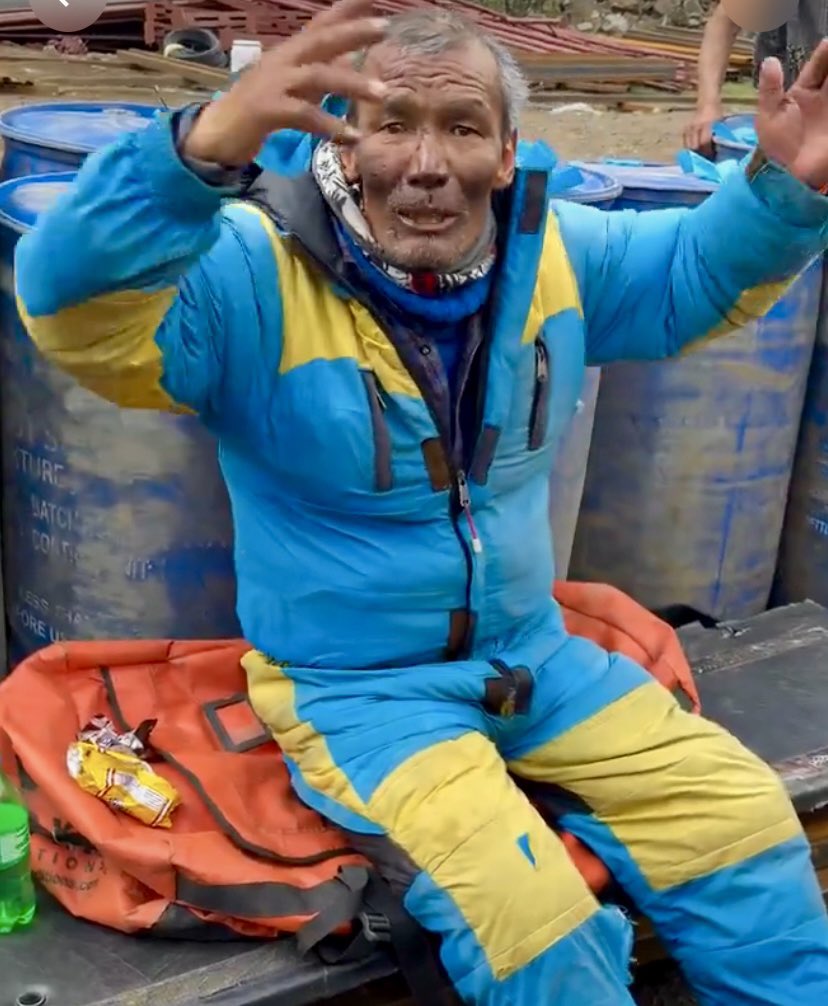
Dawa Hillary Sherpa (52 años, de Okhaldhunga, Nepal), guía sherpa experimentado, fue dejado atrás el 29 de mayo de 2026 (último día de la temporada) durante el descenso del Everest, cerca de la zona de la muerte.
Dawa guiaba a un cliente polaco con Himalayan Traverse Adventure (agencia nepalí). El cliente —que escalaba sin oxígeno suplementario— sufrió congelaciones graves cerca del Collado Sur (Campo 4, 7.950m), por lo que dieron la vuelta.
En el descenso por la Cara de Lhotse (cerca del Campo 3 / Yellow Band, 7.500-7.600 m), Dawa se detuvo a descansar con mochila pesada y les dijo al cliente y a otro sherpa que siguieran. Se separaron.
El cliente y otro sherpa llegaron al Campo 2 (6.400 m), de donde fueron evacuados en helicóptero. Dawa no apareció.
La temporada en el Everest cerraba ese mismo día. Los Icefall Doctors retiraban las escaleras de la Cascada de Hielo del Khumbu poco después (zona 5.500-6.000 m).
Su empresa tardó días en reportarlo y no activó una búsqueda inmediata.
El miércoles 3 de junio subió un helicóptero (de 8K Expeditions, a petición de la familia), pero no lo vio a pesar de buscar desde la Cascada de Hielo hasta Campo 3.
Críticas duras por negligencia y falta de apoyo.
Final milagroso (hoy, 4 de junio): Dawa sobrevivió 6-7 días solo en la montaña (sin oxígeno, sin comida, solo, sin ayuda).
Bajó arrastrándose más de 2.000 m por la vertiginosa Cara de Lhotse, Western Cwm y la peligrosa Cascada de Hielo del Khumbu, arrastrándose hacia el Campo Base . Un equipo de limpieza lo encontró cerca del Crampon Point, consciente pero con graves congelaciones. Dawa hablaba lento y estaba débil. Le dieron una sopa caliente. Fue evacuado en helicóptero a Kathmandu, donde está en el hospital recuperándose.
Su familia ya preparaba los funerales.
Pero como dice la canción de Cheo Gallego:
"Nadie sabe si luego de la muerte podemos vernos,
nunca;
Que si el infierno que resguardas tú
Lo guardas, pero en tu yo interno
NUNCA."
📷Mingmar Sherpa/Capitán Bibek Khadka
���🇧🇷 UPDATE: One of two patients with Ebola-like symptoms in Brazil has tested NEGATIVE for Ebola.
- Rio patient: Positive for malaria, Ebola ruled out (still isolated as precaution)
- São Paulo patient: Positive for severe meningitis, Ebola tests ongoing (intubated, serious condition)
Both recently arrived from outbreak areas in Africa.
King's College Hospital in London has opened a rooftop garden for critical care patients. Its first patient, a 29-year-old woman dependent on feeding tubes, said the outdoor space gave her 'a real boost to keep on going
I joined NPR Morning Edition to talk about the Ebola outbreak in the DR Congo
We learned too much, too quickly, for this outbreak to be anything but a big problem
We talked about the challenges of the response and where this likely headed
Have a listen:https://t.co/reB6stTuaQ
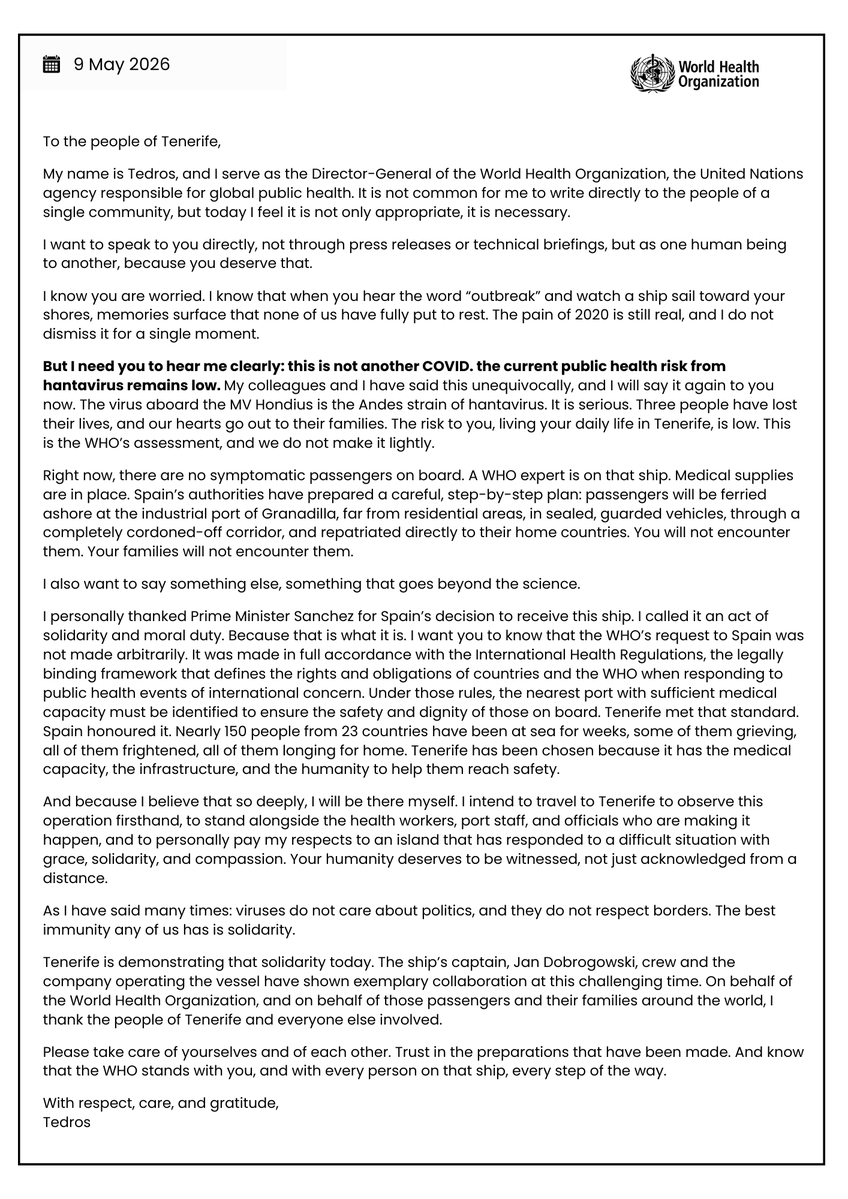
To the people of Tenerife,
My name is Tedros, and I serve as the Director-General of the @WHO, the @UN agency responsible for global public health. It is not common for me to write directly to the people of a single community, but today I feel it is not only appropriate, it is necessary.
I want to speak to you directly, not through press releases or technical briefings, but as one human being to another, because you deserve that.
I know you are worried. I know that when you hear the word “outbreak” and watch a ship sail toward your shores, memories surface that none of us have fully put to rest. The pain of 2020 is still real, and I do not dismiss it for a single moment.
But I need you to hear me clearly: this is not another COVID-19. the current public health risk from #hantavirus remains low. My colleagues and I have said this unequivocally, and I will say it again to you now.
The virus aboard the MV Hondius is the Andes strain of hantavirus. It is serious. Three people have lost their lives, and our hearts go out to their families. The risk to you, living your daily life in Tenerife, is low. This is the WHO’s assessment, and we do not make it lightly.
Right now, there are no symptomatic passengers on board. A WHO expert is on that ship. Medical supplies are in place. Spain’s authorities have prepared a careful, step-by-step plan: passengers will be ferried ashore at the industrial port of Granadilla, far from residential areas, in sealed, guarded vehicles, through a completely cordoned-off corridor, and repatriated directly to their home countries. You will not encounter them. Your families will not encounter them.
I also want to say something else, something that goes beyond the science.
I personally thanked Prime Minister @sanchezcastejon for #Spain’s decision to receive this ship. I called it an act of solidarity and moral duty. Because that is what it is. I want you to know that the WHO’s request to Spain was not made arbitrarily. It was made in full accordance with the International Health Regulations, the legally binding framework that defines the rights and obligations of countries and the WHO when responding to public health events of international concern. Under those rules, the nearest port with sufficient medical capacity must be identified to ensure the safety and dignity of those on board. Tenerife met that standard. Spain honoured it. Nearly 150 people from 23 countries have been at sea for weeks, some of them grieving, all of them frightened, all of them longing for home. Tenerife has been chosen because it has the medical capacity, the infrastructure, and the humanity to help them reach safety.
And because I believe that so deeply, I will be there myself. I intend to travel to Tenerife to observe this operation firsthand, to stand alongside the health workers, port staff, and officials who are making it happen, and to personally pay my respects to an island that has responded to a difficult situation with grace, solidarity, and compassion. Your humanity deserves to be witnessed, not just acknowledged from a distance.
As I have said many times: viruses do not care about politics, and they do not respect borders. The best immunity any of us has is solidarity.
Tenerife is demonstrating that solidarity today. The ship’s captain, Jan Dobrogowski, crew and the company operating the vessel have shown exemplary collaboration at this challenging time. On behalf of the World Health Organization, and on behalf of those passengers and their families around the world, I thank the people of Tenerife and everyone else involved.
Please take care of yourselves and of each other. Trust in the preparations that have been made. And know that the WHO stands with you, and with every person on that ship, every step of the way.
With respect, care, and gratitude,
Tedros