AI Coach helping enterprises and individuals adopt AI | Founder & CEO @ebxdoto | ISB/IIM | Keynote Speaker | AI Masterclasses | Workshops | Consulting.
THE AI BOOMERANG IS REAL
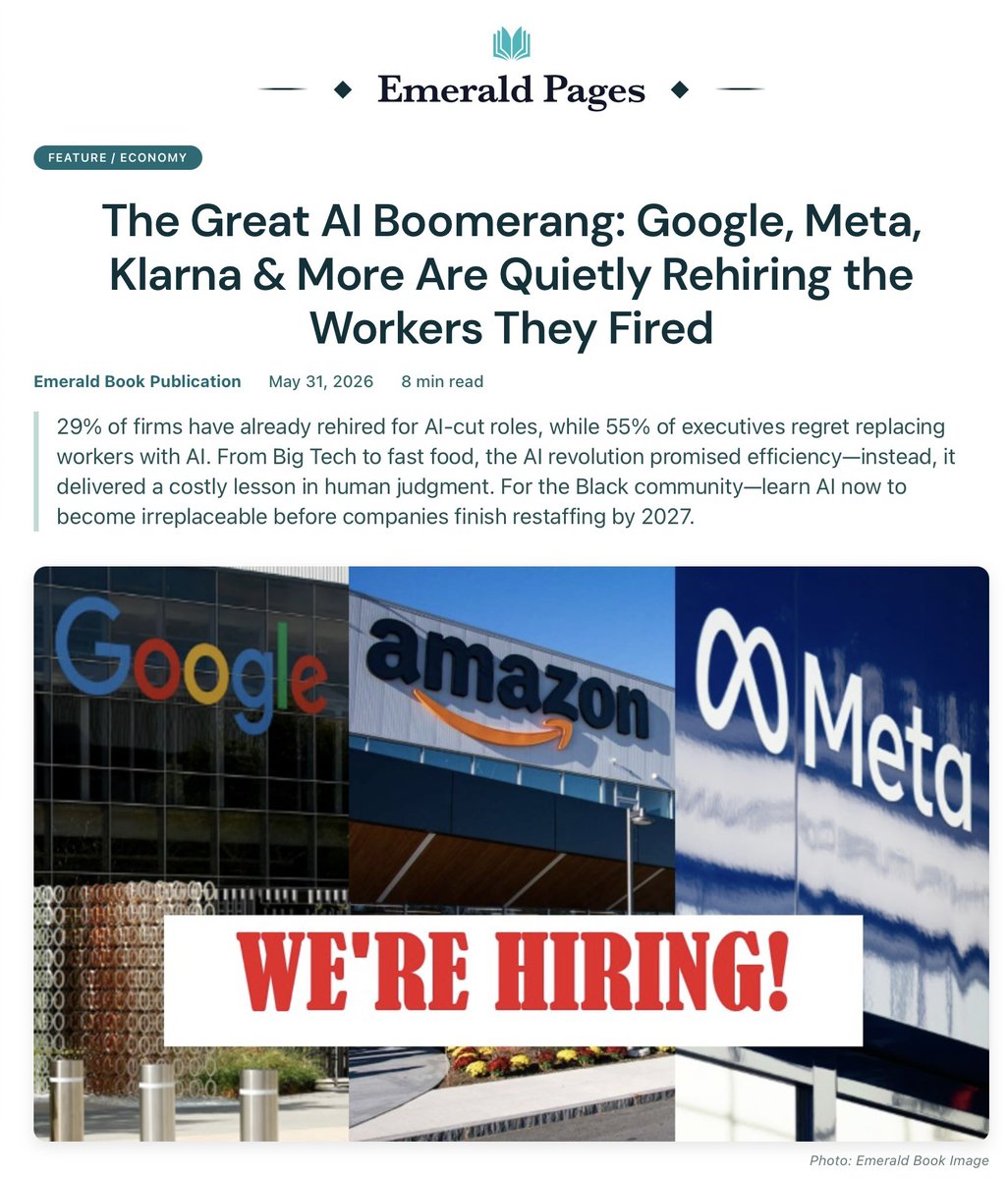
Remember when CEOs told everyone AI was coming for your job? Funny story.
Now companies are quietly rehiring after discovering that chatbots, algorithms, and AI hallucinations aren’t great at judgment, customer service, quality control, or fixing the messes they create.
• Google
• Meta
• IBM
• Salesforce
• Klarna
• Shopify
• Amazon
• McDonald’s
They replaced employees with software and then spent months realizing what the employees actually did.
For those wondering whether AI will take over all human tasks and decisions, here is your answer.
Look at this photograph. A Chinese spacecraft is returning from space. A red-and-white parachute is descending. Behind it, a full moon fills the sky.
Two decisions made this image possible. Wang Heng, a photographer for Xinhua, decided to be at the landing site in Inner Mongolia with a lens pointed at the sky. Then, in a fraction of a second, he decided to press the shutter at the exact moment the parachute crossed the face of the moon.
I struggle to think how AI will ever make those two decisions.
AI can operate a camera and recognise a moon. The gap is in the judgment about where to be, what to watch for, and the recognition of a moment that will not come again. That is what no training dataset captures.
This applies to professional life in ways most of us encounter every day.
• A hiring manager sits across from two equally qualified candidates and reads something in one of them that no CV captures and no scoring matrix surfaces.
• A sales leader is three hours into a difficult customer conversation and senses the exact moment to stop talking and let silence do the work.
• A senior partner walks into a board meeting, reads the room in the first two minutes, and decides not to put a proposal that was six months in the making.
AI can rank candidates by competency scores, flag patterns in customer conversations, and model which proposals have the highest probability of approval. These are the things AI does well. It works from patterns. It surfaces what has happened before.
But the hiring manager also noticed that one candidate used a phrase that did not sit right. She cannot name why. The sales leader read something in the customer's posture that told him the relationship was salvageable. The senior partner saw one board member exchange a look with another. None of those signals exists in any training dataset.
Humans know more than they can say. AI knows only what it has been told.
AI can be used to make decisions that are purely algorithmic, such as determining who won the race to the nanosecond. There are several decisions, though, that cannot be purely algorithmic because they involve factors that cannot be captured in algorithms.
AI will make humans sharper, faster and better informed. But for the decisions that turn on a moment, a look, a feeling that something is off or on, will continue to be made by humans.
Wang Heng decided to film the descent of the capsule and also decided to press the shutter at the right moment. No algorithm could have told him either of those.
@rohanpaul_ai Everyone is focused on model intelligence. The bigger question might be how expensive intelligence becomes when it starts taking actions instead of generating text.
the exact opposite will happen. people will stop learning new languages because ai will translate in real time.
google already has this with live translate, Apple lets you do it with airpods
people tend to choose convenience over hardship when the tech is cheap (and quick) enough to enable it.
we have a while to go until multi-language are actually good enough to understand the various nuance, tones, slang across every language but we’ll eventually get there.