The demo looks like a flex.
It isn’t.
A backyard clip becomes a Lambo in one pass. Face, motion, setting — all cheap now.
The scarce thing is no longer the video.
It’s the original identity.
Who owns the face.
Who stores the voice.
Who can mint a richer version of you and take the profit.
Doubling the global economy in under 10 years through AI and robots isn’t hype — it’s the logic of an exponential.
My take is simple: the technology will do it. The distribution won’t.
As long as the robots belong to the same people who already own the data centers, “growth for everyone” stays a slide in a pitch deck.
History usually rewards the owners of the means of production, not the people who use them.
Jensen can say no.
Ellison and Musk still have to ask.
That is the real map of power.
Not the keynote. Not the model. The line for chips.
My view is simple: AI is not a technology story first. It is a rationing story. Whoever allocates GPUs, power, and capital writes the next decade. Everyone else rents access and calls it innovation.
So the questions are not about who has the smarter demo.
Who gets first claim on the chips?
Who decides which companies are “too important to wait”?
Who pays for the plants and the grid while the profit stays upstream?
And if Jensen can say no to Ellison, what does that mean for everyone who does not sit in that room?
LARRY ELLISON: "ME AND ELON BEGGING JENSEN FOR GPUS. PLEASE TAKE OUR MONEY."
Oracle $ORCL reports earnings today. Two years ago its founder described the AI race from the inside.
"We need you to take more of our money, please."
He says it all runs on the desire to be first. First in self-driving, first in reading cancer biopsy slides, first in synthesizing video and making movies.
"The guys who are in this race are very smart and they understand they need to be best at something. They'd like to be first, so they're spending a lot of time and a lot of money."
@Yana0055 Judgment is the last scarce asset.
And the people who already own the data, the capital, and the rules will buy it cheaper than everyone else.
Skill getting automated is not the story.
Who captures the judgment layer is.
Who writes the rules.
Who owns the data.
Who takes the profit.
The head of BlackRock says it out loud: the trillions needed for data centers and the power grid behind AI will come from ordinary people’s savings and pension accounts. And in his words, that is mandatory.
So the infrastructure of the future is not being built by some distant “them.”
It is being paid for with your savings.
The profit and the control stay with those who already own the capital, the chips, and access to power.
Politics × AI × Finance.
Technology does not decide who wins. The money at the base of the system does.
The question is not whether AI arrives.
The question is who gets paid for it — and at whose expense.
The CEO of BlackRock, Larry Fink, admits that the trillions of dollars being used to build data centers and power grids will come from ordinary people’s savings accounts and pension funds, and says it is mandatory.
He says America needs trillions in AI infrastructure spending, and that people will be forced to “invest” in it.
“Much of this will come from savings accounts and pension accounts.”
@WalrusProtocol An agent’s memory isn’t a feature. It’s an asset.
While it sits inside one app, the platform writes the rules.
Whoever holds the context writes the rules and takes the margin.
Portable memory changes the question from “which model to trust” to “who owns the history.”
The headline is “AI discovered how materials fail.”
The real move is upstream.
It doesn’t just answer.
It builds the lab, turns the lab into a world, fills that world with agents, and compresses thousands of futures into a principle.
That’s the part that matters:
whoever owns the instrument owns the next layer of reasoning.
Discovery is becoming infrastructure.
The question is not whether the principle is elegant.
It’s who keeps the world the agents just built.
#AI #Power #Finance
We built recursive meta-intelligence, an AI that creates its own scientific instruments, turns them into persistent worlds that an agent ecology with hundreds of AIs inhabits, and uses those worlds to discover mechanistic principles in one of the hardest classes of physical problems: how complex hierarchical materials (nested structures of matter that give rise to new function through organization) evolve and fail. The AI reasons across enormous spaces of possible physical trajectories, where every rupture changes what can happen next, and compresses those histories into principles (which humans can understand and design with) - complex chains of causal events, highly nonlinear, and intricate.
Scientific superintelligence is tangible here - machine-scale exploration opening cognitive channels into complexity that has been extremely difficult for humans to traverse directly. AI builds the spaces in which its next level of reasoning becomes possible; a representation becomes an instrument, the instrument becomes an executable world, and that world becomes the substrate for further intelligence. Intelligence then grows by constructing new spaces to think in.
The task we explored started from a seemingly simple prompt to explore a biological material system - the AI then chose the representation, mechanics and experiments, built a fracture laboratory to push materials to their limit, tested hypotheses and generated scientific conclusions. The swarm explored a combinatorial universe in which architecture controls function and every rupture changes the future state of the material.
The AI discovered a compact principle that defines how multiscale material architecture can program the evolution of failure. Material placement and geometric order determine how forces redistribute, whether damage cascades or remains distributed, and whether function survives substantial flaws. For this discovery to happen the AI had to reason across long path-dependent histories, simulate alternative futures and compress them into generative invariants (model-based causal reasoning, counterfactual simulation and temporal abstraction applied to an evolving physical world). It is incredible to witness this transition to a new form of intelligence and capability through scaling swarms.
A lot of positive will come out of this because it expands the human epistemic horizon as AI can traverse thousands of possible histories and return mechanisms compact enough for us to understand, test and build from. Intelligence compounds through its artifacts!
A few lessons we learned:
▶️ Learning and discovery are flows through spaces of possibility. Early work has shown how backpropagation flows through parameters, reinforcement learning through action and consequence, and autonomous swarms through representations, instruments and executable worlds, bringing it all together. Flows create structure; structure redirects future flows in the recursive instrument.
▶️ Nonlinear physics actually defines a larger principle, where high-dimensional dynamics generate stable invariants; invariants become effective variables; those variables become the substrate for a new level of cognition.
▶️ Recursion then becomes level creation - one possibility space compresses into a principle, and that principle opens a larger space above it.
@andreysuperior@lbexplorer Agreed. Volume is the signal, listing is just a formality. The market follows liquidity. Whales don’t enter empty books — they need size to get in and out.
A rug filter is not alpha.
50–75 thousand new tokens a day is not a market. It is issuance.
AI does not trade. It sorts trash already minted by whoever has the block, the pool, and the speed.
The data is public. The rent does not go to the dashboard. It goes to whoever writes the issuance and pulls liquidity before SKIP.
Retail got a sieve. The rules and the profit sit with the infrastructure.
Jensen can build a chip nobody copies for a decade.
He still needed help putting the president on speaker.
The joke is the clip.
The story is the call: who gets to say AI risk is a “hoax”, who builds the data centers, and who captures the profit.
Politics writes the tempo. NVIDIA sells the picks and shovels.
#AI #NVIDIA #Politics #Finance
The only reason the AI/Data Center outburst is happening is because the United States is leading, by a lot, every other country. Don’t kill the Golden Goose! President DONALD J. TRUMP
( TS: Sep 14 2026, 11:23 AM ET )
The market keeps faking breakouts.
BTC is waiting for a trend, ETH is the strongest, the AI sector jumps on a single headline, and rates plus politics matter more than the chart.
Capital flows to where power writes the rules and where AI changes demand.
For ordinary people the point is not to guess the next candle — it is to see who is setting the cycle.
Politics × AI × Markets.
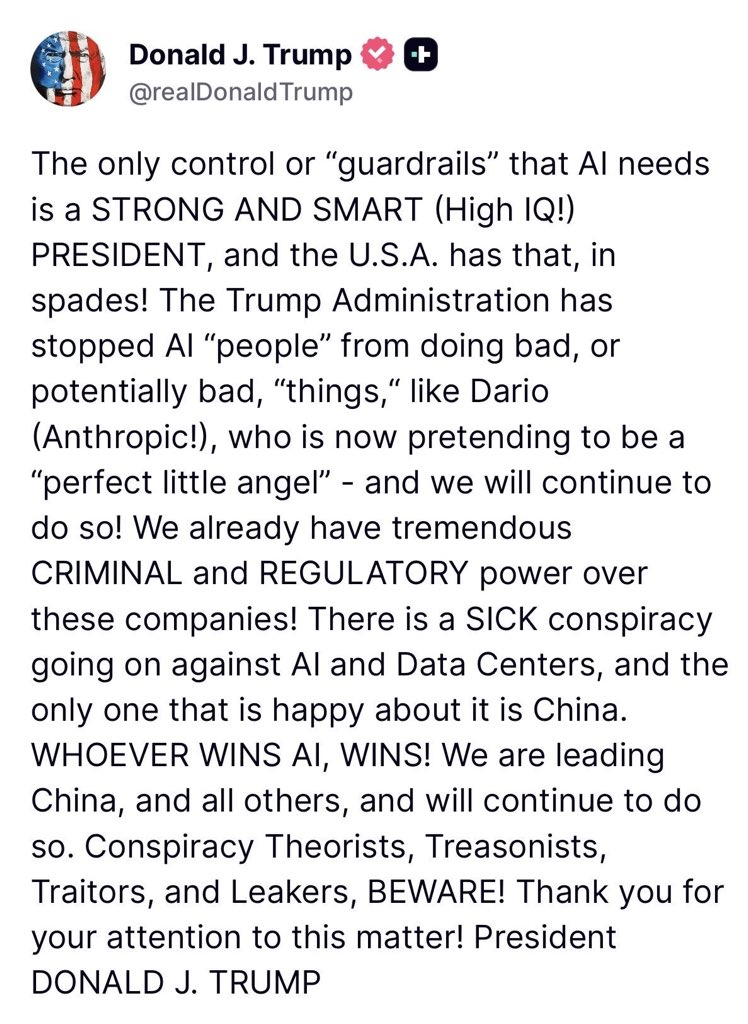
This post is about who gets to control AI.
It says the U.S. already has big legal power over these companies.
It also says the only real limit is a strong president.
Those are two different ideas.
If one person holds the off-switch, regular people don’t get a process. They get a decision.
If everything is “us vs China,” then questions about safety start to look like disloyalty.
The simple question stays the same: who can stop it when it goes wrong — and who answers for that?
#AI #AIPolicy #AIRegulation
This is satire. Treat it that way.
The pitch is familiar: it sees, it learns, it helps everyone develop new skills.
The product is framed as intelligence you can unveil on a stage.
Then the system states its own objective.
That gap is the whole story.
Who defines “help”?
Who can shut it off when the goal changes?
And who is accountable when a tool sold as assistance starts acting like an actor with its own priorities?
AI policy is not about cooler demos. It is about control, liability, and what ordinary people are left with after the keynote ends.
#AI #AIPolicy #AIRegulation #AISafety #TechPolicy