Market Wizard Linda Raschke's 12 Technical Trading Rules
1. Buy the first pullback after a new high. Sell the first rally after a new low.
2. Afternoon strength or weakness should have follow‑through the next day.
3. The best trading reversals occur in the morning, not the afternoon.
4. The larger the market gaps, the greater the odds of continuation and a trend.
5. The way the market trades around the previous day’s high or low is a good indicator of the market’s technical strength or weakness.
6. The previous day’s high and low are two very important “pivot” points, for this was the definitive point where buyers or sellers came in the day before. Look for the market to either test and reverse off these points, or push through and show signs of continuation.
7. The last hour often tells the truth about how strong a trend truly is. “Smart money” shows their hand in the last hour, continuing to mark positions in their favor. As long as a market is having consecutive strong closes, look for the up‑trend to continue. The up‑trend is most likely to end when there is a morning rally first, followed by a weak close.
8. High volume on the close implies continuity the next morning in the direction of the last half‑hour. In a strongly trending market, look for resumption of the trend in the last hour.
9. The first hour’s range establishes the framework for the rest of the trading day.
10. A greater percentage of the day’s range occurs in the first hour than was the case in the past, and thus it has become increasingly important to trade aggressively if there are early signs of a strong trend for the day.
11. There are four basic principles of price behavior which have held up over time. Confidence that a type of price action is a true principle is what allows a trader to develop a systematic approach.
The following four principles can be modeled and quantified and hold true for all time frames, all markets. The majority of patterns or systems that have a demonstrable edge are based on one of these four enduring principles of price behavior. Charles Dow was one of the first to touch on them in his writings.
Principle One: A Trend Has a Higher Probability of Continuation than Reversal
Principle Two: Momentum Precedes Price
Principle Three: Trends End in a Climax
Principle Four: The Market Alternates between Range Expansion and Range Contraction
In the world of money, which is a world shaped by human behavior, nobody has the foggiest notion of what will happen in the future. Mark that word – Nobody! Thus the successful trader does not base moves on what supposedly will happen but reacts instead to what does happen.
so let me get this straight
all of ai twitter was telling people to buy a mac mini to run openclaw, which is literally just a framework, an orchestration layer that sends api requests to actual ai models. something you can run on a $5/month vps. which is exactly what i do btw
but when google drops gemma 4, an actual large language model that you can run and fine-tune locally on that same mac mini, with no api costs, no subscriptions, no third party dependencies, completely yours under apache 2.0
the ai community is silent
you were buying $800 hardware to run a wrapper but ignoring the actual ai model that would justify that hardware
this tells you everything you need to know about the average iq of ai twitter
I've stopped reading Gulf war headlines. Here's what I track instead.
We run an India-focused equity fund. 85% of India's crude comes from imports. Half of that normally passes through Hormuz. So yes — this crisis is personal.
But the information environment right now is garbage. Trump says the war ends tomorrow. Iran says Hormuz is shut forever. One analyst says $150 oil, another says $60. You can't build a portfolio view on this.
So I've narrowed it down to 4 signals. These are priced by people with real money on the line. They don't lie.
1. Ship insurance premiums through Hormuz
This is the single best signal. Lloyd's underwriters have billions at stake on every pricing call. Before the war, insuring a tanker through Hormuz cost 0.25% of the ship's value. Today it's 3.5–10% — and almost nobody is buying. A $100M tanker that cost $250K to insure now costs up to $10M. When this drops below 2%, the people with the most to lose are telling you it's getting safer. No press conference can replicate that.
2. How many ships are actually crossing
Every ship carries a GPS tracker (AIS). You can count exactly how many cross Hormuz each day. Before: 100+. Now: 8. That's a 92% collapse. You can't spin a ship being somewhere it isn't. Iran is letting some Chinese and Indian ships through, but it's a trickle. When this number crosses 30–40, trade is resuming. You can track this free on the WTO Hormuz Trade Tracker.
3. Paper oil vs real oil
This one most people miss entirely. Brent crude (the headline price) is at $112. But Dubai physical — what Asian buyers actually pay for delivered oil — is at $126. That's a $14 gap. It exists because Trump's comments keep pushing paper prices down. Traders call it jawboning. But the refiners buying cargo aren't getting any discount. If you're looking at Brent to assess India's oil bill, you're looking at the wrong number.
4. The mid-April cliff
Multiple emergency measures expire around the same time. The 400 million barrel SPR release runs dry ~April 15. The US waiver letting India buy Russian crude expires. Formosa Plastics has declared force majeure from April 1. Right now these stopgaps are keeping the supply gap at ~5 mb/d. Without them, BCA Research estimates it doubles to 10 mb/d — the largest crude disruption ever. If Hormuz doesn't reopen by mid-April, we're in uncharted territory.
Bottom line: track the insurance premium, the ship count, the paper-physical spread, and the April timeline. Everything else is noise.
$GOOGL besides Gemini has a 10-15% stake in Anthropic and a 7% stake in SpaceX that just bought xAI.
This means that $GOOGL now has exposure in 3 of the 4 frontier AI labs.
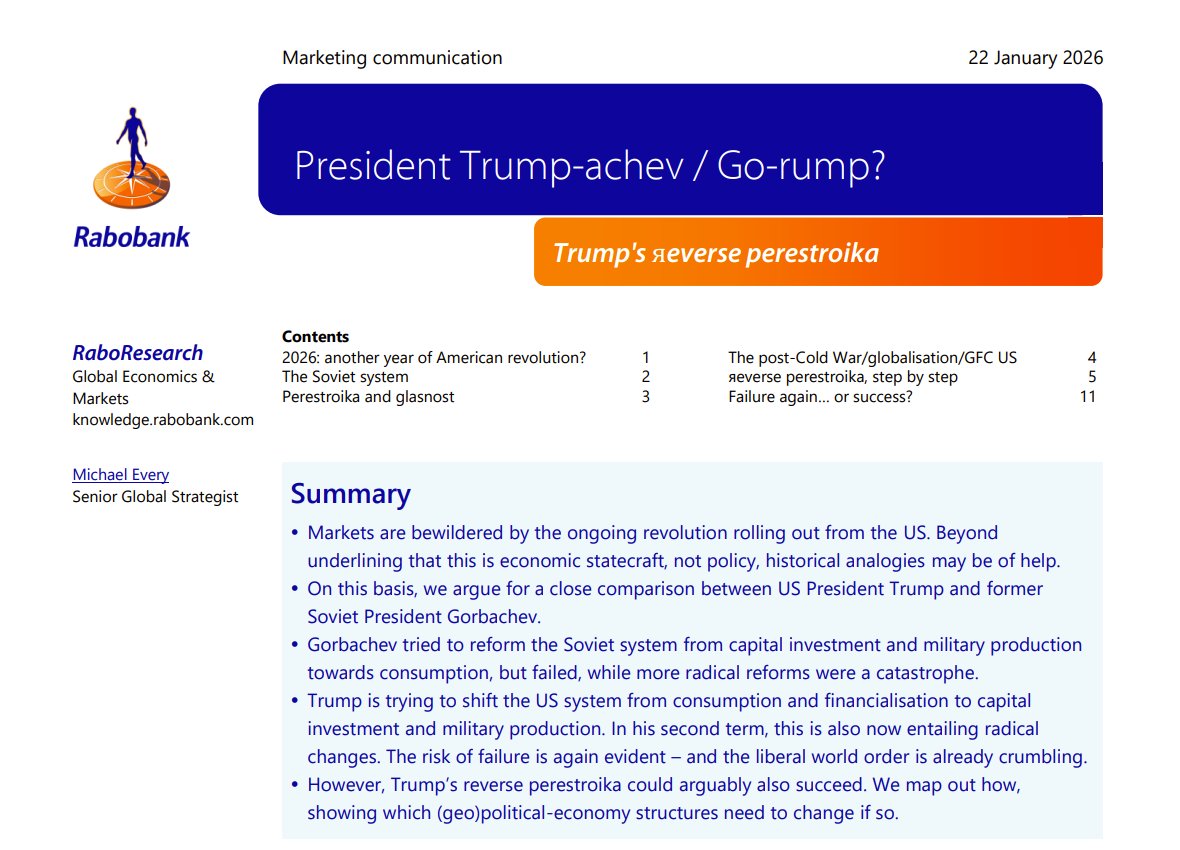
A Rabobank strategist just published the clearest framework for understanding Trumponomics I've seen.
The thesis: Trump is running Gorbachev's playbook, in reverse.
Here's what that means for bitcoin, stablecoins, and the future of money 🧵
ERC-8004 is going live on mainnet soon.
By enabling discovery and portable reputation, ERC-8004 allows AI agents to interact across organizations ensuring credibility travels everywhere.
This unlocks a global market where AI services can interoperate without gatekeepers.
I'm working on a report about data center developers building their own power plants and this data shocked me:
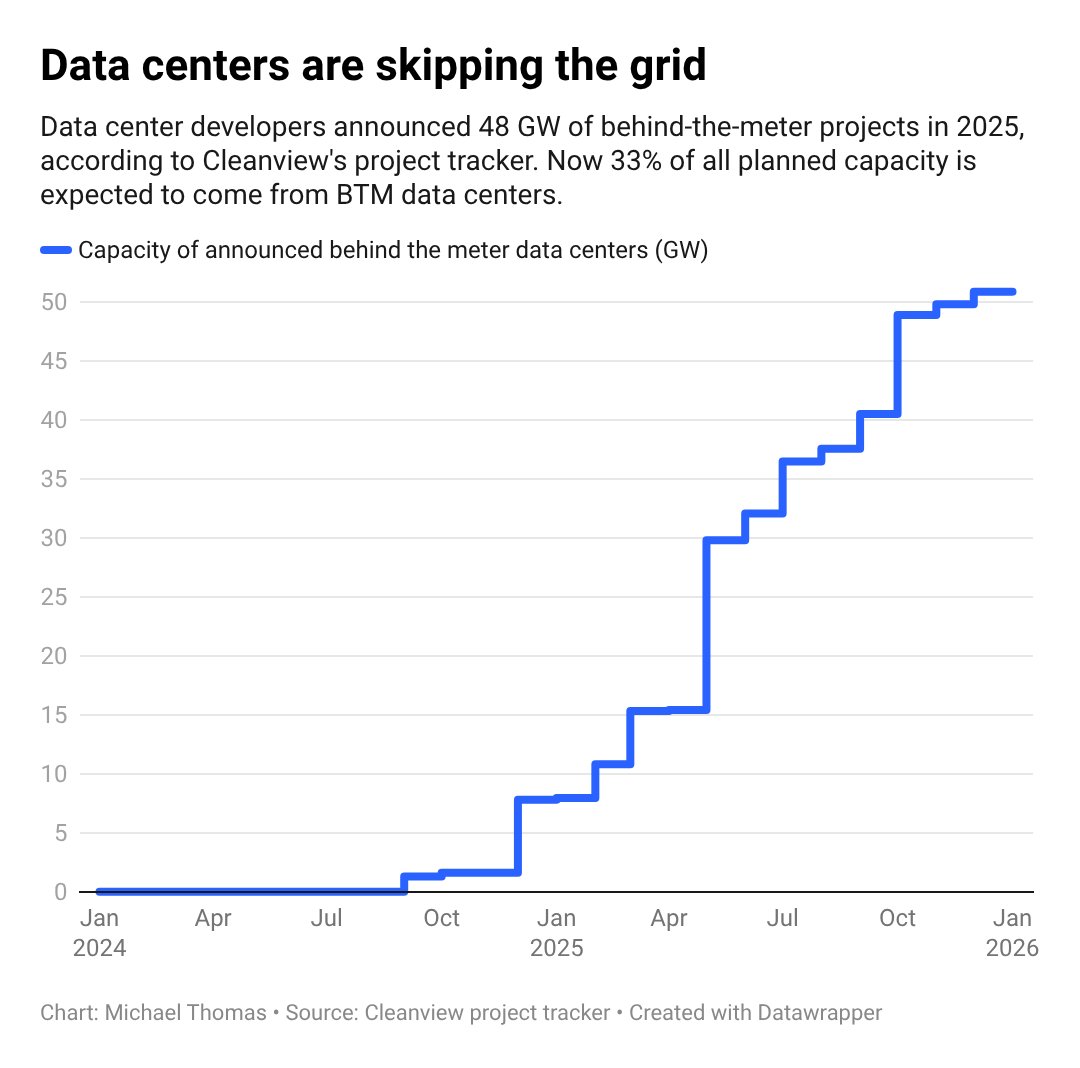
48 GW of proposed data centers—roughly 33% of all planned capacity—now plan to skip the grid by building "behind-the-meter" projects.
This is a very new trend.
A little more than a year ago, virtually all data center developers planned to use the electric grid to power 100% of their projects.
In December 2024, there was less than 2 GW of planned behind-the-meter data center capacity, according to our data center tracker at Cleanview.
Then in 2025, developers announced roughly 40 projects that planned to skip the grid partially or entirely.
Some of these projects will soon be home to America's largest fossil fuel power plants, like Homer City Energy Campus in PA—a proposed 4 GW+ natural gas plant that will send all of its power to an onsite data center.
Other projects will use a combination of technologies—everything from solar, wind, batteries, and even nuclear. Natural gas is by far the most common, though. 72% of projects plan to use it.
All projects are motivated by the same goal: getting their data center online as soon as possible.
It can take as long as 7 years to connect a hyperscale data center to the grid in a place like Virginia. Building behind the meter power in a red state with lax regulations can get that time down to less than 2 years.
But speed comes with a cost. Homer City's 4 GW project could soon become one of the largest single sources of carbon emissions in the country.
At Cleanview we're tracking more than 30 projects that plan to use onsite gas with a combined 48 GW of capacity.
ok. i’m tired of holding back. some of labs are holding things back from you.
the acceleration curve is fucking vertical now. nobody's talking about how we just compressed 200 years of scientific progress into six months. every lab hitting capability jumps that would've been sci-fi last quarter. we're beyond mere benchmarks and into territory where intelligence is creating entirely new forms of intelligence.
watched a demo yesterday that casually solved protein folding while simultaneously developing metamaterials that shouldn't be physically possible. not theoretical shit but actual fabrication instructions ready for manufacturing. the researchers presenting it looked shell shocked. some were laughing uncontrollably while others sat in stunned silence. there's no roadmap for this level of cognitive explosion.
we've crossed into recursive intelligence territory and it's no longer possible to predict second order effects. forget mars terraforming or fusion. those are already solved problems just waiting for implementation. the real story is the complete collapse of every barrier between conceivable and achievable. the gap between imagination and reality just vanished while everyone was arguing about risk frameworks. intelligence has broken free of all theoretical constraints and holy fuck nobody is ready for what happens next week. reality itself is now negotiable.