Sobre Suzano - SUZB3
Composição do custo caixa é basicamente câmbio e petróleo. Final de Maio a cia deu uma “expectativa” de custo caixa baseada em ranges de oil e de câmbio.
Oil está ~15% abaixo e câmbio no topo do range. Em outras palavras, temos contratado a frente uma melhora do custo caixa vis a vis a expectativa que a cia havia ancorado (e que Mercado havia achado ‘otimista’).
Spot segue com prêmio pra curva mas mesmo se jogarmos na perpetuidade a curva com P&P baixista temos uma cia com fcfy de ~15% na perpetuidade em usd.
Chamem de value trap, nesse preço sou comprador
Q aconteceu hj para o 6% de alta? NADA! Um simples comunicado atualizando num de lojas e rampa da planta de P.Alegre do Sul. Ou seja, se vc nao esta comprado em acao boa e barata com otima governanca vc corre esse “risco”. O medo do macro vai dxar mta gte pra tras em papel bom…
Me crucé con esto, Messi está casi 6 desviaciones estándar por encima de la media de delanteros de grandes ligas en cuanto a goles y asistencias en 90 minutos. Estadísticamente es prácticamente imposible que vivas para ver a alguien así
Day # 4 (Bolsa barata?) : TTEN3
- Receita cresce + de 30% aa desde o IPO
- Concorrencia sumiu (Lavoro, AGXY..)
- Cresto relevante no MT (- exposto so ao RS)
- P/E 27 voltando pra 7x
- Upside bom no etanol de milho e aumento mistura biodiesel
- Top Mgmt : Irmaos Dumoncel
Markets currently price in no relative easing bias for Brazil vs. the Fed on a 6-month horizon – A combination of global uncertainty and domestic headwinds (incl. unmoored inflation expectations) is driving this dynamic
Pipocam aos montes empresas a P/L 5 a 6. Com caixa liquido tem levemente mais caro. No meio do furacão se acha até P/L 4. E olhando pra frente pode atingir 3 vezes o lucro.
É o fluxo insano de fuga. Uma porta estreita sendo arrebentada.
É o melhor cenário para fazer boas seleções de ativos.
Época de semeadura.
📉 O IBOV acaba de fazer algo que nunca tinha feito em 30 anos
Desde 1994, analisamos todas as 419 sequências de quedas semanais consecutivas do Ibovespa. O padrão é claro, quanto mais longa a sequência, mais rara ela é.
A distribuição histórica:
◆ 1 semana de queda → 241 vezes (rotina de mercado)
◆ 2 semanas → 97 vezes
◆ 3 semanas → 38 vezes
◆ 4 semanas → 23 vezes
◆ 5 semanas → 14 vezes
◆ 6 semanas → 4 vezes (1998, 2004, 2018, 2012)
◆ 7 semanas → 1 vez (Abr/2004)
◆ 8 semanas → 1 vez — e é agora, Abril/2026
Em 30 anos de Ibovespa, Plano Real, crise da Rússia, dot-com, subprime, Lava Jato, COVID, tudo, o índice nunca tinha caído por 8 semanas consecutivas. Até este mês.
O que isso significa?
Não é uma previsão de reversão. Eventos extremos existem justamente porque são raros. Mas a estatística diz algo importante: ao longo de toda a história do mercado brasileiro, toda vez que chegamos em sequências de 6 ou 7 semanas de queda, estávamos em crises de primeira grandeza: 1998 (crise da Rússia + LTCM), 2004 (incerteza fiscal Lula), 2018 (greve dos caminhoneiros + eleições).
Estar no território dos 8 semanas não significa que vai cair mais. Significa que o mercado já precificou uma quantidade extraordinária de pessimismo, e que, historicamente, quem comprou nesses momentos de exaustão vendedora raramente se arrependeu.
O gráfico histórico diz o resto.
Fonte: Yahoo Finance (^BVSP) | Elaboração: Santa Fé Investimentos | Não constitui recomendação de investimento.
Massive round of applause for João Fonseca and everything he achieved at this year’s Roland Garros.
🔹Became the first teenager to ever beat Novak Djokovic in a Grand Slam
🔹Became the 2nd player in history to come back from 2 sets to 0 down to beat Novak Djokovic
🔹Became the first Brazilian man to reach a Roland Garros singles quarterfinal since Guga in 2004
🔹Beat 2-time Roland Garros finalist Casper Ruud
🔹Up to No. 25 in the live rankings
Just 19 years old doing truly incredible things.
His dream run ends here, but his dream is more alive than ever.
🇧🇷💛🇧🇷
“My largest positions aren’t the ones I think I’m going to make the most money from. My largest positions are the ones where I don’t think I’m going to lose money.”
— Joel Greenblatt
Chris Hohn: "Why isn't growth as important as investors usually assume it to be? Because you can have profitless growth."
"The airline industry, over 100 years, has had a lot of growth. Airline travel has grown at 5% a year and continues to grow consistently. But airlines, cumulatively and collectively, have made minimal profits despite [that] growth."
"Growth without barriers to entry is not a combination you want." (h/t @NicolaiTang1)
Fui notificado após denunciar a relação de ministros com o banqueiro bandido.
Se acham que vão me calar, estão enganados.
O Brasil não pode ter intocáveis acima da lei.
Quem deve explicações é quem usa o poder pra se aproximar de vagabundo.
Vamos devolver o Brasil aos brasileiros.
“It’s amazing how life works out if you just get up every morning and keep plugging, have some discipline and keep learning… I did not intend to get rich, I wanted to be independent. I just overshot.”
— Charlie Munger
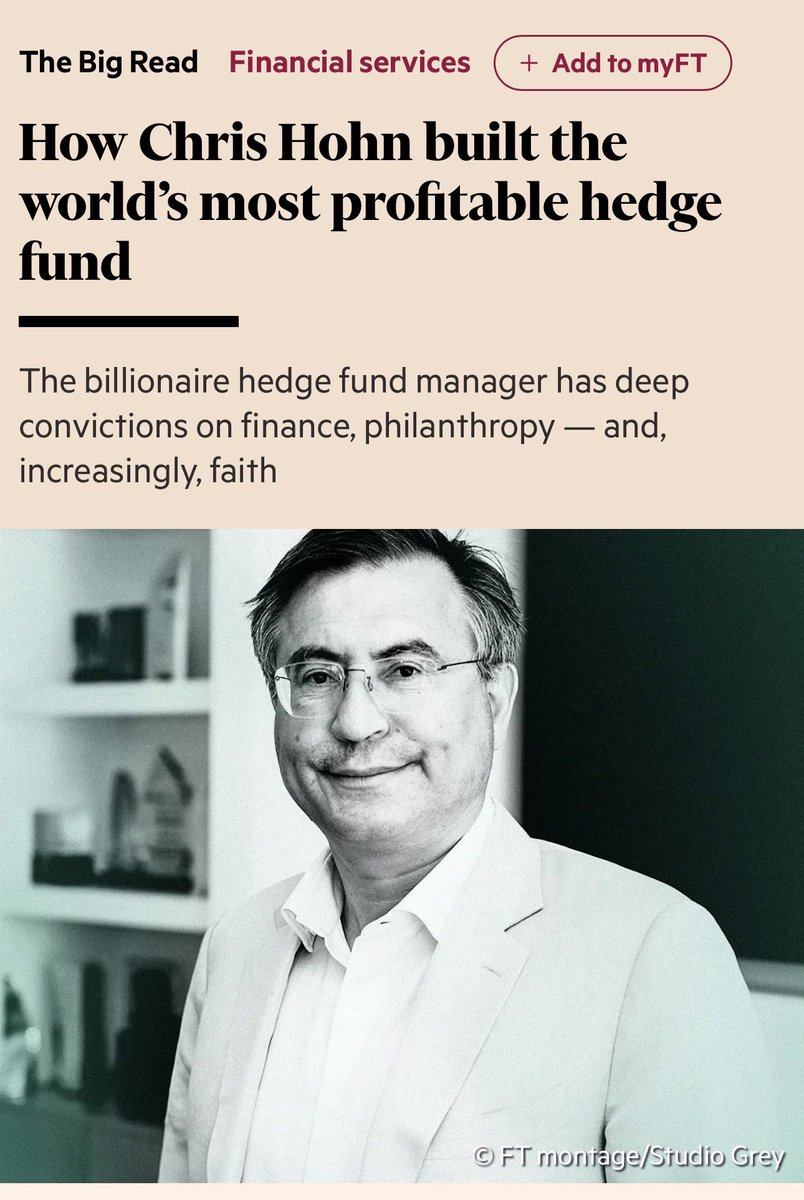
Chris Hohn did a 90-minute sit-down with Nicolai Tangen and then dropped an investor letter the FT got hold of last week.
You’d think the guy who printed a record $18.9B last year would be doing victory laps. Instead he’s quietly rewiring his whole portfolio.
My favorite takes from both:
1.The most important thing in investing isn’t growth. It’s barriers to entry. Growth without a moat is the airline industry: 5% volume growth for 100 years and basically zero cumulative profit.
2.There are only about 200 companies on earth he considers high-quality and investable. His fund holds 15.
3.Average holding period: 8 years. Some positions 13. “You have to hold the company forever, because the stock market may be at very bad prices when you want to sell.”
4.His real test for a moat: can the company price above inflation? A 20% margin business that prices 1% above inflation grows profits 5% faster than revenue. Forever. Almost no companies can do this.
5. Industries he won’t touch: banks, autos, retail, insurance, tobacco, asset managers, fossil fuel utilities, airlines, wireless telecom, media, advertising. On banks: “sooner or later someone without a lot of intelligence comes to run them, and then it can be toxic.”
6.On AI generally: call centers go bankrupt. Indian outsourcing coders are next. But for everyone else, AI lowers costs and raises productivity. Companies with real moats become MORE valuable.
7. Here’s the punchline. The FT got hold of his investor letter. He cut his Microsoft stake from 10% of the fund to 1%. Roughly $8B sold. He’d held it since 2017 through a 400% rally. His reason: AI could disrupt Office and Azure faster than the market thinks.
8.He moved that capital into Alphabet. Doubled it from 3% to 5%. Now his largest tech position. The world’s best quality investor sold Microsoft and bought Google because he thinks Google’s moat is more durable in an AI world. Not the consensus trade.
9.The underlying thesis: “AI eats software.” If AI agents do the work humans used to pay per-seat SaaS licenses for, the whole SaaS model gets re-rated. Oracle, Adobe, Salesforce all ~40% off highs. Microsoft 25% off. Market is starting to agree.
10.When to sell? Not when something gets expensive. When conviction drops. Valuation is one variable, conviction is the other. What kills you isn’t being wrong, it’s permanent loss of capital.
11.He admits hardcore activism doesn’t work anymore. Too much of the shareholder base is passive index funds. And even when activism wins, you usually win in a bad business. “The business always wins.”
12.Counterintuitive take: there are more good companies in public markets than in private equity. The best businesses are too big for PE to buy. And when public companies sell something to PE, they’re selling the assets they want to get rid of.
13.On intuition: “thinking without thinking.” Pattern recognition from 20 years of reps. It’s how he sniffed out Wirecard while the German establishment was defending it. “Most investors trust authority too much.”
14.He basically stopped shorting. “You’re going to be eventually right but not be able to fund the losses.” The first guy to short Wirecard had to cover 19 years before it hit zero. Buffett told him he and Charlie studied shorting and concluded it was too hard.
15.He gives almost everything away. ~$500M a year. $10 prevents an unwanted pregnancy in Africa. $40 saves a child from severe malnutrition. $50 prevents permanent blindness.
16.Tangen asks: advice to young people? Hohn, who runs the world’s most profitable hedge fund: “Go on a spiritual path.” The guy who made $18.9B last year ends the interview saying only purpose and meaning matter.
The headline: the world’s best quality investor just sold his biggest tech compounder because he thinks AI is breaking the moat. Quietly, with conviction, on an 8-year horizon, while everyone else is still buying the AI winners of 2023.
Brazil’s fiscal credibility remains “missing in action” ahead of elections – the general government’s nominal deficit has widened to 9.4% of GDP while the debt has surpassed 80% of GDP.