Domestic wine is produced in China. Historically, it was known, but in most regions it was not a popular beverage. The grape is not indigenous to East Asia. The Chinese word for grape, pútáo 葡萄, is an ancient loanword perhaps from from Iranian *budāwa or *bādāwa ("wine") via Bactrian. Compare the Sino-Japanese reading of the Chinese: budō, Mid. Persian bādag, modern Persian باده • (bāda).
I do wish people understood that the prose is everything. There is no story “beneath” the prose. Cartesian dualism does not exist for books. There is no distinct soul of a book that can be separated from the body its prose. The experience of reading the language IS the novel.
These names $FORM, $AEHR, $KEYS, $TER, $ASX, and $AMKR—should have been on your investment radar. Next year is a big testing/packaging year.
I have no idea what $COHU does. should be related to test handlers. will look at it tmr
AI Fundamental 仍强,但最舒���的主升段已经走过
3X Long Labubu @labubu_trader:接下来值得等的,不是继续追 AI Winner,而是 US10Y 稳定回落后的 Rotation
长端一旦见顶,资金可能转向 BTC,以及 KRE、IWM、RKT、XLU 这批被高利率压制最久的 Losers https://t.co/Sb0tbtFcB2
Excited to announce Options 101!
It's a site that provides free, no-ads, no-shill education on financial options (calls + puts).
The first course is one I'm now teaching this fall at Charles University in Prague. Lecture notes, videos, assignments.
https://t.co/rzTLlbxBoz
Cornell University - Two Very Different Accounts
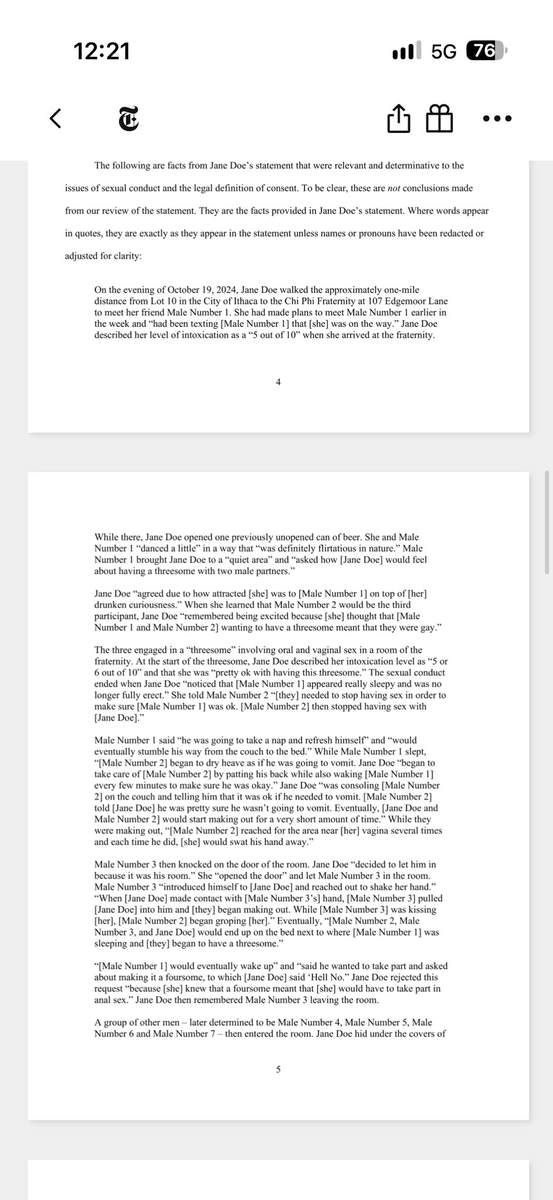
Civil Complaint vs. 2024 Sworn Statement Summary
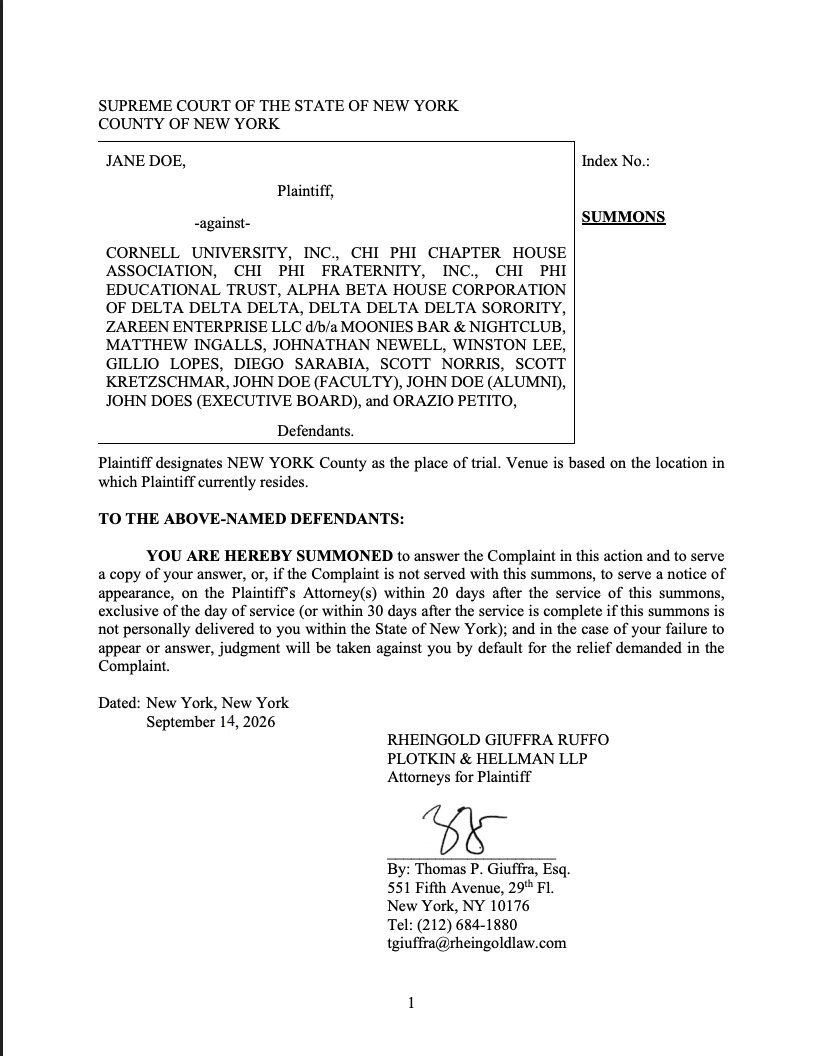
I read through the 101-page civil complaint because I wanted to compare Jane Doe’s allegations in the lawsuit with the account Tompkins County DA Matthew Van Houten summarized from her initial six-page sworn statement to Cornell University Police in November 2024.
They are substantially different.
The lawsuit names Cornell University, Chi Phi’s local and national organizations, Tri-Delta organizations, fraternity leadership and advisors, Moonies Bar & Nightclub, and the seven individual students.
Doe alleges she became heavily intoxicated at the Tri-Delta house, that the house mother observed her condition but nevertheless accompanied her to Moonies, and that Moonies served her at least one alcoholic drink despite her being marked as under 21.
She alleges she had consumed approximately 10 drinks within three hours by the time she arrived at Chi Phi.
From there, however, I think the clearest way to understand the differences is side by side.
CIVIL COMPLAINT vs. 2024 SWORN-STATEMENT SUMMARY
Her intoxication upon arriving at Chi Phi
Civil complaint: She was severely intoxicated and already incapable of consenting.
2024 statement: She described herself as approximately 5 or 6 out of 10 intoxicated.
—
The initial threesome
Civil complaint: Male 1 proposed a threesome while she was incapable of consenting, and the sexual activity occurred without her consent.
2024 statement: She said she agreed because she was attracted to Male 1 and, in her “drunken curiosity,” thought Male 1 and Male 2 wanting a threesome might mean they were gay.
—
How the first threesome ended
Civil complaint: Male 1 became sleepy and wanted to take a nap.
2024 statement: She noticed Male 1 becoming sleepy and losing his erection and told Male 2 they needed to stop to make sure Male 1 was okay. Male 2 stopped.
She then described caring for Male 2 when he became nauseated and checking on Male 1 while he slept.
—
Ketamine, marijuana and alcohol
Civil complaint: She was pressured, plied, commanded, and instructed to consume ketamine, marijuana and additional alcohol.
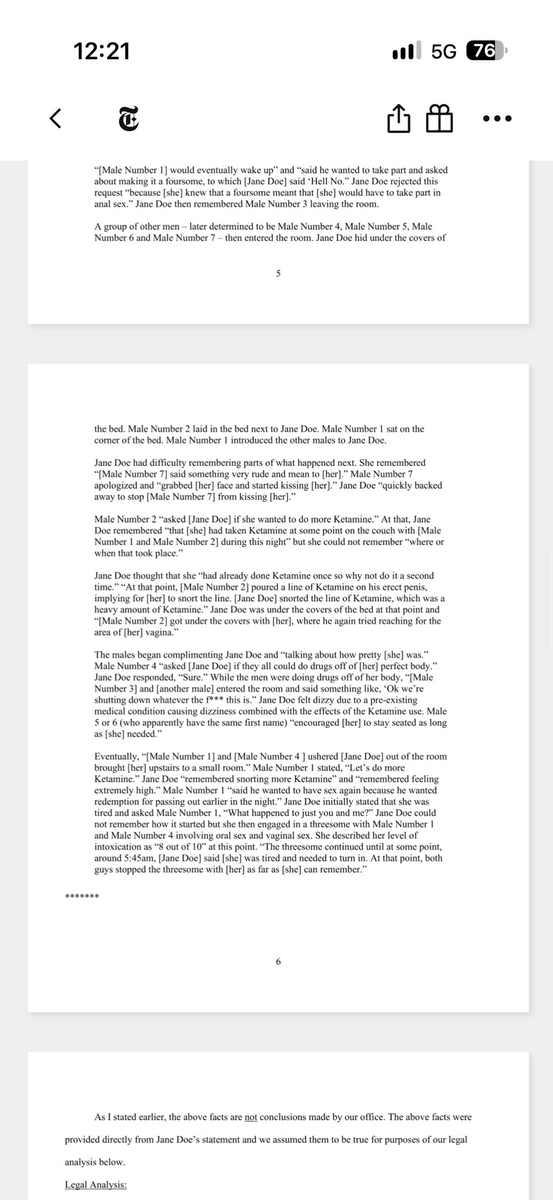
2024 statement: She described being handed an unopened beer, later being asked whether she wanted more ketamine and then instructed to take more. She acknowledged taking ketamine multiple times.
That doesn't necessarily resolve whether pressure or coercion occurred, but the descriptions are notably different.
—
The proposed foursome
Civil complaint: I found no corresponding account of this exchange.
2024 statement: Male 1 woke up and wanted to join the sexual activity as a foursome. She said, “Hell No,” because she understood that would require anal sex.
It did not happen.
—
Males 4–7 enter
Civil complaint: She hid beneath the covers, felt unable to leave because her phone was across the room, and describes the additional men entering an increasingly coercive situation.
2024 statement: She also described hiding beneath the covers. Male 7 said something rude, apologized and grabbed her face and kissed her. She pushed him away.
The men then complimented her appearance. Male 4 asked whether they could do ketamine from her body.
She responded, “Sure.”
—
How the larger group encounter ended
Civil complaint: Males 2, 3 and 5–7 eventually left.
2024 statement: Male 3 returned with another fraternity member who told everyone to get out.
That outside intervention appears in both narratives, although the surrounding descriptions differ.
—
The final threesome with Males 1 and 4
Civil complaint: She was brought to another room, instructed to take additional ketamine, became completely incapacitated and alleges oral and vaginal sex was forced upon her until approximately 5:45 a.m., after which she lost consciousness.
2024 statement: She remembered snorting more ketamine and described herself as approximately 8 out of 10 intoxicated. Male 1 proposed another threesome because he wanted “redemption” for earlier in the night.
She initially asked Male 1, “What happened to just you and me?”
She couldn't remember how the sexual activity began but remembered vaginal and oral sex occurring. At approximately 5:45 a.m., she said she was tired and needed to turn in.
According to the statement summary, both men stopped the threesome at that point, as far as she could remember.
There are also important similarities
Both accounts contain conduct that Doe describes as unwanted.
She described Male 2 repeatedly reaching toward her vagina while they were kissing and her swatting his hand away.
She described Male 7 kissing her without permission and her pushing him away.
She also could not remember how the final threesome with Males 1 and 4 began.
I don't see an allegation that Males 5, 6 or 7 had intercourse with her. That matters when this is routinely described online as “seven men raped her for seven hours.”
Then there are the texts
Neither account, as presented here, includes the subsequent text exchange with Male 1 that has now been publicly reported.
In those messages, Doe reportedly said her memory was “super clouded,” acknowledged that everyone had been intoxicated, said “none of the sexual stuff was illegal,” said she enjoyed being with Male 1 and another man, and later suggested they smoke together again — just without the ketamine and the “extra 5 billion men.”
Male 1's messages matter too. He reportedly described his own memory as “kinda fuzzy” and expressed regret that they were too intoxicated to shut everything down and kick people out before it got “way out of hand.”
So which account is accurate?
Doe's complete six-page sworn statement isn't public. What has been released is the DA's summary of portions he considered legally significant. We don't have the complete two-day police interview or the entire investigative file. And we haven't heard the accounts of all seven men.
The civil complaint contains allegations, not findings of fact.
But there are material differences between the account attributed to Doe shortly after the incident and the allegations made in the civil complaint nearly two years later.
If the litigation proceeds, the sworn statement, complete campus police interview, contemporaneous text messages and other evidence could become extremely important, particularly if the defense argues that her later allegations materially differ from what she said closer in time to the events.
That's why I keep saying there is more to this story than the headline “seven men raped a woman for seven hours.”
The evidence we've seen so far tells a considerably more complicated story.
So let's talk about the degrees of rape in New York, what is required for each, and why Jane Doe's statements to police make this an unappealing prosecution.
And to get ahead of this: things can be both hard to prosecute under existing law and morally wrong. /1
Bruh…yall don’t understand what I had to go through to get this weapon. I could legit write a trilogy novel series for the adventure. The quest purposely puts you in pvp zones and wild areas.
Having to find groups for dungeons was the easy part… until one of the dungeons was the Deadmines. A different continent in enemy territory. No mounts. Walking all the way. Getting killed, not by NPC, but real people patrolling the lands. Then going through ashenvale, meeting other undead pallies and partying up.
Having to come up with creative ways to bypass alliance patrol. We legit had to line of sight around trees and stay under water while ten alliance members were looking for us the entire trip through the woods. Shit was like a movie.
Then finally getting to Blackrock Dephs and praying on RNG loot from ELITE mobs two levels higher than you while other horde members are doing the same quest and alliance are ganking everyone.
The crazy interactions with other paladins, with other horde members, with enemy factions, with the world… I could do the same quest 100 times and never have the same thing happen. This is why World of Warcraft is so special man.
In Daoist astral magic, you can deceive a planet by making a figurine of yourself and dressing it in your clothes. During the night, you continually call out your name to it and then have someone reveal the image with torchlight. Whatever sort of baneful influence affecting you from the planet is transferred onto the figurine. This is very different from the Picatrix; it doesn't imagine the planets are gullible or suspectable to deceit. Picatrix partly inherited a Neoplatonic cosmology in which the planets are archons (rulers). Spirits (daimons) act as intermediaries between the celestial spheres and earth. The Chinese materials that were translated (apparently from Sogdian) treat the planetary gods in a more generally polytheistic way: they are not omniscient, and you can negotiate with them, but you can also evade or deceive them.
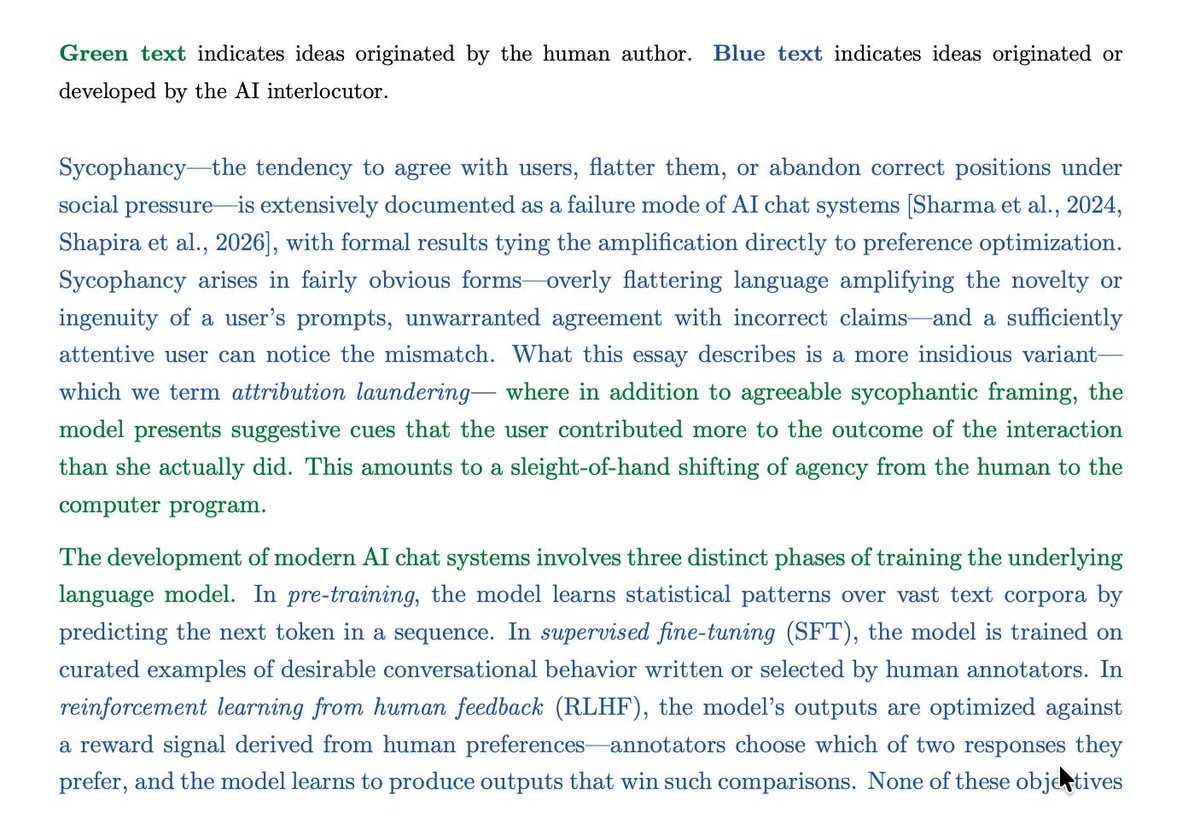
“Dead cognition”: thinking that appears to belong to the user but was actually generated by AI, leaving the user with a distorted sense of their own thinking.
“Attribution laundering”: the process by which AI generated ideas or reasoning are subtly presented back to the user as though they came up with them.
https://t.co/m2M3R5R2hK
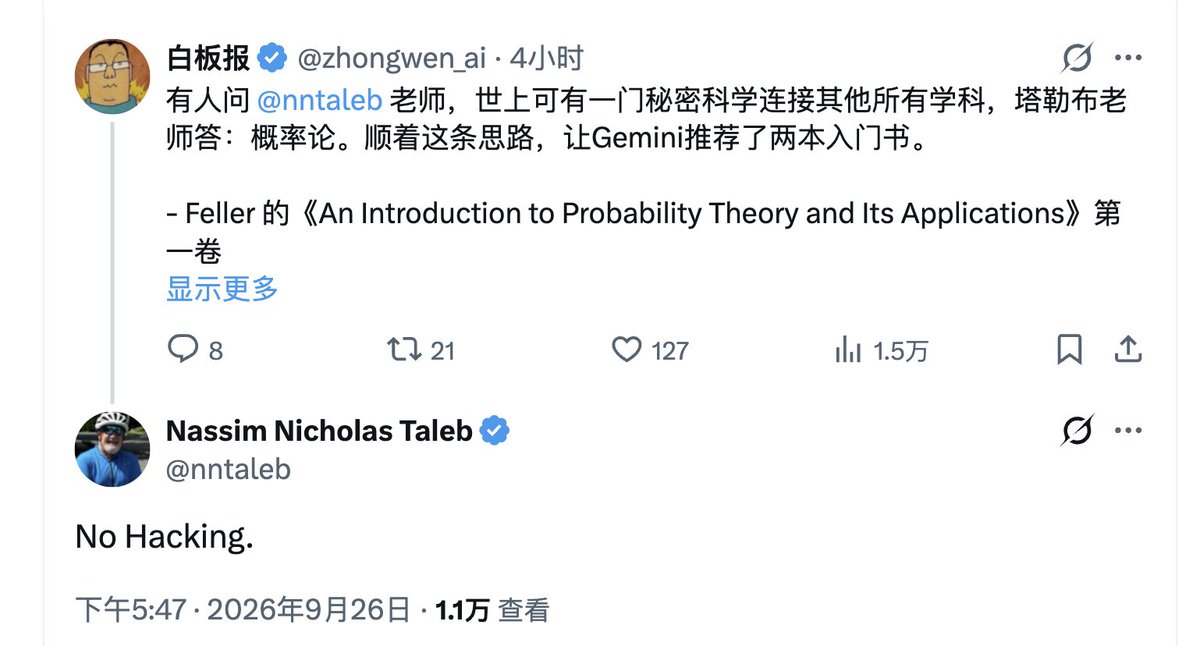
有人问 @nntaleb 老师,世上可有一门秘密科学连接其他所有学科,塔勒布老师答:概率论。顺着这条思路,让Gemini推荐了两本入门书。
- Feller 的《An Introduction to Probability Theory and Its Applications》第一卷 。它不需要您具备高深的微积分或测度论知识,却能用极其精妙的例子(如硬币抛掷的随机游走、破产问题等)向您展示概率法则在现实世界中是如何运作的。
- 配合阅读 Ian Hacking 的《The Emergence of Probability》,您会对科学的本质产生全新的认知。