Released today. Pls check out what makes EM unique and at the core of medicine: https://t.co/MzfZv8066K. Deep thx to remarkable authors/leaders in our field. #FOAMed#MedTwitter
When approaching modern learners, listen to their wants, focus on their needs for thoughtful development. Growth can be painful and understanding of gains delayed. #FOAMed#MedEd
Any lab/imaging you order multiple times a shift, master the nuances of interpretation. You’ll impact people’s lives meaningfully. With incredible modern tools, there’s no excuse not to get this done. #foamed#MedEd
Pt walks into triage, initial sat 60s/70s, run back to crit care, not ill-appearing, consider yet-to-be discovered pulm htn if items fit. #foamed#MedEd
🚨Radiologists, read this if you don't want to get sued 🚨
I see this mistake a lot and it drives me bananas.
Radiology sees an opacity on chest radiograph and diagnoses pneumonia.
But, pneumonia is a *clinical* diagnosis that shouldn't be made in the radiology reading room.
When the radiologist makes an excessively confident diagnosis of pneumonia, this may lead to premature diagnostic closure & unnecessary antibiotics. (These over-aggressive "pneumonia" interpretations put a LOT of pressure on the treating team to give antibiotics.)
Usually in the cases I'm involved with the "pneumonia" ends up being atelectasis or CHF, but it could also be an unusual cancer or PE. Chest radiograph is a blunt survey tool that isn't good at making a specific diagnosis.
Folks make fun of radiologists for hedging on their reads, but that's a conservative & safe way that they should be practicing.
(PS - There's also a LOT else wrong with this case, like not getting a PE protocol CT scan. The differential diagnosis on this retrocardiac opacity may include pulmonary infarct due to PE. For a patient with 30 pack-years tobacco history presenting with hemoptysis, only getting a chest radiograph is like bringing a knife to a gun fight. The chest radiograph will generally be insufficient and you're almost always going to need a PE protocol CT. Not ordering a CT angiogram isn't the radiologist's fault.)
Have seen a fair amount of “Euglycemic DKA” recently
I think starvation ketoacidosis and euglycemic DKA are a spectrum of the same illness (in the absence of type 1 DM)
Sometimes all you need is carb source (dextrose/PO) to resolve, sometimes need to add exogenous insulin
When your patient is in shock and the AST and ALT ⬆️⬆️
Do the Echo before the RUQUS (it might just be cardiogenic shock and “shock liver”)
Looking for to giving a shock talk at #ACEP26@ACEPNation@VtAcep
Come listen for more tips on shock management on the ED
The concept that thyroid storm is an indication for beta-blockers is a widespread myth.
Indiscriminate use of beta-blockers in thyroid storm can actually kill people.
I half-heartedly tried submitting an article about this to two journals (@JHospMedicine, @CritCareExplore). JHM thought that thyroid storm isn't common enough to warrant publication in @TWDFNR. CCE never replied to my email.
So I posted it as a blog (below). A lot of smart people read it and nobody found any errors in it, which makes me pretty confident that it's a valid article.
The myth of beta-blocking everyone with thyroid storm will probably persist for a long time in the conventional medical literature. Most people who write articles about thyroid storm don't practice critical care cardiology, so my guess is that this dogma will persist for decades.
pretty picture but mental status is over-hyped as an index of perfusion in PE (& cardiogenic shock in general)
in my experience, PE patients will mentate well until about five minutes before they arrest
I'm not reassured by normal mentation at all
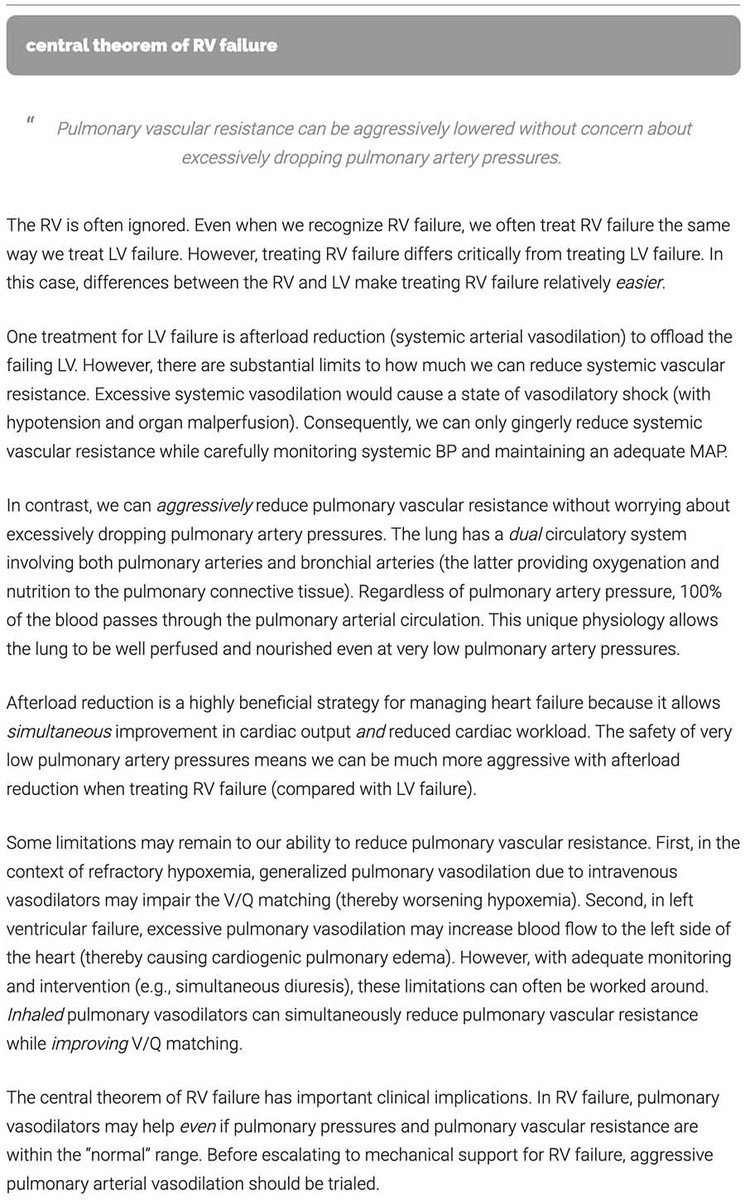
The central theorem of RV failure 😁
In LV failure, excessive afterload reduction can cause systemic hypotension (MAP << 60mm), vasodilatory shock, systemic malperfusion, and death.
In RV failure, excessive afterload reduction doesn't really exist. Low pulmonary artery pressures are well tolerated (the lung remains well perfused by *dual* pulmonary & bronchial artery circulations).
This essential difference opens a unique avenue for treating RV failure with much more aggressive afterload reduction (as compared to LV failure).
The RV is different from the LV and requires unique management strategies (not just copy/pasting a generic LV failure strategy).
#ThePeoplesVentricle
in response to this blog, lots of folks commented that hyperangulated videolaryngoscopy is great at visualizing the cords but makes tube passage difficult
my team hasn't encountered this problem. why??
I think it's because we use sniffing position +/- laryngeal manipulation