🧵I am going to try to breakdown my understanding of Utumishi Fire from my experiences as both a teacher and when I was a student:
First, it's very clear that boarding schools in Kenya are overcrowded any teacher or boarding master will tell you & each year most schools admit🧵
𝐖𝐢𝐧 𝐟𝐨𝐫 𝐎𝐃𝐏𝐏 𝐚𝐬 𝐇𝐢𝐠𝐡 𝐂𝐨𝐮𝐫𝐭 𝐧𝐮𝐥𝐥𝐢𝐟𝐢𝐞𝐬 𝐰𝐚𝐫𝐫𝐚𝐧𝐭𝐬 𝐢𝐬𝐬𝐮𝐞𝐝 𝐚𝐠𝐚𝐢𝐧𝐬𝐭 𝐒𝐞𝐧𝐢𝐨𝐫 𝐏𝐫𝐨𝐬𝐞𝐜𝐮𝐭𝐨𝐫 𝐟𝐨𝐫 𝐦𝐚𝐤𝐢𝐧𝐠 𝐩𝐫𝐨𝐬𝐞𝐜𝐮𝐭𝐨𝐫𝐢𝐚𝐥 𝐝𝐞𝐜𝐢𝐬𝐢𝐨𝐧 𝐭𝐨 𝐜𝐡𝐚𝐫𝐠𝐞
The High Court in Kajiado has ruled that subordinate courts do not have jurisdiction to question the validity of prosecutorial decisions made by the Office of the Director of Public Prosecutions (ODPP).
The court further declared as irregular the proceedings in which summons had been issued against a senior prosecutor, compelling her to appear before the Kajiado Law Courts to explain the basis of a decision to charge in a land fraud case.
The Court also nullified the resultant warrants of arrest that had been issued against the prosecutor for allegedly failing to honour the summons.
In the ruling, the High Court sitting in Kajiado held that the propriety or otherwise of a prosecutorial decision cannot be canvassed through the testimony of a prosecuting counsel before a trial court but should instead be challenged through the appropriate legal process before a court of competent jurisdiction.
In a ruling delivered by Hon. Lady Justice C. Meoli, the Court found that the actions of the subordinate court amounted to judicial overreach and an attempt at indirect control or supervision of an independent constitutional office.
The Court observed that the prosecution counsel, in making the decision to charge, was neither a State witness nor an investigator in the matter, had not sworn any affidavit in the case, and was not a person whose evidence was essential to the just determination of the proceedings.
The Judge further noted that the prosecutor had been summoned solely for the purpose of being cross-examined on the decision of the Director of Public Prosecutions to charge.
The High Court revision application was prosecuted by Ms. Vivian Kambaga, Assistant Director of Public Prosecutions.
#HakiNaUsawa
In Dholuo, we love saying “Ngima ema duong.”
It means that the gift of life is greater than anything else. It implies that as long as there’s life, we can do anything.
That as long as you’re alive, there’s room to try again. And again.
Thinking about it always makes me smile.
BREAKING: The Supreme Court has just made a massive ruling on YOUR pension money.
Attorney General Dorcas Oduor and 3 others LOST the case while defending the government’s position.
For years, the government treated pension money deducted from workers’ salaries as if it were public money.
That is why pension schemes faced endless bureaucracy, procurement rules, delays, and costly approvals before investing your savings.
The Association of Retirement Benefits Schemes challenged this in court.
They lost in the High Court.
Lost again in the Court of Appeal.
But on 15th May 2026, the Supreme Court finally ruled in their favour.
The court declared that pension schemes sponsored by public entities and state corporations are PRIVATE TRUSTS, not government money.
Meaning?
Your pension is YOUR money.
Not the government’s.
Trustees can now invest faster, avoid unnecessary procurement bureaucracy, and potentially grow retirement savings better for millions of Kenyans.
This is one of the biggest financial rulings most wananchi have never heard about.
I met a lady in her mid 50s and I can’t shake off the conversation we had. She subtly reminded me that there’s a timeframe to run and work as hard as you can and you shouldn’t miss that window. Take your highest earning and natural strength timeline seriously.
Instead of worrying that humanities degrees don’t prepare students for jobs in today’s world [product managers finance consultants startups], we should worry that we’ve created a world with such little value for literature, art, philosophy—anything that expresses the human soul
@wmnjoya This was the situation many years ago when I was in primary school. We used to be beaten for failing to pay tuition fees which was Kshs. 400 a month.
Disappear for a bit, work on yourself, get mentally and physically strong….get your money right , learn to love yourself, form a relationship with God and come back a new person.
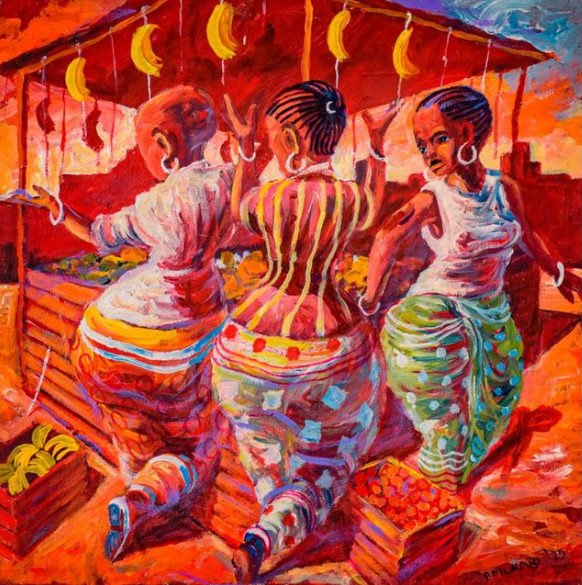
Patrick Mukabi (1969-2026) 🇰🇪🎨
Few Kenyan institutions captured the cheerful bustle of middle-class aspiration quite like Java House. Its walls, adorned with the robust, kanga-clad women of Patrick Mukabi, offered a visual anthem to everyday resilience: market traders with baskets balanced on heads, mothers whose ample forms suggested both abundance and endurance. Mukabi, who died this month after a long battle with diabetes that culminated in amputation and intensive care, painted a Kenya that was neither idealised nor pitied but simply observed.. with warmth, volume, and unapologetic colour.
Born in Nairobi in 1969, the fourth of seven children, Mukabi (known affectionately as “Panye���) began drawing young, inspired by Catholic imagery and encouraged by a father who worked for Kenya Railways. After a certificate in graphic design at what is now the Technical University of Kenya, he returned to his first love: painting, mostly in acrylic on canvas. His focus was the human figure, above all women engaged in the ordinary commerce of life.. hawking, carrying, conversing. Layers remained visible; the process was transparent, much like the man.
His style was instantly recognisable: voluptuous forms rendered with directness and dignity, sunlight suggested rather than depicted, movement captured without fuss. Critics sometimes called it accessible; in truth, it was democratic. Art, for Mukabi, belonged not in rarefied galleries but on the walls of cafés where ordinary Kenyans met over coffee. Java House commissioned him extensively; his work also graced airports and private collections. He exhibited in more than 20 countries, yet never lost the habit of teaching.
At Dust Depo, his studio beside the old Railway Museum.. practically on the tracks of his family’s history.. he ran an open-door academy. Aspiring artists, local and foreign, found space, advice, and often materials. Children’s classes on Saturday mornings (some televised as “Uncle Supuu” on Citizen TV) introduced a generation to brushes and bold hues. Many of Kenya’s younger painters passed through his mentorship; he was, as one curator put it, the closest thing the scene had to a godfather. Generosity came naturally, sometimes to his financial detriment. He gave works away cheaply or for free, undervaluing his own output in a market that rarely rewarded seniority.
Mukabi’s own life had railway rhythms: travel, teaching, exhibition. He spoke of Michelangelo as a mentor across centuries and painted from live models in later series such as “Cover Girls,” celebrating fuller-figured women who would never grace magazine covers but possessed their own majestic presence. Barefoot in the studio, he claimed he could not think with shoes on.. a small eccentricity that fitted the man who taught toddlers to slather paint “like jam on bread.”
In recent years illness confined him to Kenyatta National Hospital. Fellow artists organised benefit exhibitions, “Mali Safi” among them, to cover mounting bills. The shows celebrated his legacy while quietly underscoring a familiar Kenyan story: a towering talent who gave more than he received.
Patrick Mukabi leaves behind a visual vocabulary that has become part of Nairobi’s everyday scenery. His women endure.. self-assured, labouring, luminous.. on café walls where new generations sip coffee and, perhaps, notice the art for the first time. In a country still learning to value its own makers, he painted abundance where others saw only survival. Kenya’s art world is poorer for his passing; its walls, richer for his brush.
The Supreme on Criminal Litigation:
1. Abolfathi decision 2019, bail & bond✅️
2. Lendrix Waswa(Holding brief & watching brief, role of VIA in Criminal trials)✅️
3. Re Mwangi, minimum sentences✅️
4. Muruatetu 1 & 2, mandatory nature of death penalty✅️
5. Re Ruth Wanjiku, the defence of Battered woman syndrome ✅️
6. Okemo, on extradition✅️
Some substantial shaping of our Kenyan Jurisprudence. Beware!
"I think one of the greatest weaknesses of African people is the inherent belief that everything will work out in the end. If we have faith, if we believe, if we pray, if we just hold on, it will all work out in the end, and somebody or something will do for us and save us. And so, many of us become complacent and don’t do much or certainly don’t do all that we are capable of. And that frustrates me, and it must frustrate and discourage those of us who want to and are willing to go all the way. Now, if I get frustrated, imagine how Garvey and Malcolm and Harriet must have felt sometimes. But what makes them great, in my opinion, is that despite their frustration, they somehow kept going."
– Dr. Runoko Rashidi
If you know of any patients in Nairobi who are unwell and unable to afford proper homecare, please connect me with them. At Noor Homecare, we are committed to offering our services free of charge to those in need.
Let’s look out for one another🫶🏽
Oh’to be disgustingly educated. To have a degree with your name on it. To enter rooms & raise the standard. To know your stuff & to know it well. To have knowledge nobody can take from you. Such a big flex. & most importantly, to be in alignment with God…