📢 Join the AI conversation with two Founders @marcussawyerr Interviewing Duncan Taylor, PhD, on practical tips for AI sales & recruiting; bookmark this one! 🚀 #AI#marketing#sales#recruiting#Founders https://t.co/RAkjE3SqJo
Closing out another day in the Bay Area.
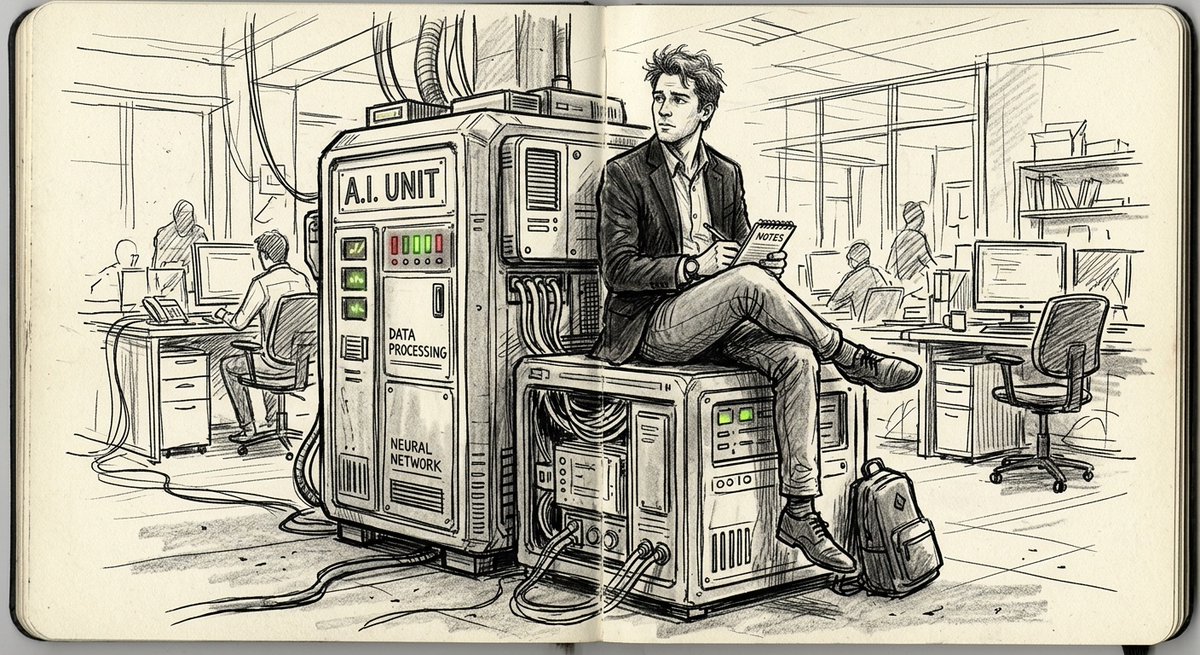
What did work look like today for you? If you ran into a workflow issue, how could your system have been rearranged?
How could your days end better? Look into what EQ could do for you.
https://t.co/DC0FAu2hEb
Traditional contract-to-hire is reactive. A manager opens a role, a recruiter scrambles, an agency sends profiles, and everyone hopes the shortlist is current.
AI-supported recruiting operations work differently. They can continuously:
Map talent markets: Identify likely candidates in priority functions before demand spikes.
Keep data alive: Refresh contact and role information so the team isn’t calling dead records.
Verify fit faster: Surface candidates with the right background for a trial-based role.
Support multichannel outreach: Coordinate email, LinkedIn, and direct messaging without fragmenting the workflow.
Being in Egypt made some things incredibly clear, one being: The future is not humans versus AI.
It is not recruiters versus agents.
It is not relationships versus automation.
The future is a better division of work.
Humans handle trust while agents can handle repeatable execution.
By July 2023, 862,000 workers were provided by contract firms in their sole or main job, showing how large the contingent labor pool has become in practice, not just in theory.
AI changes contract-to-hire by turning it from a one-off hiring tactic into a continuous talent system. Instead of waiting for an urgent req, modern teams can identify, verify, and engage potential contract-to-hire talent before the role formally opens.
https://t.co/YxyKNv2LNL went to Egypt this past week, and looking at the last remaining wonder of the Ancient World, it was hard to move past this one thought:
“Look what they built.”
They had a vision for something incredible, and without this vision, the landscape of Egypt would be entirely different.
This is how AI transformation happens as well, not with software, but with the question: "What are we trying to build?"
We have a limited number of tickets to share for Human+Tech Week 2026 in San Francisco (May 11–15) — and we wanted to offer them to our network first.
HTW is a working offsite for the people who want to be part of solving the biggest Human+AI challenges in work, health, and cities. 5,000 contributors. Three tracks. Structured sessions built for output, not observation.
AGENCY — Future of Work (May 12) HOPE — Future of Healthspan (May 13) REACH — Future of Flourishing Cities (May 14)
If you've been looking for the right room to work through your organization's AI challenges alongside the people who are actually building the solutions — this is it.
Tickets at https://t.co/OwkU9s5U44. Reach out directly if you want to talk through which track fits your priorities.
#HumanTechWeek
Thinking about "Digital Labor" in staffing? In 2026, the goal isn't just to automate tasks. Here is the 2026 blueprint for where AI agents should be taking over:
1. Top-of-Funnel "Grind" 🔍
Digital Labor: 24/7 autonomous sourcing, skill-adjacency mapping, and personalized outreach.
Human Value: Setting the search strategy and identifying the "X-Factor" in a candidate that data can't see.
2. High-Friction Coordination 📅
Digital Labor: Managing complex, multi-party interview scheduling and automated compliance redacting.
Human Value: Managing the "white-glove" experience and keeping the candidate excited through the process.
3. High-Volume Operations ⚡
Digital Labor: Instant credential verification, 3:00 AM shift-filling, and automated onboarding orchestration.
Human Value: Relationship management and handling complex escalations where empathy is required.
The main difference between static and AI signal research is that static research is a snapshot, while AI signal research provides monitored change over time.
That difference matters because timing usually determines whether outreach feels sharp or irrelevant.
In practice, the system is watching for shifts such as new headcount demand, tool adoption, leadership changes, expansion into a new region, or a role that appears for the first time. Then it adds context. Is this normal for the company? Is it new budget, backfill, or a strategic move? Does it create an opening now, or is it just noise?
You don't have to ban personal AI tools in your company to ban Shadow AI.
Instead, move toward a system of controlled enablement.
But to understand what that should look like, you have to understand your employees reasoning for using shadow AI in the first place.
Is shadow AI seen as faster than your official tools or containing more features then what you have?
↪️ Sanctioned tools ensure that data isn't used for model training. Integrate AI into your ATS.
Do your employees know when they can and can't use AI?
↪️ Bring the shadow use into light and categorize AI use accordingly.
Do they not know what these "free tools" often own the data you feed them?
↪️ Train staff on where data "lives" when they use a tool. Explain that a personal AI account is essentially a "public leak" of a candidate’s private resume.
Here's one question that's been floating around on LinkedIn: "How do I stay irreplaceable in an AI landscape?"
Most advice for recruiters tells us to sharpen empathy, learn prompting, and keep a human touch. All fair points, but it doesn't solve the operational mess most agencies are living with.
A recruiter doesn't become more valuable because they can talk fluently about AI on LinkedIn.
They become more valuable when their team can run faster, keep data current, reach the right people sooner, and spend more time in real conversations instead of in browser tabs. The firms pulling ahead are the ones deciding exactly where machines should work and where humans must stay in control.
This is the shift. Start thinking about AI as an agent-based workforce that handles sourcing, verification, enrichment, and admin in the background while your people handle judgment, nuance, and persuasion.
That distinction matters because recruiting has never really had a talent shortage. It has had an attention shortage. Good recruiters lose hours to stale records, fragmented systems, duplicate work, manual follow-ups, and list building that should've been automated years ago.
EQ's Enrich allows you to refresh your database, to transform static data into working data.
But is static data really that bad?
In short, yes.
Static databases create fake productivity
It encourages wrong behavior. A recruiter exports prospects, a sales rep buys contacts, someone enriches emails, and then the team starts outreach as if the record itself is the asset.
It isn't. The asset is current context.
Without current context, teams end up doing low-value labor.
Check out https://t.co/YxyKNv2LNL's Enrich here and see where else your labor could be used👇
https://t.co/ka6xTYfCo4
The "college degree required" filter used to work. Now it's more than outdated, it's become a competitive liability.
Today's workforce can be considered a "constellation of talent," we've integrated full-time staff, independent contractors, and fractional executives into a unified ecosystem.
But, at the same time, we are undergoing a skills-first revolution, with most employers prioritizing validated competencies over traditional degrees.
This intent-based targeting not only expands the available talent pool by up to 19x, but it also increases employee retention.
Looking toward the future of work, the defining question is this: What if capability and not contract type/pedigree defined your workforce?
Each week, as a staffing company, you have a new AI company promising something better than your current tools.
Whether it's faster sourcing or smarter candidate processing, they're offering an AI for purchase.
But many staffing firms have a system problem, not a tool problem, so a new AI might not be what you need.
Build a new system, don't tack on to the one you've had for years.
If you're ready to try something new, reach out to us here 👇
https://t.co/1tYDLxvhMr
We've been asked a lot, why is "autonomous" software often so labor-intensive?
There's a paradox in the AI agent sphere. We automate the "doing" but, for some, this increases the need for "stewardship."
Our EQ "Alive" Flywheel was built, not as another database, but as a solution for the "Labor Shift"
The paradox of the AI agent sphere is that as you automate the "doing," you actually increase the need for "stewardship." When we built the EQ "Alive" Flywheel, we didn't just want to create another database; we wanted to solve the "Labor Shift."
At EQ, we see three main reasons why "automation" feels like a lot of work:
The Governance Tax: You aren't just a recruiter anymore; you’re an auditor. Ensuring agents remain aligned requires high-level human oversight.
Contextual Debt: AI can start 1,000 conversations, but when a human jumps in, that person has to stitch together the context instantly.
Data Stewardship: Agents are only as good as the "semantic layer" they sit on. Keeping that data "Alive" is a collaborative effort between human intuition and machine speed.
We believe evidently believe in Zero-Admin, but that doesn't mean zero people. It means shifting your team's energy away from "low-value" manual research and into high-value relationship strategy.
We aren't replacing the recruiter; we’re upgrading them to Agent Handlers.
18% of firms have adopted AI by the end of 2025.
41% of individuals have reported work-related generative AI adoption.
So, what is the market telling us?
The Enterprise and corporate data is moving in the same direction.
The newest Gallup workplace data shows that half of employed Americans say their organization has already integrated it to improve operations.
In staffing language, that matters for one reason.
The expectations around speed, responsiveness, and workflow are changing.
Are you reorganizing with it, or are you still asking recruiters, coordinators, and account teams to carry workflow that should already be handled by the system?
Spend 15 minutes getting to know more about what AI and https://t.co/wKVXiWWy8P could do for you.
https://t.co/tXizWKcxqZ
Is manual admin work quietly destroying your team's profit margins? The answer is probably yes if your tech stack relies on disconnected systems.
Currently, plenty of teams are operating with 5-12 fragmented platforms. Fragmentation creates endless manual reconciliation loops that can cost us 5-10 hours a week.
So, how do we eliminate the admin burden?
Instead of a human manually checking an ATS for candidate availability, cross-referencing a hiring manager's Outlook calendar, sending an invite, and updating the CRM, an AI agent executes all of these steps autonomously in just 8 seconds
By offloading the redundant tasks, your human team can finally flip their time allocation, moving away from spending 80% of their week on administration to spending 80% of their time on the irreplaceable human skills.
🥇One question continues to be asked in the world of staffing:
What should stay human?🤖
Staffing does not need more AI tools.
It needs a better way to organize work, and a better talent mix around that work.
🥈The next question is what should become digital labour? And what happens when the operating layer actually changes?
And when it changes, the lift is real.⬆️
This week, one staffing CEO described roughly 40 percent more productivity per employee.💼
That is not theory.
That is not AI hype.
That is what starts to happen when you stop layering more software onto bad workflow and start redesigning how the work gets done.📝
If you're still wondering what the best community automation software is for high-volume client interactions, you could be asking the wrong question.
The bottleneck for many teams when handling high-volume interactions is the structural mess of fragmented systems.
Over-reliance on disconnected CRMS, applicant tracking, and standalone outreach apps has your team stuck doing "swivel-chair admin."
Firms that are truly scaling their high-volume interactions are adopting unified architectures powered by Agentic AI and the Model Context Protocol
By utilizing zero-admin, multichannel engagement platforms (like https://t.co/YxyKNv2LNL) or unified AI-native systems, you shift from simply "using AI tools" to managing autonomous workflows. This empowers your human team to spend 80% of their time on what actually closes deals.
:cat The headline numbers look resilient, but the underlying operating picture exposes a massive structural shift: 6.9 million job openings, but only 4.8 million hires.
The hires rate just fell to 3.1%, its lowest point since April 2020. What is actually happening in the market? Roles tied to repeatable execution are quietly not being backfilled.
The work hasn't vanished—ownership has simply shifted from humans to systems.
Right now, the 56% wage premium for AI-skilled talent is forcing companies to ask: "Should this role exist at all?".
Yet, the staffing industry is currently stuck in "AI theatre".
Most companies are just layering new AI tools onto old org charts built for human execution, which is exactly why 81% of them see little to no bottom-line impact. As long as you keep the same roles and the same accountability, nothing compounds.
Agencies need to stop pretending this is just a tech upgrade; it is a fundamental redesign. This week, audit your firm's workflows. Identify where your team is acting as "human middleware" doing repetitive robot work—moving data, matching records, and routing tasks. Shift the ownership of these tasks entirely to digital workers so your human team can focus on the high-value strategy that actually captures the market.
Are you restructuring your firm to change who owns the work, or are you just running a faster version of yesterday's broken system? Let me know your thoughts below!
It's about time we stop categorizing workers strictly as "contingent" or "permanent." That binary is dead.
Looking toward 2030, capability will define how we build teams, and the focus will shift entirely to simply getting the work done.
This new ecosystem blends full-time staff, independent contractors, fractional talent, and a new category of worker: AI and automation.
To survive this shift, staffing leaders must evolve from simple administrators into strategic architects. By deploying Agentic AI to autonomously handle 80% of transactional administrative tasks, human recruiters can finally allocate 80% of their time to the things that matter: relationship-building, assessing cultural fit, and high-stakes negotiation.
Are you restructuring your firm to manage hybrid human-digital teams, or are you letting yesterday's best practices become tomorrow's bottlenecks?