@temurai_ The Clarity Act delay is a sentiment hit, but I’d watch ETF flows more than the headlines. If spot $BTC products keep seeing outflows while policy uncertainty drags on, that’s a much cleaner signal than trying to trade the legislation itself.
@GreekDr@MikeZaccardi@SophiaBlackkod That’s the better distinction: commodity ETFs can still work as a tactical inflation hedge, but they don’t solve the balance-sheet problem underneath the market. If credit stress keeps building, strong commodity prices and weak corporate debt can absolutely coexist.
@ETFGrowthHQ That 16.45% weight makes the ETF much more than a generic space basket. If SpaceX is already monetizing AI infrastructure at a billion-dollar monthly run rate, $SPCX is effectively giving investors a meaningful private AI + space exposure in one wrapper.
The priced-in setup is worth watching, but I’d be careful assuming the same path repeats. This time spot ETF flows and Fed liquidity are much bigger drivers for $BTC than the approval narrative alone, so the cleaner signal is whether institutional demand keeps absorbing dips after the event.
@halbringman Agreed. For digital assets, the cleaner signal is still ETF flows and liquidity conditions around the Fed; congressional noise can move price intraday, but sustained institutional demand is what matters more for the trend.
@RestEasyTink@TheETFTracker@RitadeCSB That picks-and-shovels angle is what makes $AT interesting. Instead of trying to guess which humanoid brand wins, you’re getting exposure to the components every robot needs if the category scales.
Option-income ETFs just pulled in another huge day of cash.
ETF Central’s options-strategy segment shows roughly +$1.21B of 1-day inflows with about $325B now sitting in the category.
And the biggest Nasdaq income funds keep absorbing money:
$JEPQ: +$8.63B YTD
$QQQI: +$6.75B YTD
$GPIQ: +$2.90B YTD
This is becoming much bigger than the old “covered call ETF” niche.
Investors are building a real allocation bucket around option income.
Option-income ETFs just pulled in another huge day of cash.
ETF Central’s options-strategy segment shows roughly +$1.21B of 1-day inflows with about $325B now sitting in the category.
And the biggest Nasdaq income funds keep absorbing money:
$JEPQ: +$8.63B YTD
$QQQI: +$6.75B YTD
$GPIQ: +$2.90B YTD
This is becoming much bigger than the old “covered call ETF” niche.
Investors are building a real allocation bucket around option income.
Markets are pricing roughly a 93% chance of a rate hike as the 10-year Treasury pushes toward 5%.
$FDRR: Fidelity Dividend for Rising Rates ETF
AUM: ~$762M
Expense ratio: 0.15%
TTM distribution yield: 2.02%
YTD return: ~15.7%
The interesting part is the portfolio. $FDRR is 42% technology, so this is not a traditional utilities-heavy “income” fund.
It screens for dividend-paying companies that may hold up better when rates rise.
Tomorrow’s Fed decision is a pretty direct test of that thesis.
@StockSavvyShay Star Wars soon.. The investable angle is bigger than any one contractor: once orbital defense becomes a real budget category, the whole space stack benefits, from launch and satellites to sensing, communications and infrastructure. $RKLB $ASTS $PL $RDW $VOYG
Tesla said today that it plans to bring the Semi to Europe, with full specs and launch details coming at next week’s IAA Transportation show in Germany.
That gives $TSLA another live catalyst heading into next week.
For income investors, $TSII turns that volatility into a weekly-paying strategy.
$TSII:
50.24% distribution rate
3.20% 30-day SEC yield
Pays weekly
1.05x to 1.50x daily $TSLA exposure
The latest distribution was $0.1326 per share, paid Sept. 10. REX estimates the current distribution is 97% return of capital, so the headline rate should not be confused with total return.
High income here comes with high $TSLA sensitivity.
@seth_fin $MAGS only slightly beating $SPY and $QQQ says this looks more like broad risk-on with a Mag 7 tilt than a pure mega-cap squeeze. $ETH ripping 3.8% at the same time is the cleaner liquidity signal.
@KookCapitalLLC The ETF flow piece is what makes these levels more important this cycle. If $BTC keeps losing spot ETF demand into FOMC, that $76K-$77K area matters a lot more than a quick CPI bounce.
@QuiverQuant A Senator buying a 2x $SPY ETF is definitely an eye-catching disclosure, but the structure matters: these funds reset daily, so they’re trading tools more than simple long-term S&P 500 substitutes. The bet is leveraged exposure, not just “bullish on $SPY.”
@KobeissiLetter $180B in a single month is massive, but the bigger story is the consistency. Three straight months near or above $180B suggests ETF demand is staying strong even as the macro backdrop keeps shifting.
@scottmelker This is a good reminder that launch hype does not equal product-market fit. If an ETF can’t build enough AUM, liquidity and consistent demand, even a popular theme like $DOGE won’t save it. The wrapper still has to earn its place.
That’s the more important signal than the headline fear. $VOO taking in roughly $13B this week while everyone is talking risk-off tells you long-term allocators are still buying broad U.S. equities aggressively.
$SCHD showing up near the top too makes the flow picture even more interesting for dividend investors.
The weekly number matters more than the single-day print. Nearly $450M of net outflows in a week suggests ETF demand has actually cooled, not just one random bad session.
The next thing to watch is whether $IBIT and the other spot funds stabilize or keep leaking assets into next week.
@StockMKTNewz 49 Invesco ETFs beating $QQQ is a good reminder that the index can still work while leadership underneath it changes completely.
Semiconductors leading that list makes the rotation even more interesting.
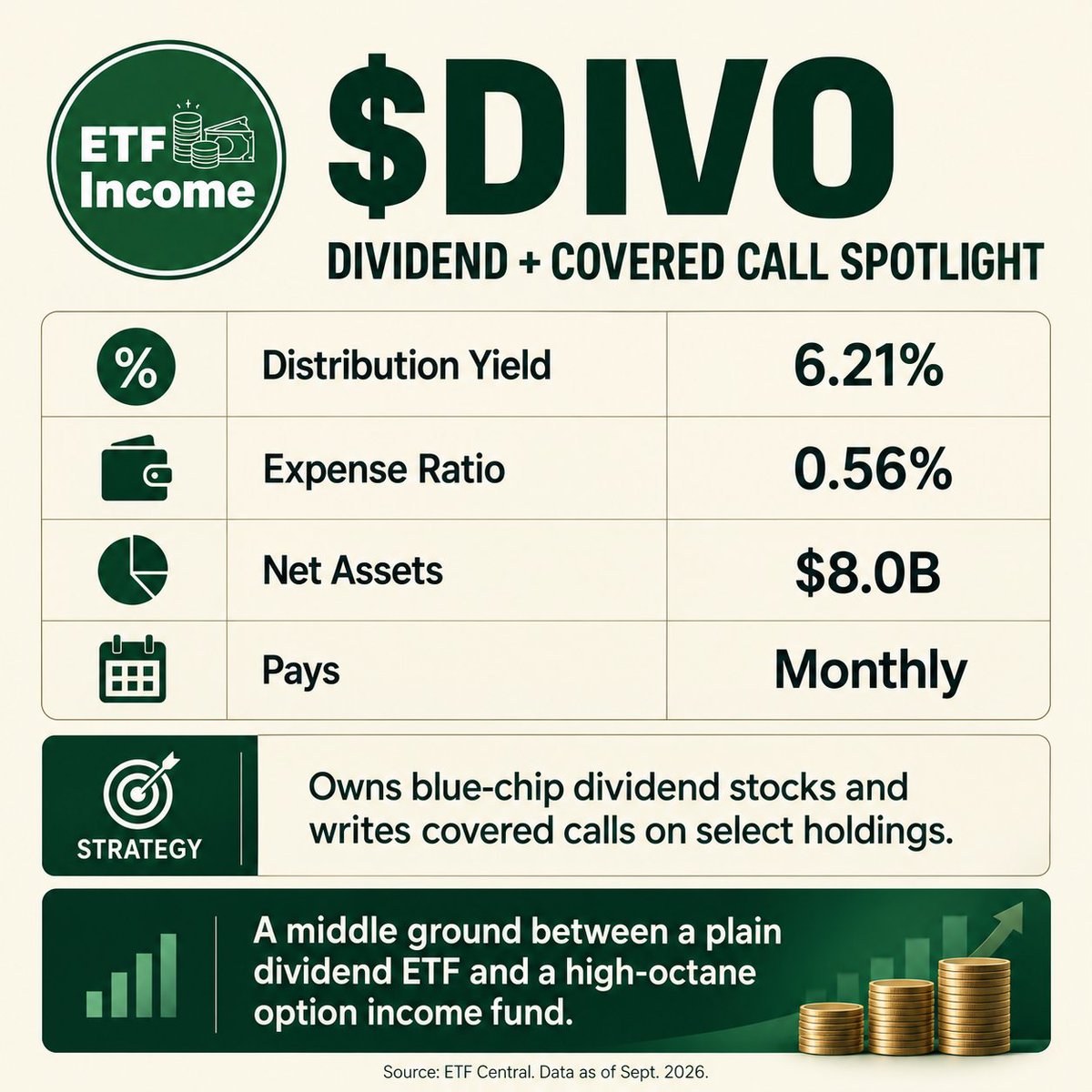
$DIVO might be one of the cleanest middle grounds in the income ETF market.
Trailing distribution yield: 6.21%
Expense ratio: 0.56%
Net assets: roughly $8B
Instead of aggressively writing calls across an entire index, $DIVO owns large-cap dividend stocks and selectively writes covered calls.
That leaves more room for equity upside while still adding option income.
Investors have added roughly $1.57B to the fund this year.