Interesting insights and constructive interview. Could there be a DAT that integrates/merges with an insurance company? If insurance is about the optimization of matching float with liabilities could an insurance company invest in #BTC structured products with defined outcomes that roll with its rate of stored value?
Another successful visit to DC for @SavinoVaness and I to meet with the offices of Senators Reed, Britt, Moreno, Kennedy, Rounds and Warnock, as well as the senior Senate Banking Committee staff. Followed up on our earlier visit on the House side to discuss @tZERO, the need for independent regulated tokenization infrastructure to facilitate compliant industry transition, Clarity Act open issues and the importance of cohesive federal-only regime for multi-asset rails - as well as the need to focus on protection of fundamental IP rights in this industry. Grateful to @FS_Vector for facilitating. Now, it’s typical to post goofy pictures by the US Capitol or something as proof of attendance. We won’t do that. What we will do is post this picture of Alphonse the Stuffed Alligator from Senator Kennedy’s office. Thank you for your attention to this matter.
Structure Matters (SM): I always enjoy that story! Counter tale, according to AI Willis Tower Watson came up with the awful narrative for ETF - “ Smart Beta” back 20 yrs ago. Awful because it says nothing and for decades has been an industry joke since the opposite of smart is stupid! https://t.co/v2gITIOKXX
$60 BILLION COINBASE AND FANNIE MAE ARE STARTING THE ROLLOUT OF #BITCOIN-BACKED MORTGAGES NATIONWIDE THIS SUMMER
120 MILLION AMERICANS WILL BE ABLE TO BUY A HOME USING BTC AS COLLATERAL
WHAT A TIME TO BE ALIVE 🔥
@saylor@Geertjancap Michael, Been with you since since 2020 and the dutch tender! Lot’s of peaks and valleys on this #BTC journey, but your commitment has always been clear!
🚨 NEXT WEEK COULD DECIDE THE FUTURE OF CRYPTO IN AMERICA.
Bipartisan crypto negotiators are preparing a final round of meetings next week to lock in key parts of the bill before the Senate runs out of time ahead of the August recess.
Lawmakers are now trying to finalize:
• SEC vs CFTC jurisdiction
• Token classification rules
• Stablecoin language
• DeFi treatment and crypto exchange regulation
This is one of the biggest crypto regulation moments the US has seen in years.
For years, crypto companies in the US have been operating in a legal grey area where nobody fully knows:
• Which tokens are securities
• Which regulator has authority or what rules exchanges actually fall under.
The CLARITY Act is supposed to finally define that.
A huge part of the current negotiations is focused on the CFTC side of the bill, which would oversee:
• Bitcoin spot markets
• Commodity-style tokens and large parts of the exchange industry.
If negotiators can reach an agreement, the US could move much closer to a proper federal crypto framework with clear rules for exchanges, tokens, and digital asset markets.
If talks fail, major crypto legislation could get delayed until 2027.
Next week could become one of the most important weeks for US crypto regulation in years.
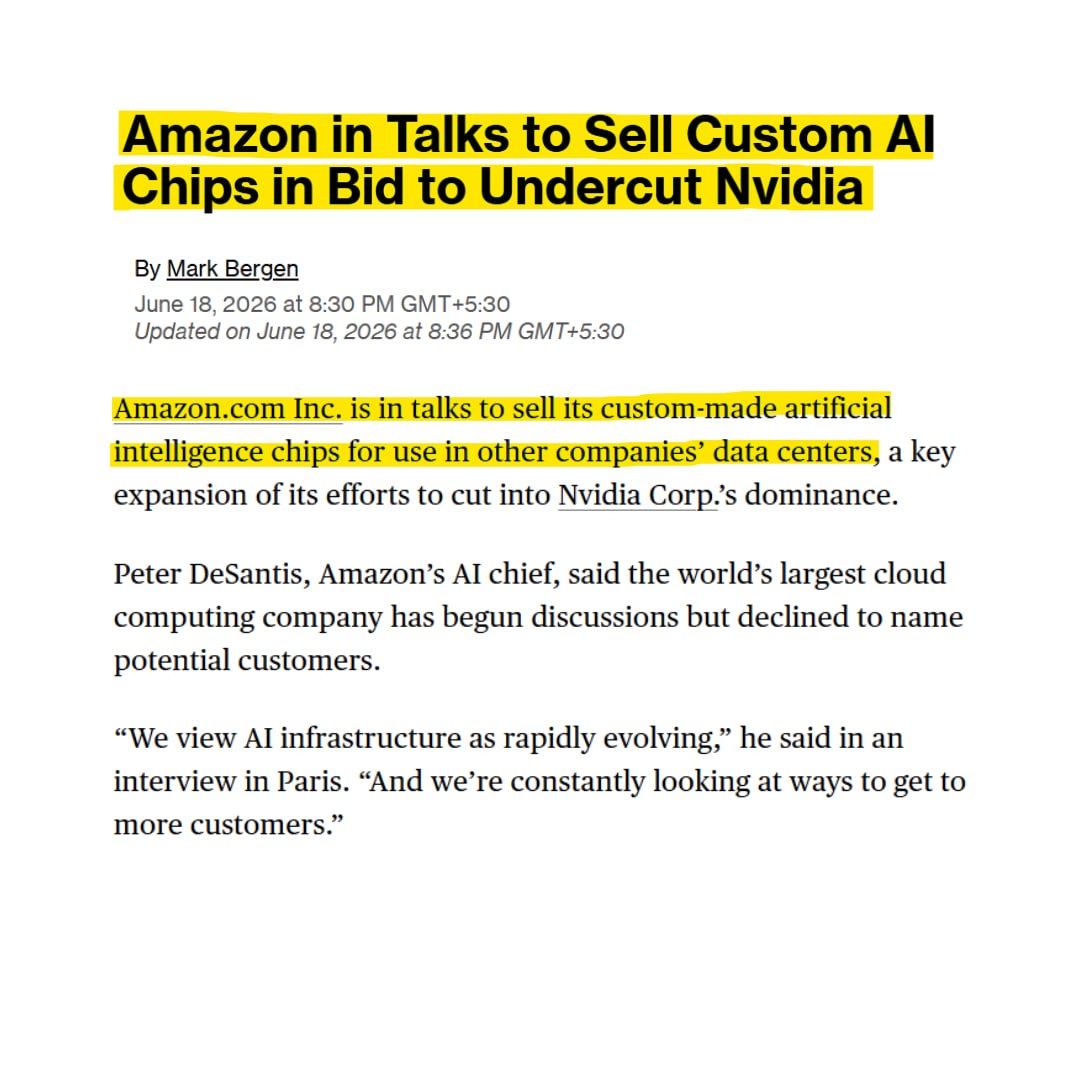
🚨 AMAZON MAY BE ABOUT TO DECLARE FULL SCALE WAR ON NVIDIA.
Amazon is exploring selling its in-house AI chips, including AWS Trainium, directly to data centres and enterprise customers.
Amazon runs a three chip AI stack: Trainium for training, Inferentia for inference and Graviton CPUs for general compute.
Trainium has been restricted to AWS infrastructure until now, the reported plan would extend availability to external buyers.
This would mark Amazon's shift from a cloud provider using custom chips to a vertically integrated AI compute supplier, offering both cloud services and the hardware that powers them.
Nvidia's business model depends on every company needing to buy GPUs from Nvidia, regardless of which cloud they use. If Amazon starts selling Trainium directly to data centres, a company no longer needs AWS or Nvidia.
They can buy Amazon's chips and run them on their own infrastructure. That removes Nvidia from the transaction entirely.
Amazon's Trainium AI accelerator has already attracted major customers including OpenAI, Anthropic and Uber, all accessing it via AWS.
Anthropic has committed to up to 5 gigawatts of current and future Trainium capacity.
OpenAI has agreed to about 2 gigawatts. These are workloads that would otherwise likely run on Nvidia GPUs.
Amazon said in April that the Trainium chip has generated over $225 billion in revenue commitments. Trainium2 has largely sold out.
Trainium3 began shipping at the start of 2026 and is nearly fully subscribed. Much of Trainium4, still about 18 months from broad availability, has already been reserved.
That level of demand shows real customers are choosing Trainium over Nvidia GPUs even while restricted to AWS only.
Andy Jassy said in his April shareholder letter that the chip business is generating roughly $20 billion annualized across Trainium, Graviton, and Nitro, growing at a triple-digit percentage rate year over year.
He said that if the chip business sold externally the same way Nvidia does, it would represent a $50 billion annual run-rate business on its own.
Peter DeSantis, the AWS executive overseeing the chip effort, confirmed the talks, citing demand for AI compute to stay under local control, especially Europe's push for sovereign infrastructure. He dismissed concerns about cannibalizing AWS cloud revenue, citing heavy underconsumption of AI compute industry-wide.
This follows Alphabet's move in April, when CEO Sundar Pichai said Google would start making its TPUs available to outside data centres through a limited customer program.
Two of the three largest cloud providers on earth are now independently moving to sell their own AI chips outside their own cloud walls. That is the part that should worry Nvidia most.
It is not one competitor. It is the entire hyperscaler layer simultaneously deciding they no longer need to be Nvidia's customer exclusively.
Nvidia is still the dominant force today.
Data center revenue rose 92% year over year to a record $75.2 billion last quarter, and Amazon itself remains one of Nvidia's largest customers, committing to deploy more than 1 million Nvidia GPUs starting in 2026.
The two largest cloud companies on earth are now actively building the infrastructure to compete with Nvidia directly, using customers Nvidia currently depends on.