@VitalikButerin@session_app Session is becoming a case study in how AI compresses organizational scale. Open-source + community funding + AI-assisted engineering turns a project that once needed multiple specialized teams into something a handful of high-agency builders can sustain.
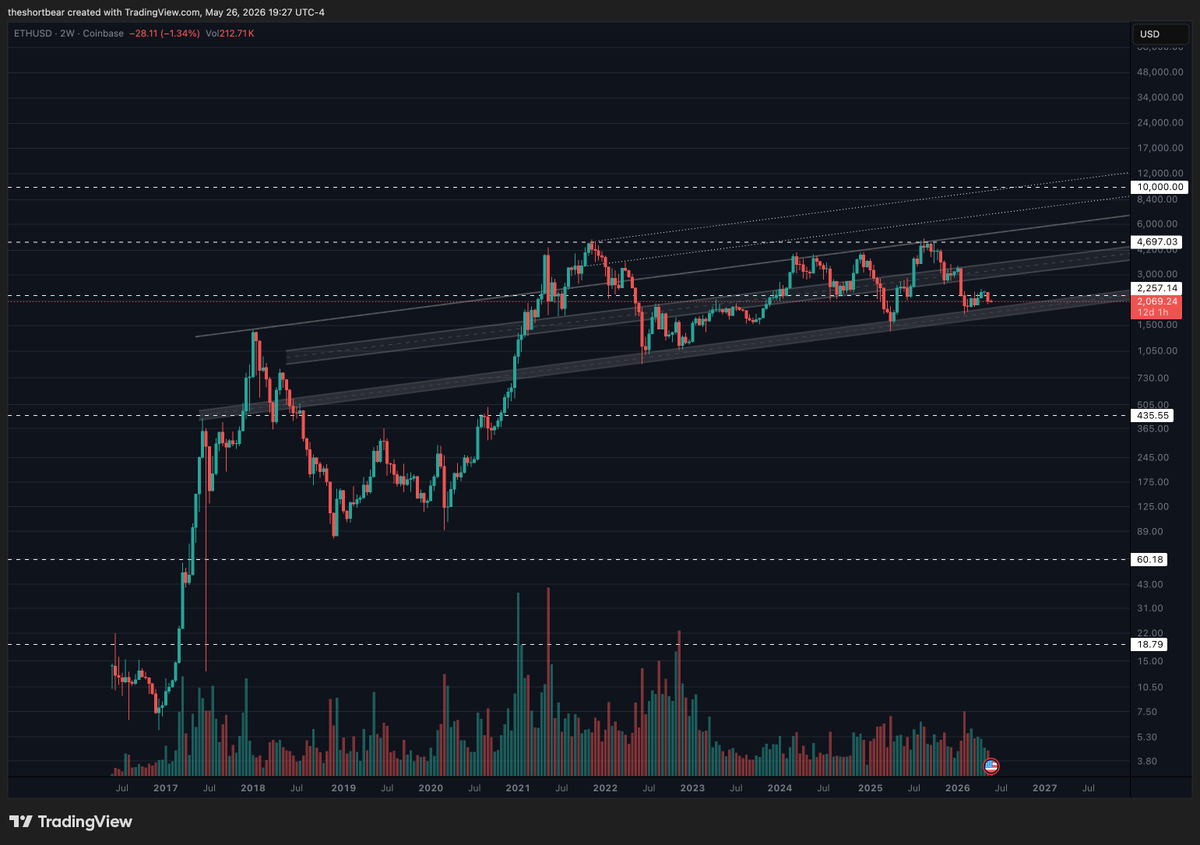
I have never seen so many people capitulating out of $ETH or crypto.
Some are writing blogs and essays explaining why it failed, mainly naming how other chains won the race, measured by fees taken in.
Some of my thoughts, in these hard times:
Time will tell, but I think many people are mistaken in treating $ETH like an end-stage $AMZN, as if the main question is already about mature margins, fees, and cash flows.
In reality, Ethereum is still very much earlier in its economies-of-scale phase, with nearly all metrics in the top right corner and growing at mid double digits to tripple.
Furthermore, most of the market is focused on the wrong battle: who can become the fastest and cheapest payment processor.
Lower fees, higher throughput, faster settlement. But that is likely a race to commoditization, similar to the payment processors crash over the last years.
If the only value proposition is speed and cost, then the moat gets thinner over time, easy disruptable. Someone can always be faster. Someone can always subsidize fees lower. Someone can always optimize one narrow use case.
The real value may not be in the transaction fee itself.
The real value is likely in the amount of economic activity secured by the network, the credibility of that security, the neutrality of the base layer, and the difficulty of replacing it once enough assets, applications, institutions, and users depend on it.
That is where Ethereum seems different to me and why so many institutions are choosing $ETH.
Most other projects still feel replaceable. They may have better performance in one area, better UX in another, or lower fees in the short term. But if their advantage is mainly technical efficiency, that advantage can be copied, competed away, or made irrelevant.
The newest hottest thing today is replacing the hottest thing from last quarter.
Ethereum’s bet appears to be much larger: become the most secure, decentralized, credibly neutral settlement layer for the internet economy.
Not the cheapest rail.
The hardest rail to replace.
In the end, the most valuable network may not be the one with the lowest transaction costs. It may be the one people trust most to secure the highest-value assets and applications over the longest period of time.
If $ETH can retain its market share while continuing to scale through upgrades that improve speed, throughput, and fees, its potential remains significant, especially if AI agents become truly crypto-native.
If it combines all of the above and earn the crown as the leading value-secured network, then $ETH could eventually be viewed as something like a truly decentralized, inflation-adjusting global bond: securing the world’s assets, free from political meddling, and deserving of a premium market cap because of the value it protects on top of the deflationary pressures create incentives to stake, get yield and trust the equivalent of buybacks and griwth in value secured to provide additional value.
Keep in mind over 1/3 of $ETH is now staked!
In that scenario, $ETH would not just be another asset to hold. It could become one of the only truly neutral and secure bonds for the digital economy.
... But sure, lets compare it to $SOL with 6% inflation, no moat, no security, massive outages, decreasing validator nodes and alike.
it just all feels like people are getting lost in short term fees and the easiest valuation attempt rather than what $ETH is actually built for, all while its testing its bottom range and players go full portfolio into AI.
$IBRX is one of the most misunderstood stories in biotech today.
The market continues to value ImmunityBio as a clinical-stage company. It isn’t.
Q1 revenue reached 44.2M, up 168% YoY and 15% sequentially, with cash at 380M. ANKTIVA is no longer theoretical - it’s commercial, reimbursed, and actively scaling.
Regulatory approvals now span 34 countries. Saudi Arabia has already launched with distribution infrastructure in place and patients actively dosing. This is not a speculative international narrative; it’s a methodical global commercialization rollout already underway.
This week, the FDA accepted the supplemental BLA for papillary NMIBC expansion - same disease setting, same validated mechanism, same commercial infrastructure. PDUFA date: January 6, 2027.
Importantly, at the FDA’s own workshop last week, expert panelists described CIS and papillary disease as biologically equivalent. That is about as meaningful a de-risking signal as investors can get ahead of an approval decision.
The commercial ramp is real. The label expansion pathway is active. Yet the stock still trades at a substantial disconnect to both the revenue trajectory and platform potential.
Do your own DD.
@ImmunityBio@DrPatrick
$IBRX ImmunityBio ASCO highlights:
ImmunityBio….
•Crushes JNJ’s TAR-200 (NMIBC)
•Crushed Keytruda (CPI) alone (NSCLC)
•Best GBM results for any treatment (where the Patient also does not look worse than a Holocaust survivor)
50% increase in progression free survival (PFS) when added to standard of care (SOC)
Big question -Has ImmunityBio submitted BLA for NSCLC? This is 100% Confirmation Saudis are correct in approving NSCLC.
Why did Saudi Arabia approve $IBRX Anktiva for metastatic lung cancer?They are trying to get a reputation of responding to promising innovation I guess.
Not sure if this may clear things up or muddy it further - I just know we are winning and it's time to get fully back to building and remember that our patience will be rewarded:
imo it's a common misconception that the EF and/or Vitalik don't care about the price of ETH.
They do care, very much, because they want Ethereum to be globally ubiquitous for a thousand years, and they know that this audacious goal requires lots of resources and economic security which can only come from a terrific ETH valuation.
The reason the EF has often over the years appeared not to care about the price of ETH is two-fold:
One, the EF is overall insanely confident in Ethereum and in ETH. As they should be. They've earned it and earn it every day. So when we are bearish or scared about the spot price, it's just effectively noise from their perspective of strong conviction and focus.
Two, the EF cares about price in long term structural ways that are incomprehensible to many of us.
We want to know why Didn't Number Go Up in Q4 Or Yesterday.
Whereas they want to know, "How will Ethereum remain dominant after quantum computers?" and, "How will Ethereum be the world's economic hub for trillions in assets and thousands of L2s across a hundred countries?" These are inherently bullish questions. And their programs/answers in response are gigabullish.
The EF departures are not because the people departing feel differently about Ethereum and our trajectory vs. the people staying at EF or vs. community folks like me.
The EF departures are because -
Even benevolent special smart wonderful people naturally have internal politics and differences of opinion over substrategies, policies, etc.
Vitalik and his leadership team feel the EF should be run in a certain way. Some folks disagreed. Some tiny number were asked to leave for Reasons. Some few others left immediately due to Reasonable Net Feelings. Some more are leaving because the Wheel is Turning and they feel that while we all love Ethereum and are extremely excited for our roadmap and proud of past wins, the time for new blood is here.
New blood means genzeth and also young up and comers who are ready to take the reins of their teams and departments.
What's important is that the EF's determination is as strong as ever and its strategy and focus are better than ever before. Credible neutrality. Decentralization. 100% Uptime. Postquantum. Privacy. Scaling L1+L2. Unifying/improving UX for L1+L2. The EF is on it.
What's also important is that the EF is now complemented and balanced by a growing cohort of deeply invested elite eth orgs across the stack/verticals/technologies/go-to-markets, including top L2s like Base, Arb, and zkSync, DATs like BMNR and SBET, and enterprise groups like Etherealize and Consensys, and too many more orgs and kinds of orgs to list here.
We will miss the great EFers leaving this season.
The EF is not only going to be fine, they are going to be amazing. Let the wheel turn. We're ready.
This bear market- secularly in crypto and in terms of global issues- is unfortunate, but that's the industry.
ETH will hit multi trillion in due course. Strap in, be patient. Help out. Get involved. I've been here for 8 years now full-time and it's never more felt like I'm just getting started.
Ethereum.
ImmunityBio $IBRX just got their supplemental application accepted by the FDA to expand ANKTIVA's label to cover papillary-only bladder cancer, which is about 85% of non-muscle invasive bladder cancer patients. Right now it's only approved for CIS (a different subtype).
Decision date is January 6, 2027. The key argument is that CIS and papillary disease are biologically the same thing, and doctors already treat papillary patients off-label with CIS-approved therapies anyway. If approved, it significantly expands the addressable market.