Structural duality enables a single protein to act as a toxin–antidote pair for meiotic drive | PNAS https://t.co/EvqCPMO14e
&
A meiotic driver hijacks an epigenetic reader to disrupt mitosis in noncarrier offspring | PNAS https://t.co/AzhZQa5JO2
2 amazing papers! 🤩
At the end of 2018 I was lucky to receive a @cziscience Ben Barres award. This preprint is the culmination of that funding, which allowed us to try "out of the box" ideas to study neurodegeneration. Fearlessly led by amazing student @MitaliTyagi2! 🧵 /1 https://t.co/5EOxdXLGKb
Women lose >90% of their #eggs by their mid-30s, with persistent #DNADamage driving this loss. But why isn’t this damage repaired?
Our new work in @CurrentBiology, led by @ninadini_sharma, reveals the causes of high DNA damage in aged oocytes.🧬💥
https://t.co/hd8iT1TKnJ (1/13)
This year’s medicine laureates Victor Ambros and Gary Ruvkun studied a relatively unassuming 1 mm long roundworm, C. elegans.
Despite its small size, C. elegans possesses many specialised cell types such as nerve and muscle cells also found in larger, more complex animals, making it a useful model for investigating how tissues develop and mature in multicellular organisms.
Read how the 2024 medicine laureates’ investigations into C. elegans revealed an entirely new dimension to gene regulation: https://t.co/8RwUplwYQA
#NobelPrize
BREAKING NEWS
The 2024 #NobelPrize in Physiology or Medicine has been awarded to Victor Ambros and Gary Ruvkun for the discovery of microRNA and its role in post-transcriptional gene regulation.
Can we use CRISPR screens to identify genes that drive neural stem cell aging?
Super excited to see this work published @Nature!
Huge congrats to Tyson @ruetz_tyson, Angie Pogson, @kashiwagi_chloe, and all authors! Great collaboration with @MCBassik!
https://t.co/iwZIzEssyz
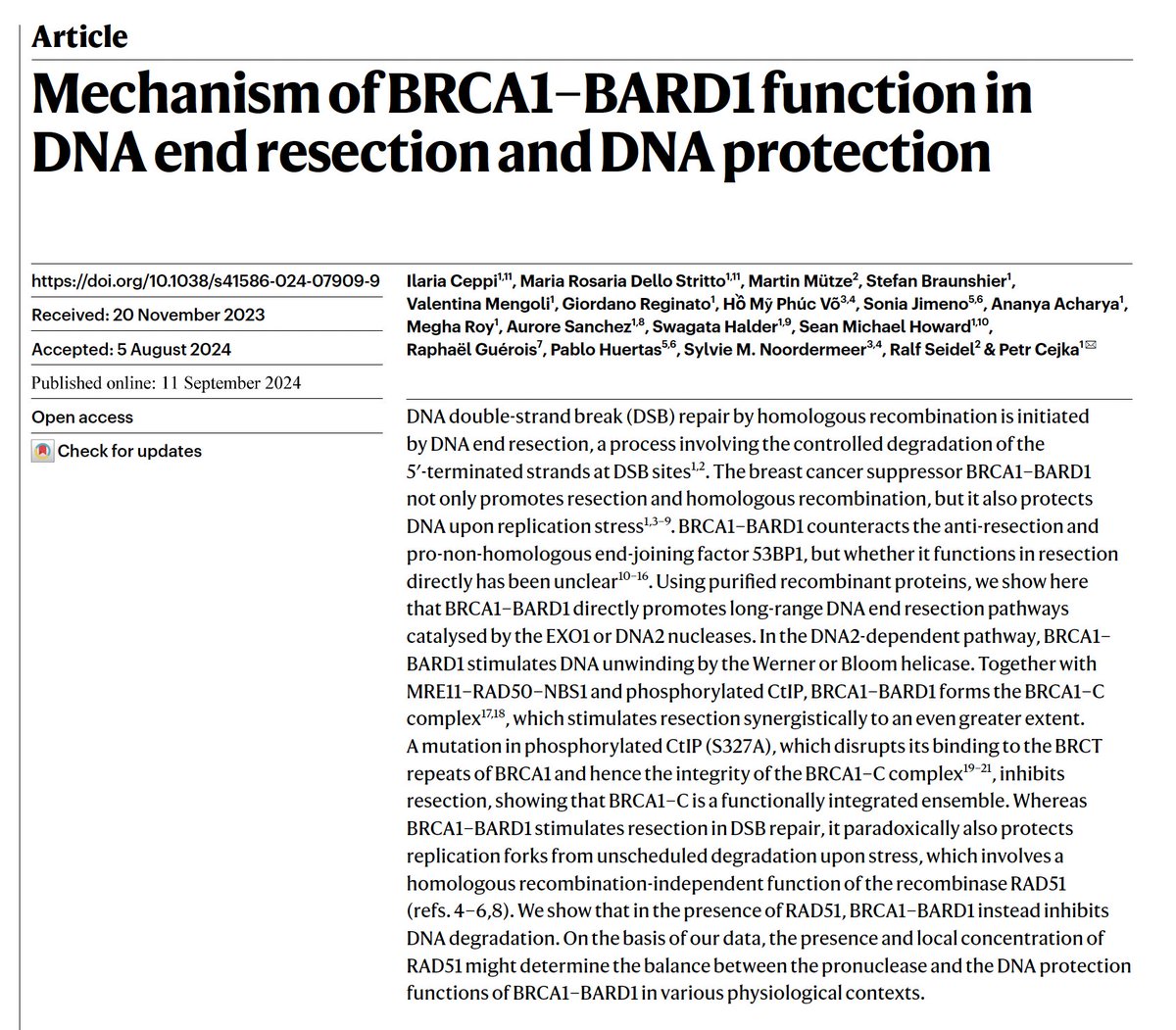
We are thrilled to present you our work on BRCA1-BARD1 @Nature showing that the complex has a direct role in long-range DNA end resection. With @CeppiIlaria@DelloStritto_MR and our collaborators @PabloHuertasLab@SylvieNoorderm1 and Seidel labs.
https://t.co/xh3J7mtwaV
@arielframe@albertosanzmon1 @ctmurphy1 @RKaletsky The Ocampo group also saw that pan-soma expression of reprogramming factors had deleterious effects on worms, so I would hazard a guess that most cells in C. elegans aren't benefitting https://t.co/qohHNsMZwL
@arielframe@albertosanzmon1 @ctmurphy1 @RKaletsky We haven't! Our interest is in cognitive aging, so we focused on testing behaviors for that phenotype +/- OSK. As chemotaxis towards multiple olfactants can be disrupted, it seems like OSK probably isn't helpful for chemosensory neurons at a minimum.
@arielframe@albertosanzmon1 @ctmurphy1 @RKaletsky Definitely agree - we hope that our data will contribute to a comparative biology approach to understand what cell types reprogramming will benefit! Effect of OSK on mouse RGCs seems impressive, but maybe not all neurons will benefit similarly
@HyperSapient @ctmurphy1 It should be noted that the same group also found that reprogramming factor ortholog expression in worms caused developmental defects, had no effect on or shortened lifespan, and caused behavioral and physiological defects https://t.co/qohHNsMrHd
@kapahi_pankaj @ctmurphy1 @RKaletsky As C. elegans lacks 5mC, we can't rely on DNA methylation clocks to infer rejuvenation. However, we might have been able to employ the Schumacher C. elegans gene-expression based clocks to profile the 'age' of their neurons as well https://t.co/28uyOIdpwL
When I started my postdoc, I asked if partial reprogramming could rejuvenate aging worm neurons. It turns out, these worm OSK factors are neutral or even deleterious to C. elegans lifespan and chemosensation! Thanks to @ctmurphy1 and @RKaletsky for their help and support!
@kapahi_pankaj @ctmurphy1 @RKaletsky We planned to perform neuronal single-nucleus RNAseq to profile aged neurons +/- OSK expression! Our initial hypothesis was that we would see a more youthful gene expression profile, as our lab showed that C. elegans neuron gene expression changes with age https://t.co/zmSx95CFnM
We created a comic book based on our research on the role of GJ channels and bioelectricity in neuromuscular development! This was an amazing collaboration with undergraduate art student Bentley Smallwood.🐟🔬⚡️
Read the whole version here: https://t.co/RSmqFXKQa0
#Zebrafish
The last of my graduate work with @DianaLibuda is out in @eLife! We show that BRCA1 and SMC-5/6 regulate DNA break repair pathway engagement in C. elegans meiosis, but are not required for intersister repair. A fun "crossover" collab with @TheRogLab! https://t.co/9rhlPENhrW