How do lipids influence aging?
We find that membrane lipid composition impacts neural stem cell aging and 'rejuvenation'!
HUGE congratulations to @xiaoaizh on her paper just published at @ScienceAdvances!! 🤩🍾
And a big thank you to all our collaborators!
A thread 🧵...
Deeply honored to be elected to the National Academy of Medicine and grateful for all of the kind notes I have been getting from colleagues! https://t.co/fw72Z9RL7W This recognition belongs to the extraordinary people who made this journey possible—my laboratory members, past and present, my colleagues at Northwestern, National Cancer Institute for funding my work for the past thirty-plus years, the visionary philanthropists who believed in our science, and my wife and our four children, whose love, patience, and unwavering support have made everything possible. Science is a team endeavor, and I feel enormously fortunate and grateful. I truly am one of the luckiest people alive. @NU_BMG_SQE@NUFeinbergMed@NorthwesternMed@theNASciences@theNAMedicine@NIH@theNCI
Our new paper in @NatImmunol explores this question through PPARδ, a lipid-sensing transcription factor that we identify as a regulator of the #fitness balance between #cancer and #immune cells. You can read the open access paper here: https://t.co/7iYvfAR0M6
Brain vascular aging isn’t a single path. Our new work shows that the aging brain diverges into two states:
🧠 Hypovascular (expected)
🧠 Hypervascular (surprising), with BBB leakage, inflammation and cognitive decline.
Our study👇🏻: https://t.co/ob00oHR43C
We recently introduced DISCO-seq 🤩: scRNA-seq after tissue clearing 🧬
https://t.co/r0JewTn5yC
First, image whole organs or bodies in 3D at cellular resolution. Then select regions for unbiased scRNA-seq.
From glioblastoma to whole-body SARS-CoV-2 spike mapping 👇🏻 #DISCOseq
Excited to share our discovery of a cognitive resilience sentinel in aging (Nature Neuroscience, Open Access https://t.co/H1GbqXl80Y) led by a terrific postdoc Cinzia Vicidomini PhD, other members of the Sahay lab and terrific collaborators.
Background
Healthy cognitive aging depends on a balance of resilience and vulnerability factors that dictate the tempo of synapse loss, lipid dysregulation, excitation-inhibition imbalance, ferroptosis, and neuroinflammation. Disruption of this balance accelerates cognitive decline and increases risk for MCI and Alzheimer’s disease (AD). Cognitive reserve theory posits the existence of compensatory factors in the aging brain that offset pathophysiological alterations; however, the identities of such factors have remained elusive.
The discovery
We discovered a secreted phospholipase, Pla2g2f, in a screen for synapse loss-induced genes in the Dentate Gyrus region of the hippocampus. We found that Pla2g2f expression is increased during perforant path synapse loss in aging and in aged cognitively resilient individuals with AD pathology. To study the functions of Pla2g2f, we employed genetic and viral approaches to bidirectionally manipulate levels of Pla2g2f in the hippocampus of aging mice. We found that Pla2g2f loss exacerbates aging-associated synapse loss, inflammatory microglia, reactive gliosis, impaired neurogenesis, lipid dysregulation, lipid droplet accumulation in neurons and microglia, and memory loss. Conversely, boosting levels of Pla2g2f during aging in mice is sufficient to prevent these pathophysiological alterations and protect memory. Remarkably, increasing Pla2g2f levels in middle-age prophylactically modified the trajectory of cognitive decline. In a human model system, we showed that neuronal PLA2G2F signaling reduced lipid droplet accumulation and cholesterol ester load in microglia, both signatures of AD (Alois Alzheimer, 1907).
Impact and Translation
Neuroinflammation is driven by pathological buildup of lipid droplets in microglia which impairs phagocytosis, debris clearance and synapse pruning, and produces toxic cytokines. Compensatory PLA2G2f upregulation confers neuroprotection through mobilization of lipid droplets, phospholipid remodeling, lipid signaling and potentially, ferroptosis suppression (Jiang lab, MSKCC). Much like EPO’s compensatory role in maintaining blood oxygen levels, we think that PLA2G2F is a sentinel to detect and protect synapses during aging. Boosting Pla2g2f levels in aging-sensitive knock-in AD models reduces lipid droplet accumulation in microglia, amyloid plaques and improves memory (preprint, unpublished, Sahay lab). Ongoing efforts are aimed at derisking therapeutic modalities to increase Pla2g2f expression in aging and AD to prevent memory decline.
Big thanks to our terrific collaborators @chopralab, @LabSalta, Li-Huei Tsai and @MatBVictor, Shannan Ho Sui, Murakami and @SimonsFdn (The Simons Collaboration on Plasticity and the Aging Brain) for funding.
#aging #cognition #resilience #healthspan
Feedback and questions are welcome.
Check our new story on chromatin interactions and the activation of regeneration-responsive enhancers during African killifish and zebrafish fin regeneration. https://t.co/14Vjy3mFbY
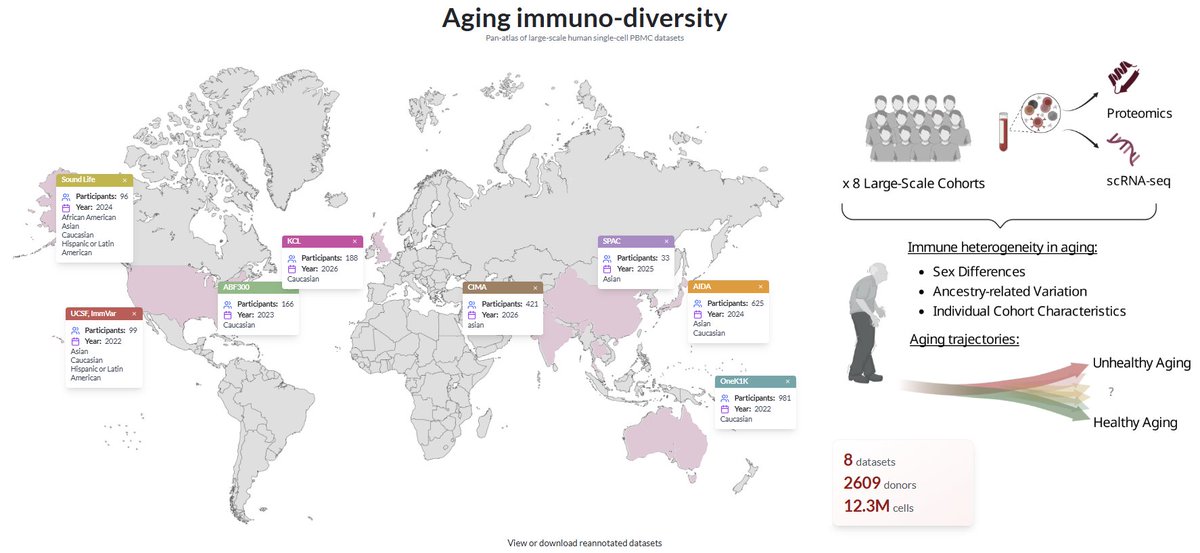
Out today in Immunity! Our pan-atlas of human immune aging: 12.4 million PBMCs from 2,609 people across 8 global cohorts (including new 188 people cohort from UK).
https://t.co/hYbe2k3XEi
We map shared aging patterns onto 59 key immune populations and link the balance of GZMK+ and GZMB+ CD8 effector memory T cells to health trajectories; show differences in RTEs and Th2s with sex etc; ethnicity associated features.
https://t.co/AHmFVQVfM6
How it came to be:
in 2023 we published first hierarchically annotatied atlas of human immune aging in PBMC - 166 people, 55 populations, key changes revealed - CD8 naives, KLRC2/NKG2C+ CD8 memory going down, GZMK+ CD8 T cells and Th2 and Tc2 type 2 memory cells going up! (Terekhova et al, Immunity 2023)
in 2024 we added major phenotypes within naive cells - SOX4+ RTE cells and their CD38 marker going down. (Bohacova et al, Immunity 2024)
In 2025-26 more atlases published with their own annotations making impossible to leverage power of data..
Now we provide unique in its power and consistency resource - 2600 people across ages, sexes, races, continents etc. All annotated in sync and analyzed for what aging looks like globally!
This week we're releasing a preprint exploring state space models for long-sequence genomic prediction, alongside Cerberus, a set of open PyTorch models built on this work. https://t.co/dldDylctoo
Happy to share an exciting paper https://t.co/SovCU46l20 by Dr. Bercin Cenik @bkcenik from our lab in collaboration with Vijay Ramani's lab @GladstoneInst@UCSFMedicine revealing how SETDB1 selectively silences specific retrotransposons, particularly ERVK and ERV1, while LINE/L1 elements follow a different regulatory molecular logic. Bercin used long-read RNA-seq and a telomere-to-telomere genomic information to uncover TE regulation at single-locus resolution, revealing that even elements within the same family can behave differently. The big takeaway for me is that Genome defense is not one-size-fits-all. Distinct transposable elements rely on different layers of epigenetic mechanisms to regulate repression. @NU_BMG_SQE@NUFeinbergMed@PNASNews@theNASciences@theNAMedicine #epigenetics #retrotransposons
My group's paper out on the cover of Science!
Native Hawaiians are most closely related to the Rapanui of distant Easter Island 😮
Proud of it my students, the two co-first authors Cole Shanks & former MS student @edwardhuangc, and 3rd author @chrisoutho.
https://t.co/QKOEaqKbQf
Exciting day for DNA Typewriter w/ 2 papers from the lab & SeaHub out today :)
1. Mouse lineage from E0 to E13.5
https://t.co/wTVo9mHQ5P
2. A fluctuation test for gastruloid heterogeneity
https://t.co/hkXNM9lgZK
Paper #1 covered in quoted thread. More on paper #2 here. 1/n
A team at Amsterdam UMC compared the fats in tissues from mice, worms, flies, and people. In all four, the fatty tails of membrane lipids get longer with age, and in worms, reversing that lengthening extended lifespan. One potential explanation is that membrane lipid makeup affects vulnerability to oxidative damage, though this paper doesn’t test that idea.