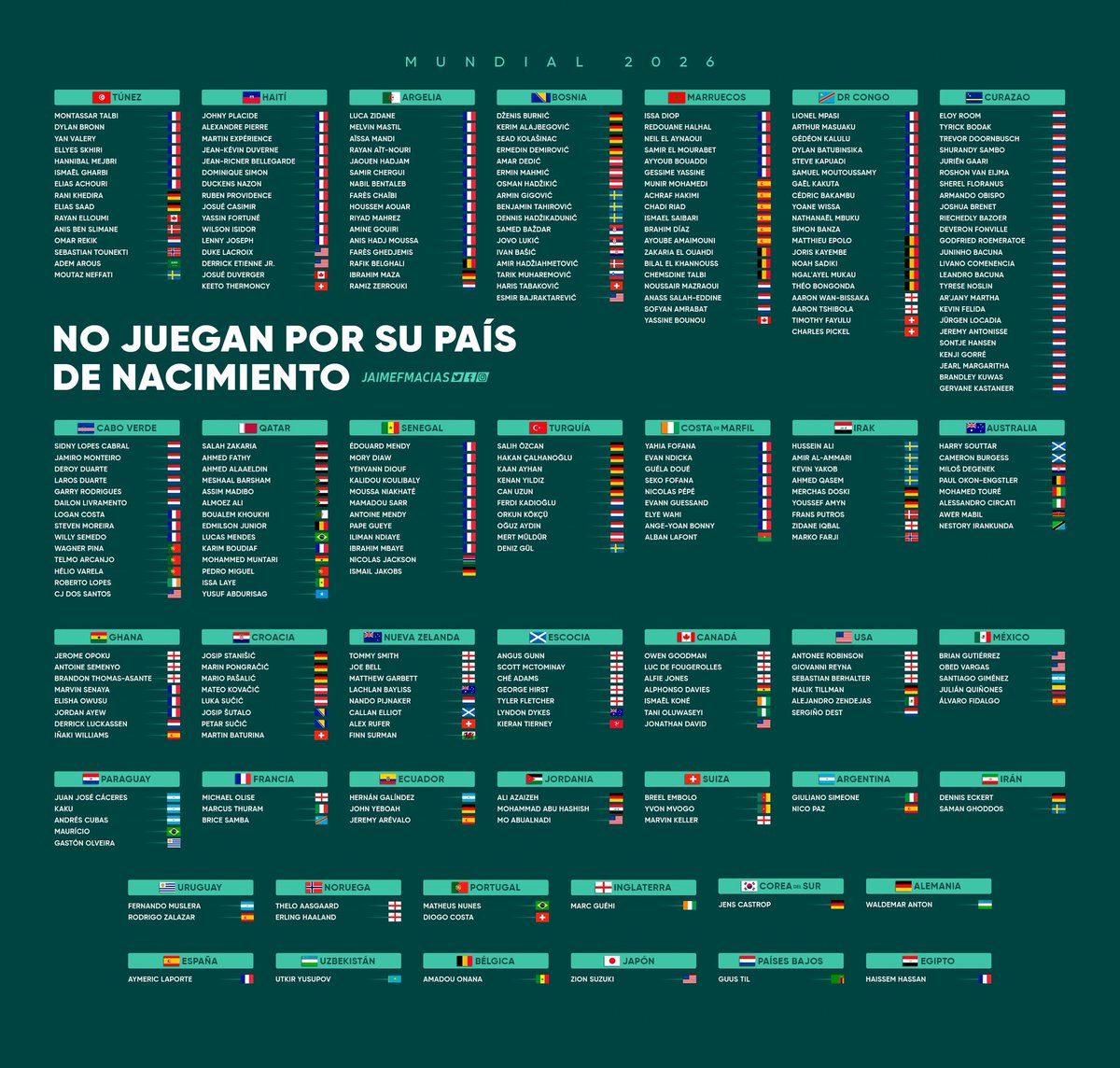
🌍 Did you know that Oceania is the least-represented continent at the World Cup? That a trio of non-independent nations are taking part? Or that a double-landlocked country has qualified for the first time ever?
If you love football and maps, this thread is for you. Here are 8 fun geography facts about the 2026 tournament in North America.
THREAD 🧵
The 2026 World Cup had a major challenge with grass: FIFA retrofit 16 stadiums in Canada, Mexico and US to keep fields consistent for 48 teams and 104 matches.
It asked grass scientists at U of Tennessee and to design solution:
▫️they made a modular hybrid turf (95% grass / 5% synthetic fiber) that is easily rollable, transportable and installable
▫️each field has 20 million synenthic fibers sewn into dirt (grassroots intertwine with fibers to prevent field from tearing)
▫️all 11 stadiums in US host NFL teams…7 of those had to do special conversion of astroturf fields (Atlanta, Boston, Dallas, Houston, LA, NY, Seattle)
▫️5 stadiums have a dome (eg. BC Place in Vancouver) and scientists developed special UV grow light machines to help maintain grass in those structures
▫️grass in Southern US and two Mexico locations (Monterrey, Guadalajara) need grass species for warm and humid temperatures (“Bermuda grass”)
▫️Northern US/Canada and Mexico City need grass for cooler climates (“Kentucky bluegrass”)
▫️scientists built special machines to test player foot impact and ball bouncing effect (reduce injuries and make sure ball movement consistent)
▫️grass sods we’re grown on plastic so they spread horizontally, making it easier to roll and transport
***
Interview with U Tennessee grass science expert Dr. John Sorochan (via PBS): https://t.co/FohkCQK39m
Tom Brady reveals the overlooked reason practice squad players never succeed in the NFL
It’s not a lack of talent.
Brady watched it happen for 20 years. The pattern was undeniable.
As soon as a practice squad player got promoted and had to perform under real pressure, they crumbled. It took years for Brady to understand why.
“There’s 53 guys on the active roster and there’s now 15 guys on the practice squad. So there’s 68 players. But those practice squad players are important because if anybody on the active roster gets hurt, they can get elevated to the squad.”
“These scout team receivers would come in and practice with the scout team and they do really well. And I’d be watching. I’m like, ‘Man, we got to get that guy. Let’s get him up on offense. He’s making a lot of plays.’”
“Then all of a sudden, we’re like, ‘Hey man, you’re doing really well. You got to come over here and deal with the pressure of succeeding now that you have expectation.’”
“And these guys are like, they weren’t prepared for it. So whatever we saw in practice against where there was not a lot of pressure, now when they’re put in a situation where there’s an expectation for performance, they’ve never had to personally deal with that and then they fail.”
“And then what I realized was a lot of guys on those practice squads, they don’t want to be elevated to the roster.”
“They’re very happy living this life where they could tell their family and friends, which I have no problem with that. But the reality is a lot of guys don’t want the pressure of dealing with top.”
Twenty years in the league and seven Super Bowl rings later, Brady learned that talent wasn’t the hardest thing to find.
It was people who actually wanted the pressure that comes with being great.
Claude Mellan's Face of Christ, also known as The Sudarium of Saint Veronica (1649), is one of the most technically extraordinary works in art history...
The entire portrait is rendered using a single, continuous spiralling line that begins at the tip of Christ's nose and expands outward to the edges of the cloth.
Mellan achieved the illusion of depth, shadow, and facial features without any cross-hatching or traditional shading. Instead, he precisely varied the thickness and pressure of the burin (his engraving tool) as he rotated the copper plate, creating "swelling" lines that darken the image where needed.
The spiralling line is estimated to be approximately 150m (about 500ft) long if it were stretched out.
The processional custody of the Cathedral of Toledo, known mainly as the Custody of Arfe, is one of the absolute masterpieces of universal goldsmithing.
Made between 1515 and 1523 by the master silversmith of German origin Enrique de Arfe, it stands out for its imposing late Gothic style structure that reaches three meters in height and exceeds 200 kilos in weight.
Its fame lies both in its incalculable material value and technical complexity and in its leading role every year in the famous Corpus Christi procession of Toledo. It contains about 183 kg of pure silver and 18 kg of sterling gold. It is made up of an intricate puzzle of 5,600 individual pieces joined by 12,500 screws.
The fact that this was done in the 1600s without a photo reference is absolutely insane.
And it’s not just the candlelight. Even the hue stays perfectly consistent across every single face in the scene...
It feels cinematic centuries before cameras even existed.
This masterpiece is called Christ Before the High Priest, painted by Gerrit van Honthorst, and it depicts the moment of Christ’s trial before the Sanhedrin, the Jewish judicial council.
The entire composition is built around a single candle placed at the center of the table.
That tiny flame illuminates the faces of Christ and the man seated opposite him, believed to be the priest Caiaphas, while the rest dissolves into darkness.
The painting also reveals why, during his years in Rome between 1610 and 1620, Honthorst earned the nickname: “Gherardo della Notte”, Gerard of the Night.
If you want a deeper dive into the craft of painting, I recently wrote a piece exploring it in detail. You can read it here:
https://t.co/UgwJLfhD3h
And if you'd like to support my work, a paid subscription is what makes it possible:
https://t.co/hgJUdR0jlx
That water clarity is an engineering decision, and the math behind it is wilder than the video.
Roman aqueducts ran on gravity alone. No pumps, no pressure systems. Engineers carved channels with a gradient so shallow it borders on absurd. The Pont du Gard in southern France drops 2.5 centimeters over 275 meters. That's roughly the thickness of a coin over the length of three football fields. They surveyed that accuracy with plumb lines and wooden leveling instruments.
The clarity you're seeing is a direct product of flow velocity. Too steep and the water erodes the channel walls, picks up sediment, turns brown. Too flat and it stagnates. Roman engineers targeted a slope of about 20 centimeters per kilometer, which kept the water moving fast enough to stay fresh but slow enough to stay clear. Before the water reached the city, it passed through multi-chamber settling tanks where velocity dropped near zero. Suspended particles sank. Clean water flowed out the top into the next chamber. Repeat three or four times.
Pliny specified the minimum slope in writing. Vitruvius published the exact mortar ratio for hydraulic cement: one part lime to two parts volcanic ash for underwater work. The pozzolana from Pozzuoli reacted with water to form a calcium-aluminum-silicate compound that actually gets stronger the longer it sits submerged. Modern concrete degrades in water. Roman concrete bonds with it.
Scale the whole system and it gets harder to process. Eleven aqueducts fed Rome at its peak. Combined output: roughly 1 million cubic meters of water per day. That works out to about 250 gallons per person for a city of one million. Modern New York delivers about 125 gallons per person per day. Ancient Rome had access to double the per capita water supply of the largest city in the United States, running entirely on slope and stone.
The Trevi Fountain in Rome is still fed by one of them. Two thousand years, same source, same gravity, same water.
🚨 The real masterminds and backstage geniuses behind the rose petals falling from the Pantheon’s oculus on Pentecost Sunday?
The Rome firefighters!
Italy at its finest 🇮🇹🔥
Today at noon thousands of red rose petals will flutter down through the oculus of the Pantheon in Rome. This spectacular tradition is held each year on the feast of Pentecost.
The annual Pentecost tradition (today!) at Rome's Pantheon is a moment of extraordinary beauty.
It occurs every year on the seventh Sunday after Easter. At noon, after the Holy Mass, thousands of rose petals are dropped through the oculus of the mighty dome.
As the petals fall, a choir sings "Veni Sancte Spiritus," known as the Golden Sequence, a masterpiece of sacred Latin poetry.
This is to celebrate the descent of the Holy Spirit on the Virgin Mary and the Apostles.
The rose petal ritual likely dates back to 607 AD when the pagan temple became a Christian church.
@mnufcnews Also: Would love to see a stat for how often JP uses his right foot - he always cuts to his left. It’s his strength, but at some point he has to go right so the d isn’t just sitting on his cut back.
@mnufcnews Disagree: scored twice…almost. Long ball plays to team strengths. Ant got caught and RSL capitalized. RSL’s offense looks quicker and more decisive than ours. Would love to see JP drive at somebody when we can’t just go long.
@EverythingMNUFC Romero seems thicker than last year; not as athletic. Maybe that is why he wasn’t playing earlier this season?
Simple execution: it seems too often, we have soft passes (like this one) and usually aren’t punished. NE had the desire/plan and quickness to make it hurt last night.
@johnmeeker54@martinezjo009@Tyler735_MNUFC Agree with most of this; and 100% with the last sentence.
Another (obvious?) option: invert it for a match. Give MG, Bongi, Fitz, DR, etc. the 60-minute run and have the first-line guys be available for the final 30…if needed.
@Tyler735_MNUFC@JCShades3 He needs a loan similar to how Tani went on loan. He seems really athletic and wanting to do well, but seeing the right lane to attack and having the skill/touch to make the right play seem to be lacking for this level.