AI progress creates more work for humans, not less. Dive into our new report from @danshipper — and use the companion repo to read it with your agent 👇
We’ve automated every single thing we can @every with AI agents.
And yet there’s way more human work to do than ever. We’ve gone from 4 -> 30 human employees since GPT-3.
I wrote a report on the structural reasons: how AI makes expert competence cheap, why that drives up demand for experts, and why the dynamic only intensifies as we approach AGI.
After Automation: https://t.co/Lb7SUCduAg
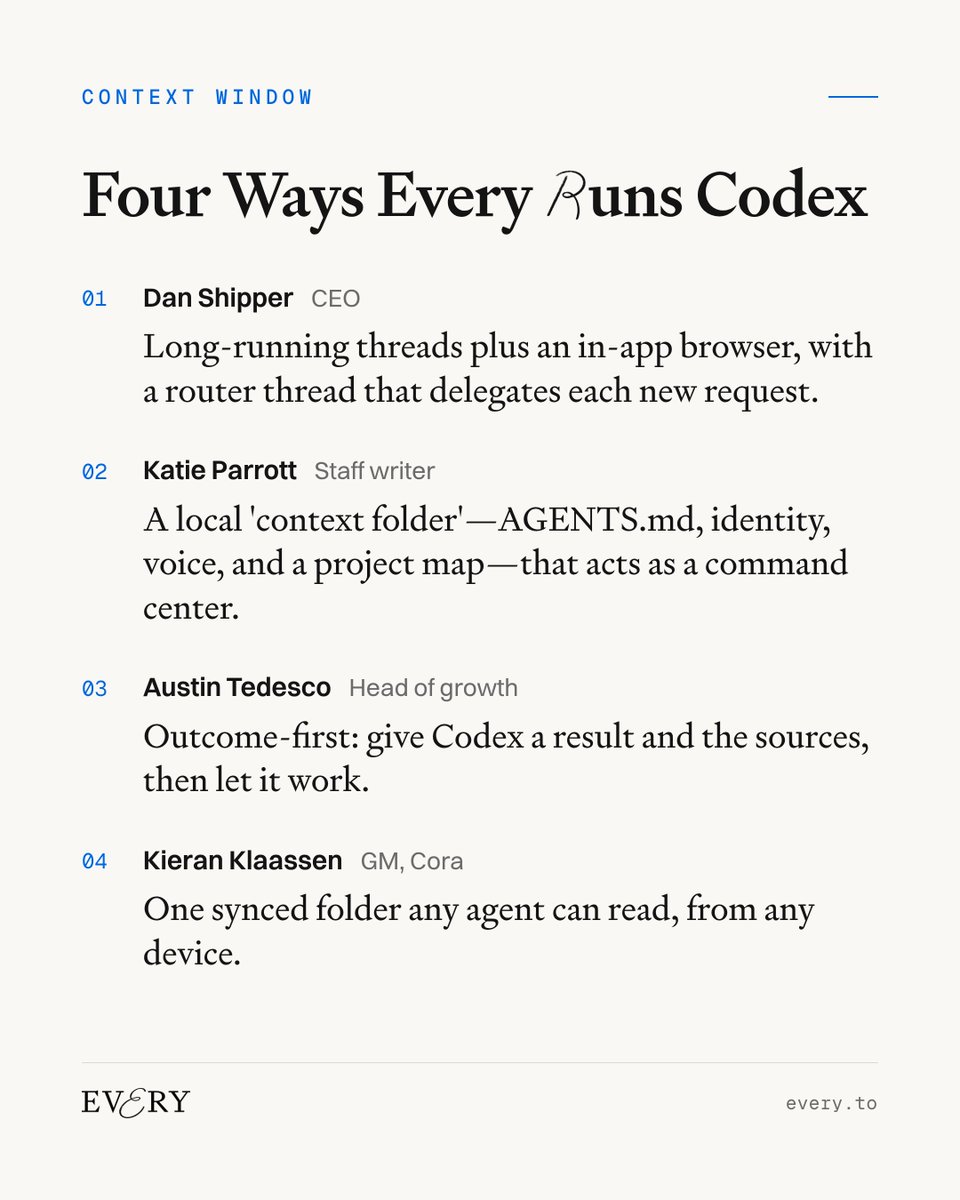
Codex works best when the setup matches how you work. Long-running threads, local context folders, outcome-first prompts — our team’s setups look nothing alike. (@tedescau refuses to search for specific files, for example)
Every AI strategy contains hidden bets.
For example: if your product’s value is adding memory, retrieval, or workflow orchestration around a model, you’re betting the model won’t absorb that capability itself.
Dan Pupius, chief technology officer at The General Partnership, has a framework for naming which bets are reversible, and which ones aren’t:
We're so back.
We'll be live streaming later whenever Fable officially returns, and our team is already loading up a hit list of tasks to turn over to the best coding model ever.
Trying to figure out where to start? Use this discovery prompt to find Fable-worthy work, and send us the results. We'll run some of our favorites during the stream.
---
You are helping me decide which parts of my work are worth escalating to Claude Fable 5. Do not execute any of the work yet. Your job is to inspect my context, find strong candidates, and turn the best ones into ready-to-run Fable briefs.
My role and current goals:
[Describe your role, priorities, team, business goals, creative goals, or personal operating constraints.]
Use this context:
[List the sources you can inspect: repositories, project folders, docs, Notion, Slack, Linear/Jira, email, calendar, analytics, customer research, previous agent sessions, task lists, or anything else relevant.]
Constraints:
[List deadlines, privacy boundaries, accounts or tools you may not use, budget, sensitive areas, approval rules, and work that must remain human.]
First, inspect the available context. Do not brainstorm generic examples.
Build an inventory of:
1. Active projects.
2. Repeated workflows.
3. Stalled decisions.
4. Messy backlogs.
5. Work that spans several tools or sources.
6. Work where better planning, judgment, verification, or follow-through would materially improve the result.
Then identify the best candidates for Fable.
Score each candidate from 1 to 5 on:
1. Multi-source context.
2. Delegation fit.
3. Judgment required.
4. Clear finish line.
5. Leverage.
6. Fable fit.
Recommend Fable only when the task is large enough to justify a slower, more expensive run. Down-rank work that is short, obvious, highly interactive, hard to verify, or better handled by a faster Claude model or a human.
Return:
1. The top 10 Fable-worthy use cases, ranked.
2. The evidence you found for each one.
3. Why each one is or is not worth Fable specifically.
4. The expected deliverable.
5. The verification method.
6. The likely context, tools, and permissions needed.
7. Risks, blockers, or human decisions required.
8. A ready-to-run Fable Brief for the top three candidates.
For each ready-to-run Fable Brief, include:
- The problem to solve.
- The final outcome.
- Sources to inspect.
- Constraints.
- Suggested workflow.
- Human checkpoints.
- Evidence required before completion.
Stop after the ranked list and the three briefs. Do not start any Fable task until I choose one.
yo — it's the Every growth team. Dan's in Cabo, so we're taking over for some live reactions to Sonnet 5.
before our official vibe check drops, we asked the new model to search our systems and guess what Dan's up to on vacation right now 👇
1. checking Slack from the beach 10 minutes after telling ops he's "on PTO"
2. running his own one-man vibe check before ours is even live
3. locking in so deep with Codex vibe coding he doesn't even know Sonnet 5 dropped
4. texting Dario unsolicited hot takes
5. giving out free copies of Annie Dillard to everyone at his hotel
follow along for more updates from the big dog's account while our team runs their benchmarks
Introducing Claude Sonnet 5, our most agentic Sonnet yet.
It makes plans, uses tools like browsers and terminals, and runs autonomously at a level that just a few months ago required larger and more expensive models.
The Every consulting team was building 2-3 client decks a week by hand. Slide prep had consumed roughly 80% of their work.
So head of tech consulting @hammer_mt tried to automate it.