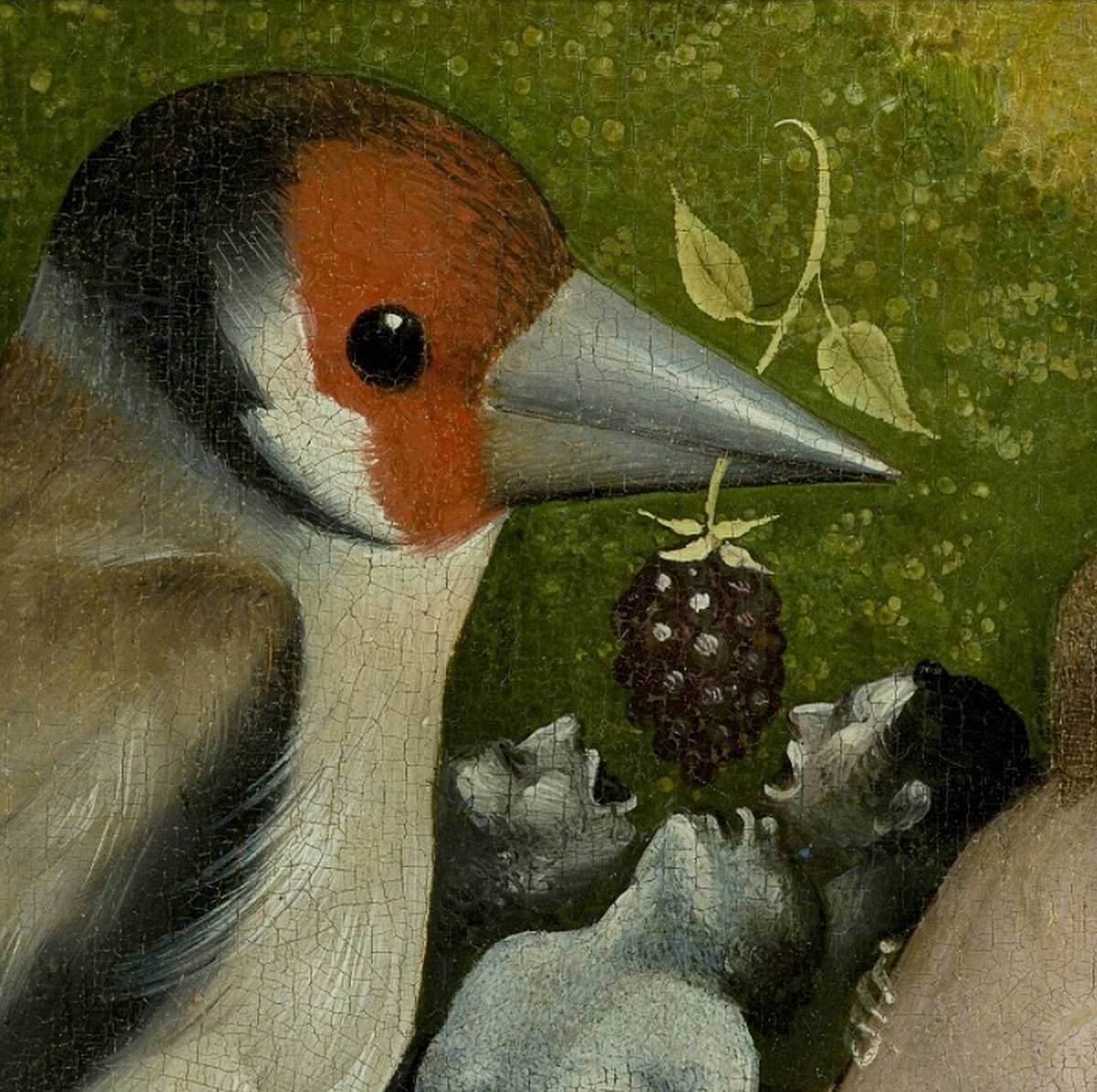
Detail of the giant goldfinch from the central panel of Hieronymus Bosch's 'The Garden of Earthly Delights' (c. 1490-1500, oil on oak panel), Museo del Prado, Madrid.
For Bosch, scale is a tool for meaning.
The giant fruit shows the magnitude of desire; the shrunken human shows how small humanity becomes in the face of it. The fruit in the beak is ripe, and on the verge of being eaten. In other words, it's fleeting. Bosch's philosophy lies hidden in this difference in scale.
The bird's species is significant: the European goldfinch (Carduelis carduelis). In late medieval and Renaissance imagery, the goldfinch had multiple layers of meaning. Because Pliny's 'Natural History' describes small birds like the goldfinch or the linnet as highly prolific species, this motif became linked to reproduction and physical multiplication. Bosch's decision to place a giant goldfinch next to nude figures can be read in this light.
The second layer, however, is much darker. In Christian symbolism, because the goldfinch eats thorny thistle seeds, it was linked to the Crown of Thorns Christ wore on the cross. The red on the bird's face came from the legend that it was stained by Christ's blood while trying to pull the thorns from his crown.
That's Bosch's move. He places the exact same bird - a symbol of both fertility and the Passion - right in the middle of the nude figures. The promise of pleasure and the potential downfall it brings share the exact same scene.
Silver Bracelets of Queen Hetepheres I
Some of the earliest silver objects unearthed in Egypt are this rare pair of silver bracelets, belong to Queen Hetepheres I, inlaid with semi-precious stones in the form of a butterfly (silver, turquoise, lapis lazuli, and carnelian).
An amazing optical phenomenon—a subsun—was captured in Austria ❄️
It occurs when sunlight reflects off tiny, flat ice crystals suspended in the air. The rays refract, creating arcs and circles that form bright, luminous spots.
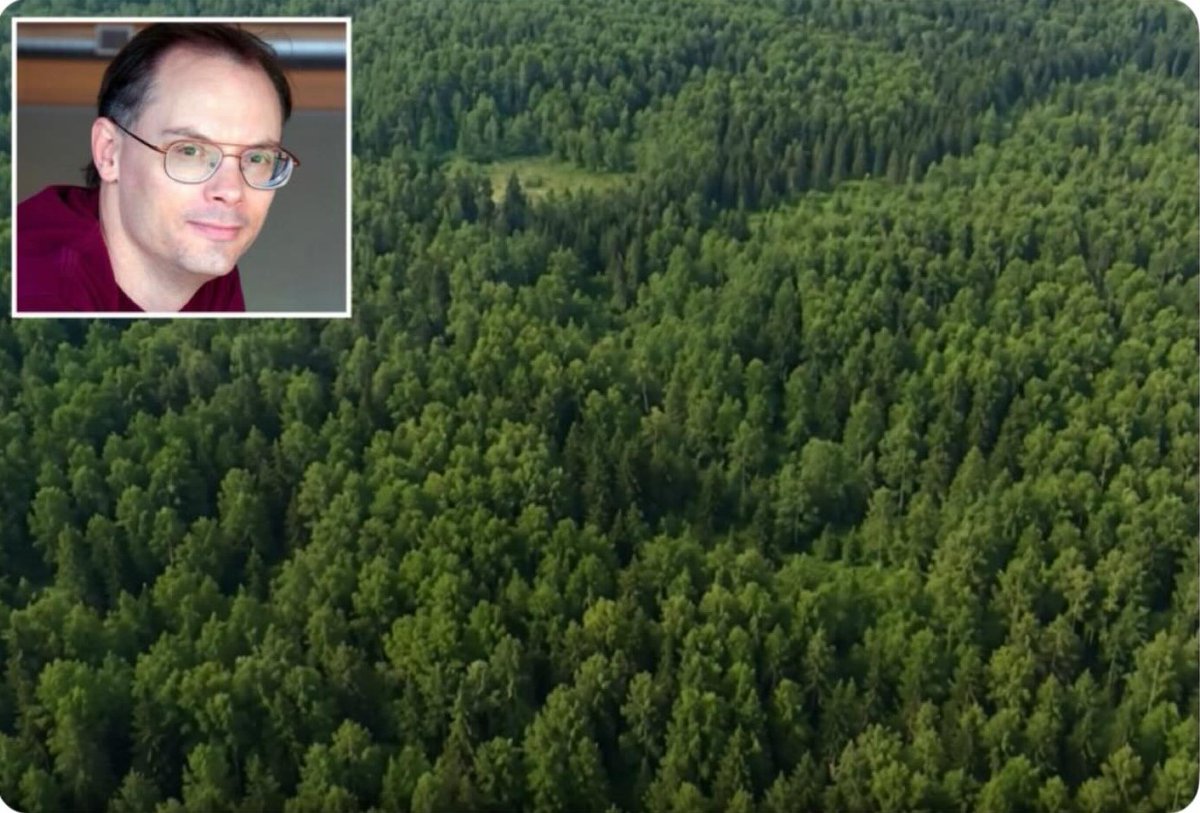
The guy who created Fortnite (Tim Sweeney) has been quietly buying up U.S. forests to save them from developers.
He has spent over $200M to buy 50,000+ acres of wilderness in North Carolina, using permanent legal protections to block any future logging or building.
David Bowie once casually revealed that a noise weapon capable of destroying an entire city was sitting in a French patent office, available to anyone for the price of a few dollars.
In this rarely discussed interview, Bowie is asked about "black noise," a concept he had encountered through the work of writer William S. Burroughs.
He explains the foundational principle:
"Everything like a glass, if you hit a particular note, the vibrations are that of the metabolism of the glass and it cracks it."
Black noise operates on the same logic, scaled upward. Find the resonant frequency of a structure, a crowd, a city, and you could theoretically shatter it.
The interviewer presses him:
Is this a real thing? Could a tyrant actually use it?
Bowie's answer is calm, almost offhand:
"Until last year, you could buy the patent for it in the French patent office for about the equivalent of three, four dollars."
He continues:
"A small one could probably kill about half the people here, but a big one could destroy a city or even more."
The interviewer, clearly unsettled, cuts him off before he can go further: "Let's not give the instructions on how to do it."
Bowie shrugs it off. "It's not my idea."
—
Source: David Bowie — interview on The Dick Cavett Show
A scene from F.W. Murnau’s masterpiece Faust (1926), where the demon Mephisto takes Faust on a flying tour of the world.
To fake this in the 1920s, the crew built a hidden iron platform in the studio to hold the actors, using massive fans to blow their capes and billowing glass wool to create the surrounding clouds. They then used double exposure to layer the actors over a moving, miniature model city, making it look like they were actually soaring over the mountains and rooftops.