Alcatraz was built to be escape-proof.
• Sharks in the water
• Guards on every tower
• Freezing currents no man could survive
For years, no one made it out until June 11, 1962.
The true story of the greatest prison break in history:
Kevin O'Leary learned his entire investment philosophy from his mother.
His mother, Georgette, was fiercely independent. She started early, working for her father. She got paid in cash, and every week she took 20% of it and put it into two things: large-cap stocks that paid dividends, and seven-year telco bonds paying about 6.5% to 8% back then.
Her rules were simple:
No more than 5% in any one stock or bond.
No more than 20% in any one sector, ever.
When a stock ran past 5%, she'd sell it down. Just basic diversification.
She held that portfolio for 55 years. She never spent the principal, only the dividends and the interest. With that she put Kevin and his brother through college and took care of her sisters when they fell on hard times.
When she passed and Kevin saw the portfolio as executor, he was shocked.
"The performance was extraordinary. It was beyond any hedge fund guy or anything, 55 years."
Kevin explains what happened next:
"When I saw the results, I said, that's it. That's how I'm going to invest for the rest of my life. Exactly the way Georgia did. No more than 5% in any one stock ever, no matter what it is. And no more than 20% in any one sector."
This is the strategy Kevin has followed for decades. It's how he maintains and grows wealth.
Fun fact:
When a buyer asks ChatGPT about your brand BY NAME, your website gets cited 77.6% of the time.
When a buyer asks "who is the best in this category," your site gets cited 2.2% of the time.
Here is how to close that 14x gap.
Oh, and if you want to see where your site stands across Google, ChatGPT, Claude and broader AI search, start here (it's free):
https://t.co/Evw8cXXicl
According to Foundation Marketing and AirOps's April 2026 study of 57.2 million AI citations across 50 brands in 7 B2B verticals, branded queries generate 14x more citations for brand-owned websites than unbranded discovery queries.
The brands that do appear in unbranded AI recommendations share a fairly consistent profile: deep expert content on their own site that establishes category authority, combined with editorial coverage from trusted industry publications that puts their brand name in front of the AI's retrieval system across multiple authoritative sources.
Basically, when a buyer asks AI about your brand by name, the AI searches specifically for your website and your content, so of course it finds you.
But then when a buyer asks "best CRM for mid-market companies" or "top cybersecurity platforms for healthcare," the AI is looking for the most authoritative, comprehensive answer it can assemble from every source in the category.
Every industry has a different set of sources that AI draws from for these unbranded queries.
The brands that close the 14x gap are the ones that show up across both their own site and the editorial sources AI trusts in their vertical.
That takes two things working together - both of which SEO Stuff (https://t.co/wKpf0EILTx) has been helping customers with all year.
Expert content on your own website that demonstrates deep category authority: this is what gives AI platforms a reason to include your brand when it finds you.
And editorial backlinks + mentions (authority) from trusted publications in your vertical: this is what puts your brand name across multiple authoritative sources so the AI encounters your brand repeatedly when searching for the best answer to a category query.
Again, if you want to see how your brand performs on branded versus unbranded AI queries and where the 14x gap is in your category, start here (it's free):
https://t.co/z7CwQrWps7
The expert content is doing two things simultaneously.
First, it creates a comprehensive resource that AI can cite directly when it finds the brand during category searches: the more sub-questions your content answers, the more entry points AI has to discover and recommend your brand.
Second, it creates something that editorial publications want to cover and link to: original data, expert frameworks, and comprehensive buyer guides are what industry publications write about.
Every editorial placement where a trusted publication mentions your brand and links to your site creates another source the AI can encounter during unbranded category queries.
A brand that has been covered by 10 or 15 editorial publications in its vertical gives the AI multiple authoritative references to draw from.
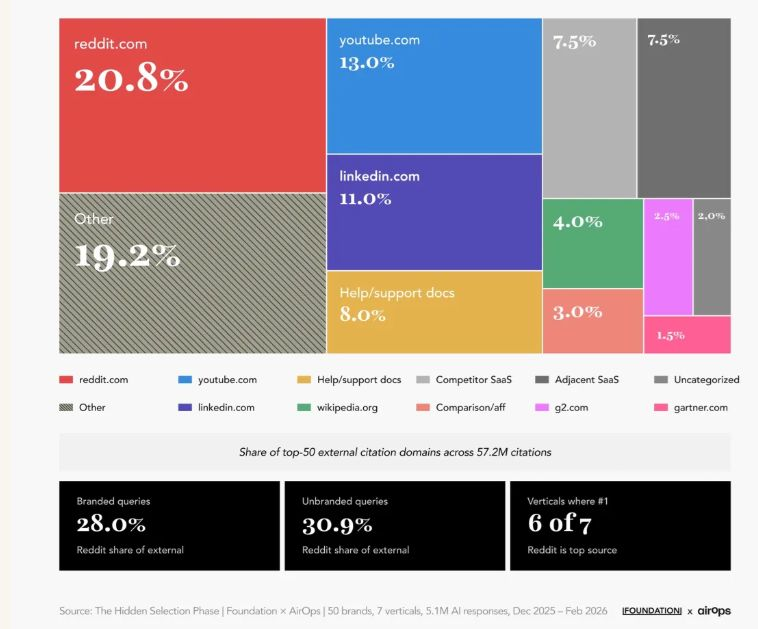
Reddit alone accounts for 20.8% of all external AI citations, but editorial publications, review sites, and industry sources collectively represent a massive portion of the citation landscape that brands can actively build presence on through expert content and earned editorial coverage.
This is the system SEO Stuff (https://t.co/wKpf0EILTx) was built around.
The done-for-you package:
https://t.co/MMsDTFf4rg
Expert-attributed content backed by DR50+ backlinks: the content builds category authority on your site that AI cites directly, and the backlinks put your brand across the editorial sources AI draws from during unbranded discovery, closing the 14x gap
The content package:
https://t.co/5osvnSaiGB
60 pages of expert-attributed content covering every question buyers ask in your category: the content depth that gives AI a reason to cite your brand and gives editorial publications something worth covering
The authority building package:
https://t.co/BMl9QCGGn3
Editorial placements on trusted publications that put your brand name across the authoritative sources AI searches during unbranded category queries, turning your brand into a recommendation for buyers who have never heard of you
And if you want to see where your site stands across Google, ChatGPT, Claude and broader AI search, start here (it's free):
https://t.co/Ta79ATW3Yf
You’d think remote companies saved a fortune by closing their offices.
They did.
Then they started flying their entire teams to Crete.
Here are the 5 places I’d take a team in 2027 (and what most founders get wrong about retreats):
For years I carried stubborn fat on my belly, hips and face, even when I thought I was eating clean.
Here’s how I finally lost it at 36 with these 9 science-backed moves:
1. I stopped eating breakfast and moved my workouts to the evening
I believe typing will become obsolete.
Not just at home. Even in offices full of people.
Today, we're officially partnering with Anker to bring soundcore Work to Typeless.
It's a tiny wearable microphone that lets you speak naturally, even in a whisper, and turn your thoughts into clear writing with Typeless.
Messages. Emails. AI interactions. Long documents.
The future of work is spoken, not typed.
This partnership is one step toward making that future real.
@typelessdotcom + @soundcoreaudio
I earned $6,435 from my AI side hustle in just one week.
99% of people won’t share their secrets but my AI Money guide will show you how.
Comment 'Guide' and I'll DM you my full guide 100% FREE.
Must follow me to get this guide in your DMs.
FREE for next 48 hours.
I added up how much money my skills made my last employer. Then I looked at what they paid me. I have never been the same since:
It was not even close.
I was running projects, solving problems, and bringing in results that were worth multiples of my salary.
And my reward was a 3% raise and a “good job” in a hallway conversation that lasted about eight seconds.
I did not get angry that day. I got curious.
If my skills were generating that much value for someone else’s business, what would happen if I used even one of those skills for myself?
So I started paying attention to what I actually did all day.
Not my job title. The real work. The problems I solved. The things people leaned on me for.
The stuff that came so naturally I never thought of it as special.
Turns out it was special. Just not to my employer.
I took one of those skills and built a simple product around it. A template.
Charged a small amount. Somebody bought it. Then another person. Then it kept going.
Not because I was some genius. Because I finally stopped giving all my best work to one place for one paycheck.
I started sharing what I was building on social media and that is when I realized how many other people were sitting on the same thing.
That path is what led me to build creatyl so I could help others do the same thing with what they already know.
This infographic is the map. The top half is every trap I stayed stuck in. The bottom half is what got me out.
Save it. You don't have to quit your job or build some massive business.
Just pick ONE skill. Find ONE problem you can solve. Create something useful and see if people will buy it.
I put together a free toolkit to help you figure out what you could sell and take those first steps.
👉 Grab it free here: https://t.co/eF9iPETUHU
Your skills are already making someone money.
The only question is whether that someone will ever be you.
Please repost to help others out there! ♻️
A smart AI agent can still fail without good structure.
Clean architecture makes AI systems easier to build and scale.
Sharing this AI Agent Project Structure by Rathnakumar Udayakumar.
A reliable agent needs more than strong reasoning capabilities.
Its codebase should keep responsibilities organized from the beginning.
README.md
Documents the project goals, installation steps, architecture, usage, and examples.
requirements.txt
Lists the Python packages and dependencies needed by the application.
.env & .gitignore
Protects configuration values while keeping secrets and unnecessary files out.
agent/
Handles planning, state, memory, reasoning loops, and task execution.
tools/
Contains functions for searches, calculations, APIs, databases, and external operations.
models/
Organizes model providers, LLM clients, embeddings, and configuration settings.
prompts/
Keeps system instructions and reusable prompt templates separate from core logic.
utils/
Stores shared helpers, parsers, configuration utilities, and logging functions.
api/
Provides endpoints and schemas for connecting the agent to other applications.
tests/
Checks agent responses, integrations, tools, APIs, and potential failure cases.
data/ & logs/
Holds datasets, reference material, examples, traces, and records for debugging.
https://t.co/ej9aU18oc0
Provides the starting point for launching the agent through different interfaces.
Good architecture does not increase the intelligence of the model.
It creates a system that is easier to manage and improve.
A well-organized codebase makes testing, monitoring, and scaling much simpler.
P.S. Is your AI architecture structured well enough?
♻️ Repost to help people create solid AI systems that scale cleanly.
——
📌 Get my top 100 infographics for free:
1) Follow me.
2) Subscribe to my free newsletter at https://t.co/jTnaNRbsRL.
You’ll receive them directly in your welcome email.
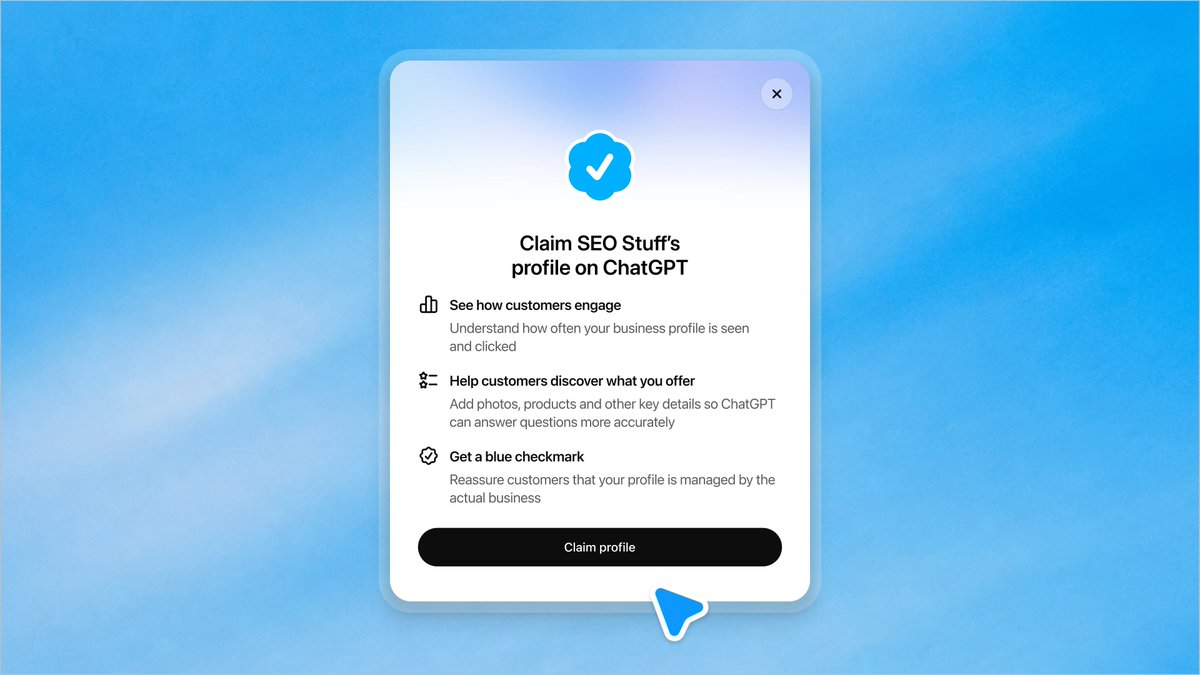
Here is a step-by-step guide on how to claim your ChatGPT business profile, update your information and access your analytics DIRECTLY inside ChatGPT.
No agency required. No advertising account required. No crazy subscription required. Simple stuff.
Let's go through it.
By the way, if you want to see where your business stands across ChatGPT, Perplexity, Gemini and Google search, SEO Stuff offers a free SEO + AI Search audit:
https://t.co/Ta79ATW3Yf
Alright, so OpenAI announced the new feature on November 10.
It's called Business Hub, and you can access it here:
https://t.co/3hgGKcOOrM
If you're confused on how to do it, just go to SEO Stuff (https://t.co/wKpf0EILTx) and chat with a rep - they will walk you through it.
Think of this as a new place where businesses can manage their information inside ChatGPT.
Once verified, eligible businesses can update their profiles, connect product feeds and access reporting showing how people are engaging with them.
That includes:
How often ChatGPT references their business or website
How many clicks ChatGPT sends to their website
The topics where their business is appearing in ChatGPT answers
And importantly, you can set this up YOURSELF.
Here's how.
STEP 1: CLAIM YOUR BUSINESS
Open:
https://t.co/3hgGKcOOrM
Sign in with your ChatGPT account.
Search for your business by name and select the matching listing.
If you run an eligible online business and don't see your company, you may have the option to add it.
SEO Stuff (https://t.co/z7CwQrWps7) can help here.
Local stores and restaurants are currently limited to claiming existing U.S. listings.
Availability also depends on your business type, location and the verification methods supported.
Once you've selected your business, ChatGPT will ask you to verify that you're authorized to manage it.
There are several possible methods:
Business email verification.
Business phone verification.
Website domain verification.
Shopify verification, if applicable.
For example, if you choose domain verification, OpenAI will give you a DNS TXT record to add to your domain's DNS settings.
Once you've added it, return to ChatGPT and select "Verify domain."
OpenAI will then review your claim and email you with its decision or a request for more information.
STEP 2: COMPLETE IDENTITY VERIFICATION
This part is important because simply getting your business claim approved doesn't unlock everything.
OpenAI requires another verification step through a service called Persona.
You'll find an option to complete verification inside your business profile.
Follow the instructions and provide any requested identification or business documents.
Once approved, your business can receive a blue verification checkmark.
More importantly, you'll unlock the ability to update your profile, connect product information and access the new Insights dashboard.
STEP 3: COMPLETE YOUR BUSINESS PROFILE
Now you can update the information ChatGPT has about your company.
That includes your website, business description, product or service category, logo and other relevant details.
If you sell products, you may also be able to connect a product feed containing current prices and availability.
Shopify merchants can connect their stores directly, while other eligible retailers can provide supported product feeds.
My recommendation here is to make your business description as specific as possible.
For example, rather than saying:
"We provide innovative software solutions for modern businesses."
Explain exactly what you do:
"We provide accounting and payroll software for construction companies managing employees across multiple states."
The second description gives considerably more useful information about your business, its category and its customers.
Keep in mind, OpenAI reviews profile updates, and ChatGPT can still use other sources when answering questions.
Updating your profile doesn't instantly change every answer.
STEP 4: ACCESS YOUR CHATGPT ANALYTICS
Now for what I think is the most interesting part of this entire announcement.
Once your business claim and identity verification are approved, open your profile and select "Insights."
OpenAI is now providing aggregated activity over the previous 28 days.
There are THREE things worth paying attention to.
First, MENTIONS.
This measures how often ChatGPT references your business under OpenAI's reporting rules.
For online businesses, a mention is counted when ChatGPT references your website.
Interestingly, simply naming your brand without referencing its website DOES NOT count toward this metric.
For local businesses, a mention can count when ChatGPT displays the location as a result, even without a website click.
That distinction is important because these aren't necessarily all the times ChatGPT has mentioned your company.
Second, WEBSITE CLICKS.
You can now see how often people click through from ChatGPT to your website.
Think about how useful this is.
Your website might already receive visitors from ChatGPT, but now you have first-party OpenAI reporting to help understand that activity.
You can start monitoring whether ChatGPT is sending more or fewer clicks to your site over time.
Just remember that website clicks aren't necessarily the same as analytics sessions, leads or completed purchases.
Third, DISCOVERY TOPICS.
This might actually be my favorite feature.
OpenAI now shows common themes in ChatGPT answers where your business was mentioned or cited.
Imagine you operate an accounting software company.
Your discovery topics might include:
Small business bookkeeping.
Payroll software.
Contractor accounting.
Tax preparation.
Those topics can help you understand which subjects are already associated with your business in ChatGPT answers.
And potentially, where your content strategy should focus next.
There is one important limitation.
OpenAI isn't handing over individual customer conversations or the exact questions people entered.
The information is aggregated, and reporting requires certain activity thresholds to protect user privacy.
So if your dashboard shows limited information, that doesn't automatically mean nobody is mentioning your company.
STEP 5: CHECK WHETHER CHATGPT IS ACTUALLY RECOMMENDING YOU
Now, this is where things get interesting from an SEO perspective.
Because there is a BIG difference between ChatGPT citing your website and ChatGPT recommending your business when someone is ready to buy.
For example:
"What is the best accounting software for a 20-person construction company?"
"Which payroll provider is best for small businesses with remote employees?"
"What are the best alternatives to QuickBooks for contractors?"
These are questions where being recommended could translate into an actual customer.
Your new Business Hub dashboard can help you understand certain types of visibility and engagement.
But it doesn't give you a complete list of every commercial question where ChatGPT recommends your competitors instead of you.
So I would combine the new dashboard with testing the actual questions your potential customers ask.
Which businesses are being recommended?
Is yours one of them?
If not, which competitors keep appearing?
What information and third-party sources are showing up in those answers?
That is exactly the type of visibility SEO Stuff's done-for-you package is designed to help businesses improve:
https://t.co/MMsDTFf4rg
And this brings us to the most important distinction in OpenAI's announcement.
CLAIMING YOUR BUSINESS DOES NOT AUTOMATICALLY INCREASE YOUR CHATGPT VISIBILITY.
OpenAI explicitly says that claiming a business profile doesn't guarantee increased visibility or give you control over its independent recommendations.
In other words, registering your business isn't some shortcut to becoming ChatGPT's preferred recommendation.
It gives you a way to manage information and measure activity.
Actually increasing your chances of being discovered, mentioned and cited is a different challenge.
And that's where traditional SEO and AI Search Optimization start to overlap.
Your website needs useful content explaining what your business does, the problems it solves, who it serves, and how its products or services compare with alternatives.
Think:
Product and service pages.
Buying guides.
Comparison pages.
Industry-specific use cases.
Pricing and cost explanations.
Alternatives.
Commercial questions customers ask before purchasing.
The more useful information AI systems can find about your business, the more opportunities they may have to consider it for relevant questions.
That's what the SEO Stuff Premium Content Bundle is designed to build:
https://t.co/5osvnSaiGB
Then there is authority.
ChatGPT doesn't exclusively rely on what your own website says about your company.
It can also encounter independent publications, industry websites, comparison pages, reviews and third-party discussions.
If you're trying to become one of the businesses AI systems recognize within a particular category, having accurate, relevant information about your company beyond your own website matters.
That's why SEO Stuff's done-for-you package combines AI-search-focused content with contextual DR50+ authority placements.
It also includes a dashboard testing 20 buyer-focused questions across ChatGPT, Claude, Gemini and Perplexity, so you can see where you're being recommended and which competitors appear instead.
https://t.co/MMsDTFf4rg
One other feature worth mentioning.
OpenAI also introduced Business Agents.
Eligible ecommerce and online service businesses in the United States can create a separate ChatGPT agent that answers questions about their products and services.
So somebody researching your company could potentially chat with your Business Agent to learn about your offerings.
However, those agents are separate from ChatGPT's independent recommendations.
And you don't need to create one to access Business Hub's analytics.
The broader direction here is pretty clear.
OpenAI is giving businesses more ways to manage their information, understand their visibility and interact with potential customers directly inside ChatGPT.
And I would strongly recommend that eligible businesses claim their profiles.
It's a useful new source of information that can help you understand how ChatGPT is interacting with your business.
But remember:
Business Hub helps you MEASURE your ChatGPT visibility.
It doesn't automatically INCREASE that visibility.
For that, you still need the content, authority, discoverability and broader brand presence that give AI systems reasons to surface your business.
And if you want to see where your business currently stands across ChatGPT, Perplexity, Gemini and Google search, SEO Stuff can help you get started with a free audit:
https://t.co/Evw8cXXicl
This $9 PDF makes more than a $300,000 rental property.
Anyone can create one with just:
• Claude
• An internet connection
• 60 minutes of free time every day
Copy the most profitable AI business system of 2026:
Microsoft dropped an official “Here Is How To Get Traffic From ChatGPT” guide.
Interestingly, it got surprisingly little attention.
Let’s go over it together.
Not long ago Microsoft released "A guide to AEO and GEO - Practical data strategies to empower retailers for AI search, AI assistants and AI browsers.”
Everything here is drawn directly from the document and its diagrams, with some of my personal takes layered on top for clarity and execution value.
I’ll also reference the pages in the PDF in case you want to go read it yourself.
And if you want to see what ChatGPT, Claude, Google AI, Perplexity, Grok and broader AI search are currently saying about your business, start here. It’s free:
https://t.co/Evw8cXXicl
Microsoft’s central message in the doc is that retail competition is shifting from “being found” to “being chosen.”
They argue that traditional SEO was optimized for: Ranking, Clicks and Page Visits.
Whereas AI-driven shopping replaces that with: Answers, Recommendations and Agent-Led Decisions.
They’re arguing that visibility is now earned by how clearly AI systems understand your products, trust your brand and can act on your data.
This is where “AEO” and “GEO” come in.
(I hate both of these acronyms and prefer to just call it all AI search optimization, but this is their doc so I’ll go with their language.)
This is also why we’ve seen brands struggle even with strong traditional SEO, but immediately improve AI visibility once they pair technical SEO with structured, intent-driven content and authoritative signals like those included in SEO Stuff’s done-for-you package.
https://t.co/MMsDTFf4rg
Microsoft also broke down the difference, to them, between AEO and GEO.
Microsoft makes it a very clean distinction:
Answer / Agentic Engine Optimization (AEO) in their estimation optimizes content and data so AI assistants and agents (Copilot, ChatGPT, Gemini) can:
Find it
Understand it
Summarize it
Recommend it
Act on it
This is about clarity and machine-readability.
Generative Engine Optimization (GEO) optimizes content so generative AI search systems trust it as:
Authoritative
Credible
Citable
This is about credibility, reputation, and justification.
Microsoft is explicit that SEO still matters, but it is now the foundation and not the endpoint.
In practice, this is why execution now requires both properly structured pages and volume at scale, something SEO Stuff intentionally designed the Premium Content Bundle to solve.
https://t.co/5osvnSaiGB
Microsoft then delved into the AI shopping ecosystem and how discovery actually works now.
One of the most interesting sections is Microsoft’s breakdown of AI browsers, assistants, and agents (pages 5–7).
These are not separate systems and they overlap constantly.
AI BROWSERS
Edge, Chrome, or similar with embedded AI
They can “see” the live page you are on and interpret it in real time.
AI ASSISTANTS
Copilot, ChatGPT, Gemini
They answer questions, summarize options, and recommend products.
AI AGENTS
They:
Navigate websites
Add items to carts
Apply promo codes
Calculate shipping
Complete purchases
The key insight:
The question is not “which AI surface am I optimizing for?”
The question is what data can AI access, trust, and use?
This is exactly where most sites break.
The data exists, but it isn’t structured, consistent, or surfaced in a way AI can reliably act on.
Microsoft then went into how AI actually decides what to recommend.
Microsoft outlines a multi-stage reasoning process used by Copilot and Bing AI (pages 7–8).
AI does not rely on one data source, but rather fuses:
CRAWLED WEB DATA
Brand reputation
Category authority
Expert mentions
Historical understanding
PRODUCT FEEDS AND APIS
Price
Availability
Variants
Inventory
Key specs
This is where competitive advantage often comes from, and where most brands are under-optimized.
LIVE WEBSITE DATA
Real-time pricing
Promotions
Reviews
Media
Checkout functionality
If your live site fails, the agent fails, even if feeds were perfect.
An example Microsoft gives is “rain jacket under $200.”
AI reasoning includes:
“Patagonia and North Face make quality jackets” (general knowledge)
“Hiking jackets need to be lightweight and waterproof” (category understanding)
“Brand X is known for hiking equipment” (brand positioning)
“Your model is $179 and in stock” (feeds)
“Competitor is $199 and backordered” (feeds)
Your product makes the top recommendations because feeds, availability, price, and context align.
This is why content that simply “ranks” but doesn’t explain, compare, or justify rarely shows up in AI answers without additional supporting assets.
Microsoft then really breaks down the journey from SEO to AEO to GEO - something SEO Stuff (https://t.co/wKpf0EILTx) has been helping brands with all year.
They summarize the transition pretty clearly (page 6):
SEO = matching keywords
“Waterproof rain jacket”
AEO = descriptive clarity
“Lightweight, packable waterproof rain jacket with ventilation and reflective piping”
GEO = justification and trust
“Best-rated by Outdoor Magazine, 4.8 stars, 180-day returns, 3-year warranty”
So basically, AEO drives understanding and GEO drives confidence, and you need both to be recommended.
This is why brands pairing long-form, intent-driven content with authoritative backlinks and mentions often outperform those relying on SEO alone.
Then Microsoft talks about three data layers you must control.
They stress that retailers must show up in three distinct data planes (page 10):
CRAWLED DATA
What AI learned during training
What it finds via real-time web search
This shapes baseline brand perception.
SEO still matters here.
PRODUCT FEEDS AND APIS
Structured data you actively provide
This is where precision and control live.
Feeds drive:
Comparisons
Rankings
Recommendations
This is where many retailers under-invest.
LIVE WEBSITE DATA
What AI agents see when they actually visit
Includes:
Reviews
Media
Dynamic pricing
Checkout capability
If agents cannot transact, influence stops at recommendation.
Here are the three action pillars Microsoft prescribes.
This is the most legit part of the document (pages 11–14).
Pillar 1: Technical foundations and structured data
AI requires structure and consistency, not creativity.
Microsoft explicitly calls for:
MACHINE-READABLE CATALOGS
DYNAMIC FIELDS:
Price
Availability
Size
Color
SKU
GTIN
dateModified
ITEMLIST MARKUP FOR CATEGORIES
LOCALIZED PRICING AND LANGUAGE VIA:
inLanguage
priceCurrency
REQUIRED SCHEMA TYPES:
Product
Offer
AggregateRating
Review
Brand
ItemList
FAQ
They also highlight this:
“Never serve different HTML to bots than to users.”
Pillar 2: Intent-driven content enrichment
AI interprets intent over keywords.
MICROSOFT RECOMMENDS:
Front-loading descriptions with:
Who it is for
What problem it solves
Why it is better
Use-case framing:
“Best for day hikes above 40 degrees”
Headings that mirror real questions
Modular, citable content blocks
THEY EXPLICITLY ENCOURAGE:
Q&A sections
Comparison content
Feature lists
“Goes well with” product relationships
Video transcripts
Detailed image alt text with ImageObject schema
This is content designed for extraction as opposed to reading.
This is also why scale matters.
One or two pages won’t move the needle.
Systems that produce dozens of structured, intent-mapped articles tend to win, which is exactly what the Premium Content Bundle is built around.
https://t.co/5osvnSaiGB
Pillar 3: Trust and credibility signals (GEO)
AI systems prioritize verifiable truth.
Microsoft highlights:
VERIFIED SOCIAL PROOF
Verified reviews
Review volume
Sentiment extraction (“highly rated for comfort and fit”)
Review and AggregateRating schema
AUTHORITATIVE BRAND IDENTITY
Expert reviews
Press mentions
Certifications
Sustainability badges
Official brand links
CONTENT INTEGRITY
Avoid exaggerated claims
Maintain consistent brand voice
Provide structured FAQs and help content
This also stood out:
“AI penalizes low-trust language.”
Interesting, but obviously open to interpretation.
Microsoft then closed with a fairly straightforward message.
Retailers already have most of the signals AI uses to rank and recommend.
The winners in AI commerce will be the brands that:
Treat data as a product
Treat feeds as strategic assets
Treat content as machine-readable infrastructure
Treat trust as a measurable ranking factor
This is what Microsoft calls “AI ranking readiness.”
If I had to reduce this entire PDF to one core idea:
AI needs to understand your products in order to justify recommending them. It needs to literally be able to act on your data in real time if you want to be a legit presence in AI-driven commerce.
And if you want to see what ChatGPT, Claude, Google AI, Perplexity, Grok and broader AI search are currently saying about your business, start here. It’s free:
https://t.co/Evw8cXXicl
Amazon already blocked Meta’s Muse from browsing and buying in its store. That’s the whole problem with shopping agents in one move.
Every agent so far shops from the outside. It scrapes the same public pages any stranger sees, which means the store can lock the door whenever it wants, and 83% of people won’t let an agent complete a purchase anyway.
Mate shops from the inside. It runs on Checkmate’s existing infrastructure, with direct partnerships at 200,000+ US stores, so the brand is participating instead of defending. You text it, and it negotiates, checks out, and tracks the package. Free, on iMessage and WhatsApp.
Built by the Checkmate team, backed by GV and DST Global.
The agents that last won’t be the ones that got good at scraping. They’ll be the ones the stores agreed to let in.
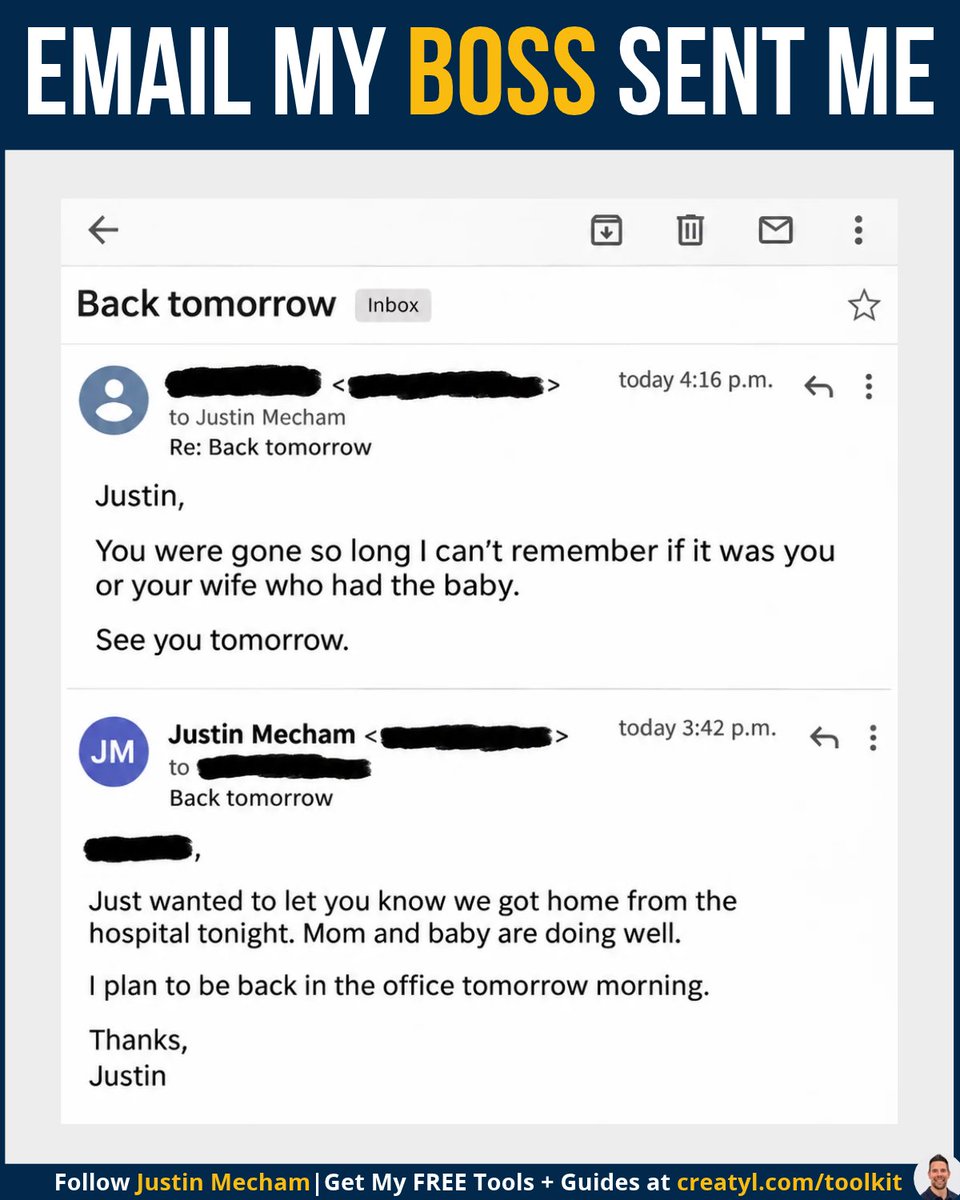
This is a real email from my real boss.
I have never shown this to anyone before.
Read my message first. Then read his reply:
My wife had just given birth to our second baby. I took TWO days off work. And this is what my boss said when I returned:
"You were gone so long I can't remember if it was you or your wife who had the baby."
Two days.
One to take my wife to the hospital and be there when our baby was born. The next to bring them home and get settled.
That was it.
And somehow, even that was too much time away.
I remember laughing it off because I didn't know what else to do.
I had a wife, two kids, a mortgage, and bills to pay. I couldn't exactly walk away from my paycheck.
(Side note: When my boss had his first baby a few months later, he took an entire month off.)
And I think that's what bothers me most looking back.
Not just what he said. But how normal I'd convinced myself this kind of treatment was.
I liked working hard. I liked being good at my job. But I hated knowing someone else had that much control over my life.
Eventually, I started building something of my own.
I took skills I already had, started creating things people could buy, made plenty of mistakes, and began sharing what I learned on social media.
That journey eventually led me to build creatyl so I could help others do the same.
And if you're stuck in a job where you feel like you can't even take care of your family without being made to feel guilty, please hear me.
You don't have to quit tomorrow.
But you can start building another option today.
I put together a free toolkit to help you start building something of your own.
👉 Grab it free here: https://t.co/eF9iPETUHU
You shouldn't have to choose between providing for your family and being there for them.
Build something that eventually gives you a choice.
Please repost to help others out there! ♻️
AI isn't one-size-fits-all.
Different types of AI solve different kinds of problems.
Sharing these 3 most used types of AI compiled by @rakeshgohel01.
1. Predictive AI
Uses historical data to anticipate future outcomes and trends.
Excels at pattern recognition and prediction-driven decisions.
Leverages relational data and feature engineering to train ML models.
Where to use:
Forecast customer demand and buying behaviors.
Anticipate equipment issues before failures occur.
Evaluate credit risk and identify fraudulent activities.
2. Generative AI
Produces new content, from text and images to code.
Powered by pre-trained models that learn from large datasets.
Enhanced with enterprise knowledge through fine-tuning and retrieval.
Where to use:
Draft emails, reports, articles, and long-form content.
Brainstorm ideas and collaborate conversationally.
Research, summarize, and simplify complex information.
3. Agentic AI
Autonomous systems built to handle multi-step workflows.
Combines reasoning, tools, and limited human oversight.
Coordinates specialized agents and external tools to complete tasks.
Where to use:
Automate complex workflows from start to finish.
Execute multi-step processes with minimal supervision.
Conduct independent research and analysis.
The key difference:
Predictive AI tells you what could happen.
Generative AI creates what you need.
Agentic AI takes action and gets the work done.
Choose the right AI for the right use case before implementing any solution.
The question isn't whether you should use AI.
It's which type of AI best solves the problem in front of you.
The most successful teams won't use the most AI.
They'll use the right AI at the right time.
♻️ Repost this for teams navigating the AI landscape.
——
📌 Get my top 100 infographics for free:
1) Follow me.
2) Subscribe to my free newsletter at https://t.co/jTnaNRbsRL.
You’ll receive them directly in your welcome email.
You can earn $7,900 a month if you have:
1. Internet
2. Mobile
3. 1 hour per day
I’ll teach you the whole process. Get my detailed Guide for FREE today.
Like & reply “Guide” and I’ll DM it to you.
Must follow me to get the guide in your DMs.
Free for 48 hours only.
There is an opportunity for businesses to become one of the sources Google uses inside its AI answers.
Google just announced several changes designed to make those source links easier to find and click.
The big one: MORE inline links inside AI answers - and Google says it is now showing those links HIGHER in the response more frequently.
It is also testing dedicated sections near the TOP of AI answers that prominently surface one or two official websites when Google thinks they are the best places to complete a task.
Let's go through it.
By the way, if you want to see whether your business is appearing across Google AI, ChatGPT, Claude, Perplexity, Grok and broader AI search, start here. It's free:
https://t.co/Evw8cXXicl
Alright, so Google announced the changes on October 15, and it directly addresses a huge question hanging over AI Search:
Even if Google uses my website to generate an AI answer...
Will anybody actually click?
Google is clearly trying to improve that part of the experience.
First, inline links.
These are links embedded directly into the words and phrases inside an AI response.
Google says it has made "continued and substantial increases" to their presence - and now it is also showing them HIGHER in AI responses more frequently.
There is a big difference between being buried in a source panel and being the clickable source directly beside the answer someone is reading.
Imagine someone searches:
"How much does it cost to replace an HVAC system?"
Google AI explains the price range and links directly from that section to the source providing the information.
Now the source is not simply contributing information - there is a much clearer path from the AI answer to the website.
That creates an interesting opportunity, because increasingly there may be TWO places to win inside the same Google search:
The traditional organic results AND the sources Google chooses to surface inside the AI answer.
Google announced another change that could matter even more for commercial searches.
It is testing a section near the TOP of AI answers that surfaces one or two official pages when those are the best places to complete a task.
So think,
"Where do I renew my passport?" or "How do I cancel my subscription?" or "How do I book this service?" or "Where can I buy this specific product?"
There may be dozens of sites discussing the topic, but only one official place where the user can actually finish the task.
Google now wants to make that destination more obvious.
That makes the quality of your actual commercial pages increasingly important.
This is something SEO Stuff's done-for-you package handles for businesses daily:
https://t.co/MMsDTFf4rg
Product pages, Service pages, Pricing pages, Booking pages, Tools, Calculators, Comparison pages, etc. - each one should make it obvious what the page does, who it is for and why it is the right destination.
The direction here is pretty clear - Google is putting more emphasis on clickable sources INSIDE the AI experience.
Keep in mind, Google says AI Overviews and AI Mode are rooted in its core Search ranking and quality systems.
So foundational SEO still matters.
Your pages need to be crawlable, indexable, useful, current and easy to understand.
Google also says there is NO special AI Search schema businesses suddenly need to add, but AI answers can use query fan-out.
One complicated question can turn into several related searches before Google generates an answer.
For example:
"What is the best accounting software for a 20-person construction company that uses QuickBooks for payroll but needs better job costing?"
That one question contains several subtopics:
Construction accounting.
Job costing.
QuickBooks compatibility.
Payroll integrations.
Company size.
Pricing.
Google can potentially use different sources for different parts of the answer.
Which means you want strong coverage around the entire decision, not just one broad keyword.
Use cases.
Industries.
Comparisons.
Alternatives.
Costs.
Integrations.
Specifications.
Decision-stage questions.
That is exactly what the SEO Stuff Premium Content Bundle is designed to build:
https://t.co/5osvnSaiGB
Then make those pages easy to understand.
Clear titles.
Direct answers.
Strong internal linking.
Current facts.
Original examples.
Useful tables where appropriate.
Because if Google is going to place one source beside a specific sentence in an AI answer...
You want to be the clearest source for THAT piece of information.
Then there is authority.
Google does not publish some special list of "AI citation factors."
But it does say these generative features rely on its core Search ranking and quality systems.
So broader SEO still matters too.
Build useful content.
Earn legitimate authority.
Keep important pages accurate and easy to discover.
That is why SEO Stuff's done-for-you package combines content with contextual DR50+ authority placements:
https://t.co/MMsDTFf4rg
There was one other interesting detail: Google says usage of its Preferred Sources feature has grown more than 7x since the beginning of 2026.
Preferred Sources lets users tell Google which publications and sites they want to see more frequently.
That reinforces a broader trend: the source itself matters.
The brand behind the information matters, and Google is increasingly making those sources more visible inside AI Search.
And remember, if you want to see whether your business is already appearing across Google AI, ChatGPT, Claude, Perplexity, Grok and broader AI search, start here.
It's free:
https://t.co/Evw8cXXicl