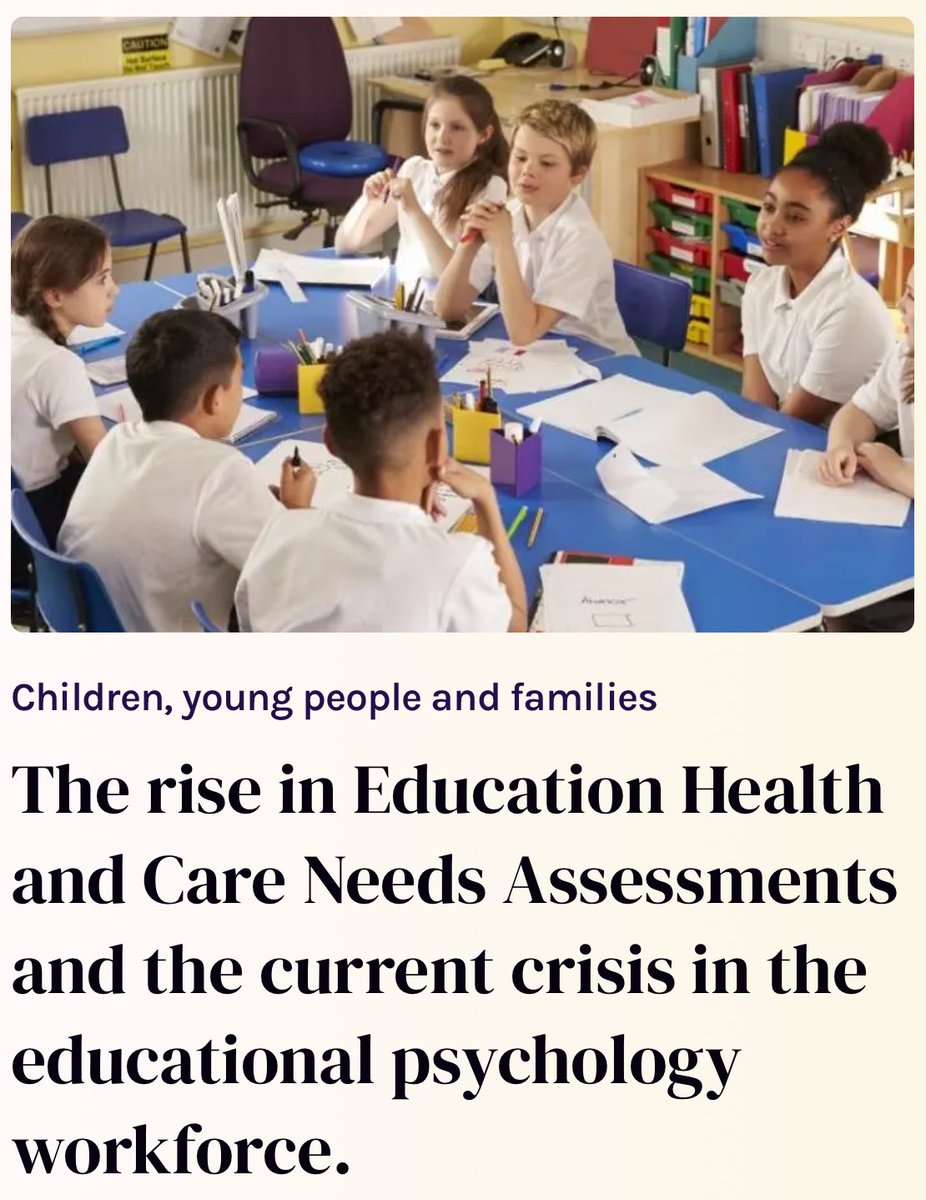
"Council chiefs sound alarm over chronic shortage of Educational Psychologists that threatens to derail Govt plans for inclusive mainstream education."
@LGAcomms backs call after BPS funded @EduPolicyInst research reveals chronic shortage of EPs 👉 https://t.co/Re1FI3Fj1u
Government must address chronic shortage of Educational Psychologists as provision gap leaves some pupils 20 times less likely to get support.
@EduPolicyInst BPS funded research reveals stark disparity in levels of EP provision 👉 https://t.co/BZ4HPpUyw5
#PsychologyMatters
We’re opening free breakfast clubs in all primary schools to boost parents' work choices and children's life chances.
750 schools are becoming the first to offer the clubs, set to save parents £450 a year.
Find out where to find the early adopter schools ⬇️🥣
"Know yourself, grow yourself sounds really easy on the surface but it represents a complex process." @edpsyuk
Dr Dan O'Hare and Educational Psychologists from across the country came together once again to share their thoughts on this year's #ChildrensMentalHealthWeek theme.
📰 Today, @EduPolicyInst published their 2024 report.
Within key recommendations, it identifies the vital need to ensure pupils 'have access to professionals such as educational psychologists' to tackle education inequality and disadvantage in education.
#TwitterEPs#SENDreform
We listened to our stakeholders when they told us they wanted to know more about what an EP does. Thank you to all the children who asked us questions. Please share ⏩ https://t.co/wtigzKmw9A
Hopefully, this can add to the debate and encouragement to move away traditional punitive practices and towards relational approaches. A systematic review of children and young people’s perceptions and experiences. https://t.co/nXKwDtkL49
DECP responds to the Local Government & Social Care Ombudsman’s ruling on the impact of a severe shortage in the Educational Psychology workforce.
Read the response here:
https://t.co/mMuf5X9cAi
And an in depth analysis here: https://t.co/FoowuWnJMV
#twittereps@BPSOfficial
Parental Traits May Influence Neurodevelopmental Disorders
A new study introduces a novel approach to predicting the risk and severity of neurodevelopmental and psychiatric disorders in children by examining the traits of their parents.
The research demonstrates that the presence of certain traits in parents, such as symptoms of depression, anxiety, autism, or schizophrenia, can significantly enhance the accuracy of risk assessments for these disorders in their offspring, beyond what genetic screening alone can provide.
This method acknowledges the complexity of genetic transmission, recognizing that some genetic variants contributing to disorders may not be detectable through standard genetic tests but can be inferred through parental traits.
Analyzing data from 97,000 families, the study not only offers new insights into the genetic and environmental intertwining in neurodevelopmental disorders but also proposes a refined model for genetic counseling and the creation of personalized therapeutic plans, marking a significant step forward in the field of developmental medicine.
1/3
'... we need to see government focus on prevention and reversing the rising rates of mental illness, as well as ensuring sufficient resourcing of specialist services' like educational psychologists who are skilled in preventative and systemic work. https://t.co/e13bF1XsVX
The lives of children with special educational needs and disabilities are being negatively affected by the shortage of educational psychologists, the local government ombudsman has warned.
Read more⬇️
https://t.co/zGeWzApTjt
Exclusive: Pupils are ’stacked up like planes at Heathrow’ waiting for places at oversubscribed alternative provision and pupil referral units, warns @wave_multi CEO Robert Gasson in a @tes investigation into the problem
https://t.co/SDmujT5MH4
🗣️The AEP were mentioned in the recent parliamentary debate on SEND provision & funding – highlighting the vital role of EPs in the delivery of effective SEND provision and the need for a greater number of EPs and better investment in services.
#TwitterEPs#SENDReview
Our action research paper describing how we used the RADIO model to develop EBSNA provision in one LA is now available to read online: https://t.co/tJ8qIyvvjL
@catrinmarykelly@Carolin077Bond please share and let us know what you think!
The AEP is pleased to see this report from @scotgov refer to the positive impact of relational, restorative & nurturing approaches on student behaviour.
EPs understand the important role of behaviour as communication which requires response #TwitterEPs
https://t.co/iFvA93dk5S
Applying for EP training for 2024? 🎓
The EPFT application process is now fully live and applicants can now submit their applications online
#TwitterEPs#DayinthelifeofaTEP#edutwitter
https://t.co/AphwPvLV8n
Sign up to the newsletter for articles on digital/tech developments in the EP space, as well as 'tech tips' to supercharge your practice. You will also receive updates on the development of the digitalEP platform - which will be free for TEPs #twitterEPs - 🔗link below⬇️
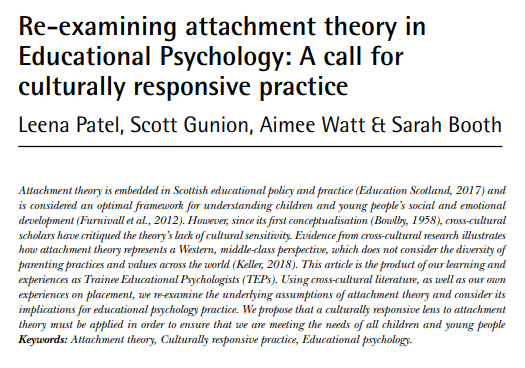
Delighted to share that my third journal article for Educational Psychology in Scotland was published today! Thanks Scott Gunion, @WattAimeeRuth & @SBooth_95 for co-authoring. To access this article, please follow this link: https://t.co/uTvsDarESb