"How’s your health, forests?" illustrates how various tools data and perspectives are needed to assess the functioning and condition of the world's forests. It features the work of many colleagues eg @DanielFZuleta @Nate_G_Swenson @Seanscience1 and our own https://t.co/GE8K3Pvc8v
We data/theory people from @EasiLabUBT really went out for field work, into a real FOREST! 😇 Leonie Gass and I set up temperature logger in the Fichtelgebirge to measure the microclimate on new disturbance patches - a collaboration with @katja_kowalski and @corneliussenf
Results are based on data from 21 forest plots covering more than 2.9 million trees of approximately 6,500 species and a new framework that allows structuring mechanisms of global forest dynamics!
Very interesting results in this new @EasiLabUBT study by @melina_sleite:
- variation in tree demography is surprisingly similar across global forests
- diverse forests feature smaller interspecific differences in tree demography
The last paper of my PhD is finally out!
"Major axes of variation in tree demography across global forests"
many thanks to the 50+ co-authors who made this study possible! special thanks to my mentors @PIPrado1, @LisaHuelsmann, @Seanscience1, Marco Visser
https://t.co/mbIk69jqz6
Can complex interactions between trees and their natural enemies shape latitudinal tree diversity patterns in forests? 🌳🌍 Our article in @Nature delves into this question by comprehensively testing the Janzen-Connell hypothesis using tree mortality data https://t.co/QqZcbwFxx2
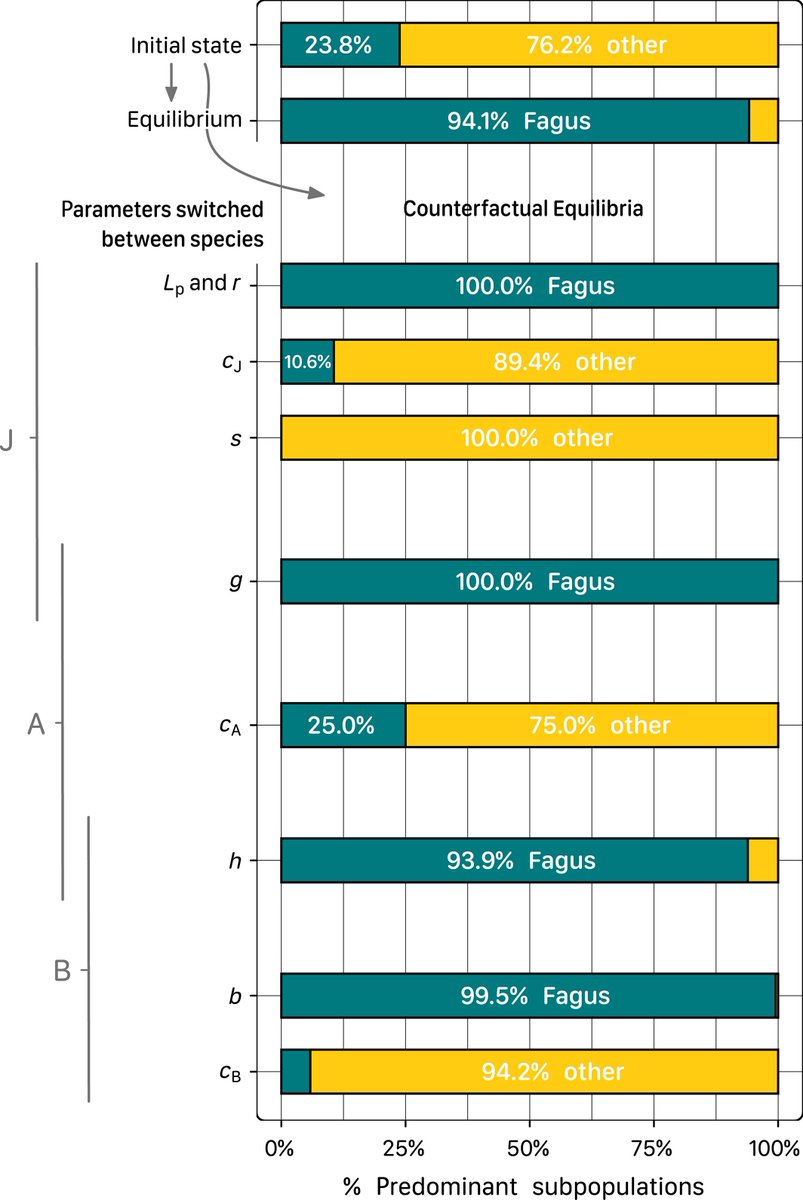
Why do some tree species become dominant? And what makes beech (Fagus sylvatica) dominant in Central European forests?
In a @Ecol_Evol study led by Lukas @heiland we provide answers through Bayesian calibration of a size-structured forest population model https://t.co/6XTovzdu1Y
The most important demographic process in sustaining Fagus' predominance is the weaker competition response of its saplings to the overstory, as demonstrated by simulations of counterfactual equilibria.
Fresh Preprint on @biorxiv_ecology
**Major axes of variation in tree demography across global forests**
Proud of this highly collaborative study!
@PIPrado1@Seanscience1@LisaHuelsmann
summary below⬇️
https://t.co/68YS1R10Cq
Please RT: We are looking for a postdoc in forest modelling and statistical ecology.
Located at @EasiLabUBT in Bayreuth / Germany!
For details see https://t.co/mZ16BYkppP
Wir laden ein zum 5. Klimadiskurs "Klima – Macht – Geschlecht".
Am heutigen #InternationalerFrauentag diskutieren wir mit @ulrike_GenderCC, wie Klimawandel und Geschlechtergerechtigkeit zusammenhängen.
18 Uhr via Zoom. Anmeldung hier: https://t.co/r49knEc8XE
@bayklif@unibt
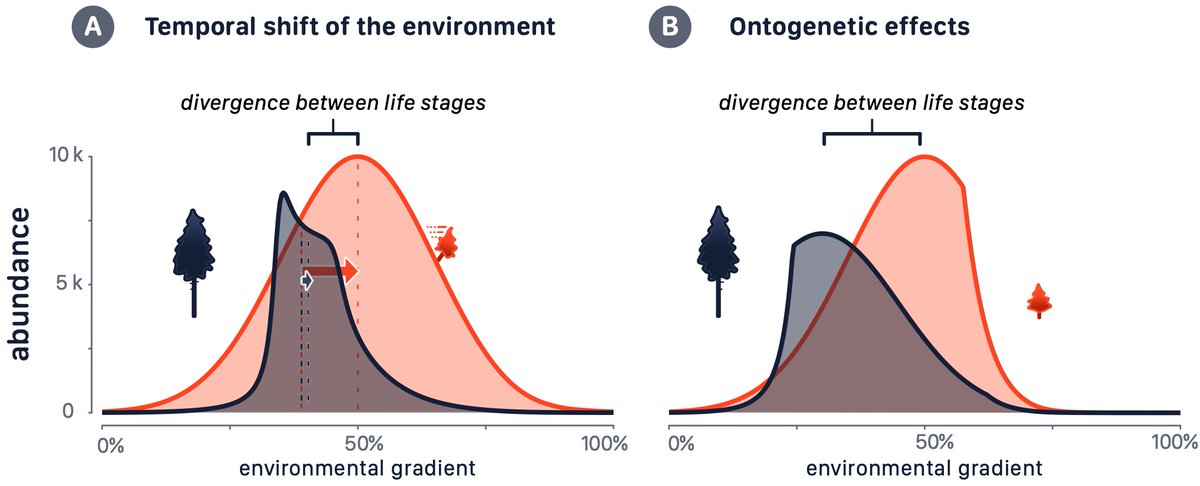
Why do small trees occur under different environmental conditions than their adult conspecifics?
Read more in @EcographyJourna: "Divergent occurrences of juvenile and adult trees are explained by both environmental change and ontogenetic effects" https://t.co/5C5k6I4ojL
Juveniles and adults diverge not only because of environmental changes, but also because of ontogenetic effects. It is therefore questionable to infer the effects of climate change from static forest data.
Wir laden ein zur digitalen Vortragsreihe #KlimaDiskurse der @bayklif Juniorforschungsgruppen – eine Klimareise entlang der Spannungsfelder Politik, Gesellschaft, Wissenschaft und Kunst.
Programm und Anmeldung unter https://t.co/r49knEc8XE
Über Pläne und Perspektiven an der Uni Bayreuth @unibt: https://t.co/PCkIUbYcYs
🌲🌳🌲🌳🌲🌳
On plans and perspectives at the University of Bayreuth: https://t.co/c4DIg0AGDb