When you look at a trophy in a case, it doesn’t say who started or who scored the most points.
All it shows is that ONE group came together to make something special.
Too many coaches think old offenses are outdated.
They're not. They're a masterclass in sequencing.
What "dinosaur" offenses teach:
- If/then decision trees
- Using deception to create conflict and a numbers advantage
- How one play sets up the next
Modern offenses: Inside Zone + RPO on repeat.
You want to grow as a play caller? Study the classics.
As an AD, I remind parents and coaches that sports are emotional. Much like relationships between parent and child or husband and wife, there will be ups and downs. When situations become emotional, whether it is playing time, a tough decision, or a disagreement, it is important to go back to the root of the relationship. Ask a simple question: does that person truly care about the individual they are in conflict with?
More often than not, if the answer is yes, the conflict is not about a lack of care or respect. It is about perspective, expectations, or personal wants not being met. When you recognize that, it allows everyone involved to respond with more clarity, accountability, and trust rather than emotion alone.
I coached college football for 20 years.
The question that decided who played had nothing to do with talent:
"Can I trust you?"
Every player on my roster was Green, Yellow, or Red.
🟢 Green — trusted and deployed
🟡 Yellow — developing, right on the edge
🔴 Red — talented but not yet deployable
Talent gets players noticed.
Trust gets them on the field.
Coaches and families both need to understand this.
https://t.co/MoG1HAHAfP
‼️Every parent and athlete should listen 🎧👂to Will Compton
🔥Facts don’t care about feelings.
🔥What matters is the evidence you are producing.
💥If you don’t like where you are on the depth chart, then produce evidence you should move up!
HS sports:
Lifting with your team 2x/wk in the off-season doesn’t always guarantee you will win a title. It just increases your likelihood of success.
But not training with your team 2x/wk in the off-season almost always guarantee that you will not win a title. It wildly decreases your chances of success.
💯 “Boring before brilliance.”
Paul Skenes details his routine
Young athletes want to constantly do something new or novel
Often avoiding routine, fundamentals & what works…
“Sometimes it’s what it takes in sports
The boring process, the boring fundamentals.”
LISTEN:
Alabama football director of performance, David Ballou
What would be his biggest tip to young athletes trying to get to the next level?
“A lot of people work hard…
it’s the people that work hard & are able to stack nutrition & sleep & those things on top of it.”
Listen up:
Free advice for football coaches:
1. If you draw up an offensive play, always draw up a defense.
2. Calling plays is hard. It's easy to question after the fact. Everyone’s a great play caller on the ride home.
3. If your players are confused, it’s probably your fault and it's too complex. Don’t assume they get it.
4. Stop obsessing over titles. Be ready when your shot comes.
5. You probably aren't as good at “winging it” as you think. Preparation is key.
6. If you only talk to kids when they mess up, don’t expect them to listen when it matters.
7. Everyone wants to call plays… until it’s 3rd & 8 with the game on the line.
8. If your system only works with great players, it’s not a great system.
9. If practice isn’t organized, don’t expect Friday night to magically be.
10. Stop blaming “kids these days.” Part of coaching is just adjusting.
11. Halftime adjustments sound great… but we would tell them before halftime if we knew what to say.
12. Film doesn’t lie, but coaches sometimes do about what they see on it.
Just my opinion, we don’t have to agree.
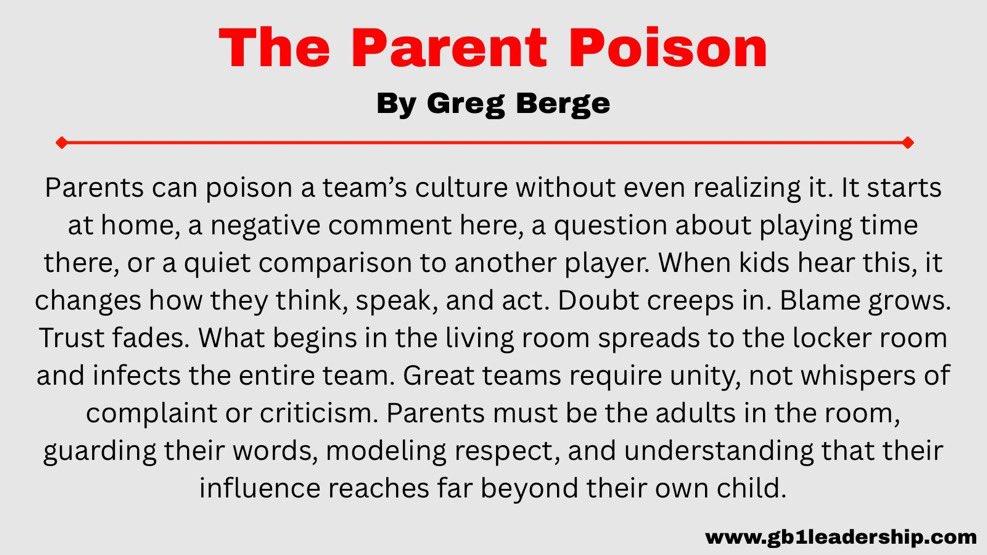
The Parent Poison…
Most parents want the best for their kids.
But sometimes, without realizing it, they slowly poison the very team their child is part of.
It rarely starts with something dramatic.
It starts small.
A comment in the car ride home.
“Why didn’t the coach play you more?”
A comparison.
“You’re better than that kid.”
A quiet complaint at the dinner table.
“That coach doesn’t know what he’s doing.”
Kids hear everything.
And when they hear it, something changes.
Doubt creeps in.
Blame grows.
Trust fades.
The mindset shifts from team first to me first.
What begins in the living room eventually shows up in the locker room.
You see it in body language.
You hear it in conversations.
You feel it in the culture.
Instead of unity, there are whispers.
Instead of accountability, there are excuses.
Instead of growth, there is resentment.
Great teams cannot survive that environment.
Because the best teams are built on three things:
Trust.
Sacrifice.
Shared purpose.
When players start believing the problem is everyone else, those things disappear.
Parents play a powerful role in a team’s culture whether they realize it or not.
The healthiest teams have parents who:
Support the program.
Encourage resilience.
Teach their kids to handle adversity.
They remind their children:
Work harder.
Be a great teammate.
Control what you can control.
They don’t feed excuses.
They build character.
And here’s the truth most people miss:
A parent’s influence extends far beyond their own child.
It affects the locker room.
It affects the culture.
It affects the entire team.
Great teams require unity, not whispers of criticism.
So the challenge for parents is simple.
Be the adult in the room.
Guard your words.
Model respect.
Support the team.
Because what starts at home always finds its way onto the court, the field, or the locker room.
And the best parents don’t poison the culture.
They protect it.