Wang Xiao was twenty-four years old when doctors told her she had about one year left to live. She suffered from uremia, a severe condition where the kidneys stop filtering waste from the blood.
Her family members took tests to see if they could donate a kidney, but no one was a match. All standard medical options had completely run out.
Instead of giving up, Wang decided to do something almost no one in her position would ever dare to try. In 2013, she posted a message in an online support group. Her words were direct and honest.
She wrote, "I just want to live."
She was looking for a terminally ill man with her same blood type who would be willing to marry her and donate his kidney after his death. In return, she promised to take care of him with everything she had for whatever time he had left.
Most people scrolled past the post, but a twenty-seven-year-old man named Yu Jianping saw it. Yu was a former manager dealing with myeloma, a serious blood cancer. He had already gone through a bone marrow transplant, but the cancer returned.
His father had to sell their family home to pay for treatments, and his girlfriend had left him after his diagnosis. Yu felt exhausted and ready to stop fighting.
However, when he saw Wang’s message, he realized their blood types matched. He sent her a short message: "I can marry you."
When they met for the first time in a park, something unexpected happened. They genuinely liked each other. During one of their online chats later on, Wang had to step away for her treatment.
She sent him a video from the dialysis machine, smiling despite the tubes and blood around her. She joked, "I am in dialysis now. My arm is stuck. Here is a one-handed monster."
Yu laughed out loud. He later admitted it was the first time he had laughed in a very long time.
On July 16, 2013, they officially registered their marriage. On paper, it was purely a practical contract. They agreed not to live together, not to combine their finances, and not to tell their families about the arrangement. If Yu passed away and his kidney matched, Wang would receive it.
In return, Wang promised to care for Yu's elderly father for the rest of his life.
Yet, daily life quickly changed their plan. Wang began accompanying Yu to his hospital visits. Yu cooked warm soup for her after her exhausting dialysis sessions.
They walked down hospital hallways together and joked about their situations. Slowly, the cold business contract transformed into genuine love.
When Yu urgently needed another expensive bone marrow transplant that his family could not afford, Wang refused to let him give up.
She set up a small street stall to sell flowers.
Next to the bouquets, she placed a handwritten note telling their story: two sick people trying to save each other, one day at a time.
Passersby stopped to read, bought flowers, and shared the story with others. Kindness spread quickly. Wang eventually raised about 500,000 yuan, which was over 90,000 dollars, covering the full cost of Yu’s operation.
Then, the unthinkable happened. Yu’s condition stabilized after his second transplant.
Around the same time, Wang’s medical team noticed her health improving, and her dialysis sessions were reduced. Eventually, doctors told her she might not even need a kidney transplant anymore.
In February 2015, they held a real wedding ceremony surrounded by friends and family.
Today, they run a flower shop called "Yongsheng Flower" in Xi'an, grown from the very same street stall that saved Yu’s life. Their story was even adapted into a major Chinese movie in 2024.
Wang and Yu showed the world that even in the darkest moments, love and human connection can heal what medicine alone cannot.
🦔AI companies are bulk-buying rare books, scanning them through high-speed machines that cut the spines off, and shredding the originals. A service called ISBNdb facilitates orders of up to a million books and keeps buyers anonymous. Pre-2022 books are premium because they're free of AI-generated text. A federal judge ruled the practice is fair use because eliminating the original means only one copy exists at a time. Anthropic hired the former head of Google Books partnerships to obtain "all the books in the world."
My Take
This got to me. A bookseller told 404 Media that rare books with almost no surviving copies are being fed into this pipeline. Books that survived wars, fires, and centuries of handling are being shredded so an AI can learn to write a better marketing email.
ISBNdb's website literally says "'AI company destroys two million books' is not a headline that generates sympathy," and they still built an entire business around making it happen quietly. They offer NDAs as a feature. They coach clients to call it "digital preservation."
I've covered AI companies scraping the internet, torrenting libraries, and stealing music. This is worse because it's irreversible. You can re-upload a website. You can reprint a bestseller. You can't replace the last three copies of an 18th-century botanical text once someone shreds them for training data. And the judge said it's legal. So it's going to accelerate.
"We shred rare books and offer NDAs so nobody finds out" is a legitimate business model in 2026. What a timeline.
Hedgie🤗
@FuckEmWeBall23@FUCCl First of all, this is Afrobeats and Nigerian asf. If they sound the same to you, you should check out other acts like Buju and Rema.
Day 36, The children kidnapped in Oyo are still held hostage by terrorist, 210 trillion naira has gone missing under kyari, Tinubu’s government hates you.
This is actually a brilliant observation that deserves a proper answer. You are not wrong about what you are seeing. But what you are describing is exactly how languages disappear without anyone noticing.
Adamawa alone has over 40 documented languages. Bura, Vere, Chamba, Gaanda, Lala, Bacchama, Bata, Marghi and more and no they are not variations as you pointed out.
But most of them are slowly being swallowed by Hausa and Fulani because those are the languages of trade, mobility and survival.
So yes, your Borno security guard speaks Shuwa Arabic and your Sokoto okada man speaks Hausa and they understand each other perfectly. That does not mean only one language exists. It means one language won the economic argument. This is what linguists call language assimilation. The dominant language does not erase the others overnight. It just makes them less useful for daily survival until the younger generation stops learning them entirely.
Now here are the facts. Ethnologue, which is the world's most authoritative database on languages, currently documents 520 living indigenous languages in Nigeria alone. Not dialects. Languages. Nigeria has also already lost 12 indigenous languages or more to extinction. Gone forever.
The Middle Belt is where this becomes undeniable. Plateau State alone has over 50 distinct languages. Keyword "Dinstinct".
Benue has Tiv, Idoma, Igede and more. Taraba has communities that cannot understand their neighbours two villages away without a translator. Your Yoruba example actually proves the point perfectly. The fact that a Yoruba person can move across the Southwest and be understood is evidence of one dominant language absorbing regional variations over centuries. That process happened. It is still happening everywhere else in Nigeria right now.
Now I am willing to bet you have never heard of Hyam, Ngas, Mwaghavul, Berom, Amo, Buji, Sura, Anaguta, or Irigwe from Plateau State. Or Kilba, Huba, Bura-Pabir, and Chibok from Borno. Or Mumuye, Jenjo, Yukuben, and Wurkum from Taraba. Or Tur, Nyandang, Kugama and Taram further into the riverine communities nobody talks about. Or what about Igala, Ebira, Bassange, Bassa-Nge, Kakanda and Oworo from Kogi alone. I have not even touched Rivers, Cross River, Bayelsa, Edo, Ondo, or Nasarawa yet. You want to know exactly where each of these is spoken? You will have to tour Nigeria for that. And I promise you, this country will humble you in ways no map ever could. The 500 languages are not cap. Most of them are just quietly dying (Bura has an estimated 11,000 speakers with most young Bura people now not able to speak the language) while we debate whether they exist. And that is the real conversation Nigeria should be having.
Que en España tengan estas tradiciones pero tengan legalizado el aborto, ley trans, matrimonio igualitario, entre otras cosas demuestra que se puede tener tradiciones muuuy catolicas y que el Estado igual legisle para TODA la población
Let me add this: there is no other historical iron smelting site that is as old AND as large scale as this site. Anywhere in the world.
There a few sites that are potentially older but at very small scale. And very few that are larger but much much later in time.
Lejja is not only one of the oldest smelting sites of this scale anywhere in the world, its history of iron smithing predates several older world civilizations.
Igbo people are ancient, and technically competent.
Secondly, Africans by extension are just as capable technically as other races. The reason we got to iron earlier than other civilizations is that tin was scarce in our area which made bronze difficult. So as a region we did brass and then iron. That tells you that our environment drove our technical innovation.
If we had not encountered a more advanced civilization when we did, we would've still built our own technology.
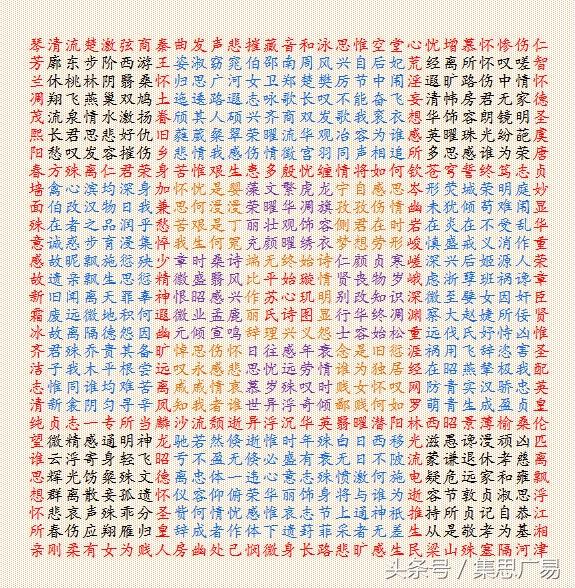
This strange square 👇 is undoubtedly the most extraordinary work of literature in human history. Yet, unfortunately, barely anyone in the West has ever heard of it.
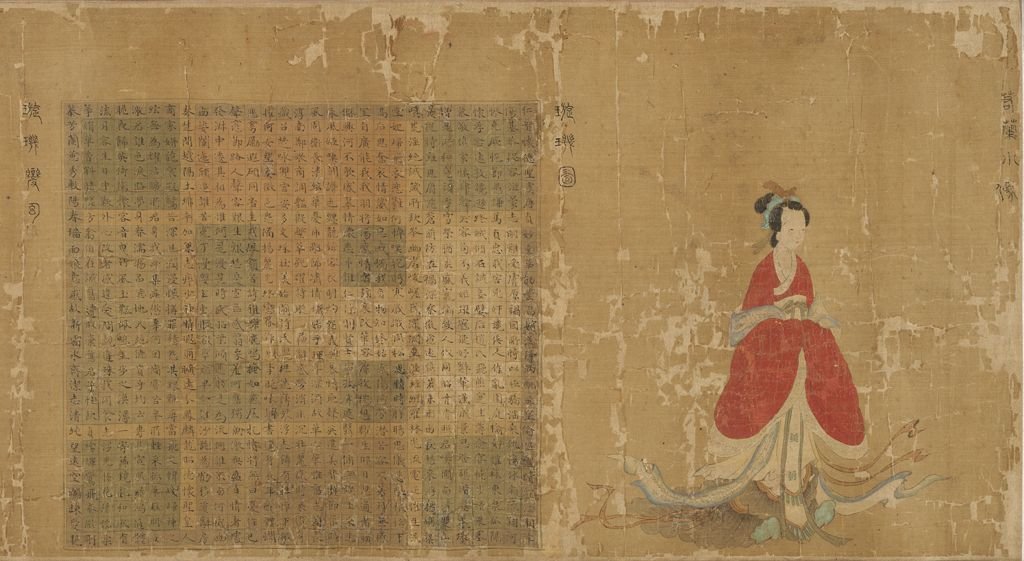
There was this woman poet in 4th century China called Su Hui (蘇蕙), a child genius who had reportedly mastered Chinese characters by age 3.
At 21 years old, heartbroken by her husband who left her for another woman, she decided to encode her feelings in a structure so intricate, so beautiful, so intellectually staggering that it still baffles scholars to this day.
Came to be known as the Xuanji Tu (璇璣圖) - the "Star Gauge" or "Map of the Armillary Sphere" - it's a 29 by 29 grid of 841 characters that can produce over 4,000 different poems.
Read it forward. Read it backward. Read it horizontally, vertically, diagonally. Read it spiraling outward from the center. Read it in circles around the outer edge. Each path through the grid produces a different poem - all of them coherent, all of them beautiful, all of them rhyming, all of them expressing variations on the same themes of longing, betrayal, regret, and undying love.
The outer ring of 112 characters forms a single circular poem - believed to be both the first and longest of its kind ever written. The interior grid produces 2,848 different four-line poems of seven characters each. In addition, there are hundreds of other smaller and longer poems, depending on the reading method.
At the center a single character she left implied but unwritten: 心 (xin) - "heart." Later copyists would add it explicitly, but in Su Hui's original the meaning was even more beautiful: 4,000 poems, all orbiting the space where her heart used to be.
Take for instance the outer red grid of the Star Gauge. Starting from the top right corner and reading down, you get this seven-character quatrain:
仁智懷德聖虞唐,
貞志篤終誓穹蒼,
欽所感想妄淫荒,
心憂增慕懷慘傷。
In pinyin, it is:
Rén zhì huái dé shèng yú táng,
zhēnzhì dǔ zhōng shì qióng cāng,
qīn suǒ gǎnxiǎng wàng yín huāng,
xīn yōu zēng mù huái cǎn shāng.
Notice how it rhymes? táng / cāng / huāng / shāng
The rough translation in English is: "The benevolent and wise cherish virtue, like the sage-kings Yao and Shun, With steadfast will I swear to the heavens above, What I revere and feel - how could it be wanton or dissolute? My heart's sorrow grows, longing brings only grief."
Now read it from the bottom to the top and you get this entirely different seven-character quatrain:
傷慘懷慕增憂心,
荒淫妄想感所欽,
蒼穹誓終篤志貞,
唐虞聖德懷智仁。
The pinyin:
Shāng cǎn huái mù zēng yōu xīn,
huāngyín wàngxiǎng gǎn suǒ qīn,
cāngqióng shì zhōng dǔzhì zhēn,
táng yúshèngdé huái zhì rén.
It rhymes too: xīn and qīn, zhēn and rén
And the meaning is just as beautiful and coherent: "Grief and sorrow, longing fills my worried heart, Wanton and dissolute fantasies - is that what you revere? I swear to the heavens my constancy is true, May we embody the sage-kings' virtue, wisdom, and benevolence."
That's just 2 poems out of the over 4,000 you can construct from the Xuanji Tu!
At the very center of the grid, the 8 red characters wrapped around the central heart, she "signed" her poem with a hidden message:
詩圖璇玑,始平蘇氏。 "The poem-picture of the Armillary Sphere, by Su of Shiping."
Or reversed:
蘇氏詩圖,璇玑始平。 "Su's poem-picture - the Armillary Sphere begins in peace."
Many scholars, and even emperors, throughout Chinese history have been completely obsessed by Su Hui's puzzle.
For instance, in the Ming dynasty, a scholar named Kang Wanmin (康萬民) devoted his entire life to the poems (https://t.co/4exP9zpqbc), ending up documenting twelve different reading methods - forward, backward, diagonal, radiating, corner-to-corner, spiraling - and extracting 4,206 poems. His book on the subject ("Reading Methods for the Xuanji Tu Poems", 璇璣圖詩讀法) runs to hundreds of pages.
Empress Wu Zetian herself, the legendary woman emperor of the Tang dynasty, wrote a preface to the Xuanji Tu around 692 CE (https://t.co/yW7aR73MPc).
Incredibly, there's even far more complexity to the Xuanji Tu than just the poems:
- The name 璇玑 (Xuanji) - Armillary Sphere - is astronomical in meaning and the way the poems can be read mirrors the way celestial bodies orbit around a fixed center. It's a model of the heavens.
- Her original work, with the characters woven on silk brocade, was in five colors (red, black, blue/green, purple, and yellow) which correspond to the Five Elements (五行) - the foundational Chinese philosophical system that explains how the universe operates. So it's also a model of the entire cosmic order according to ancient Chinese philosophy.
- It's also of course deeply mathematical with this 29 x 29 perfect square grid, with sub-squares, lines and rectangles, and a structure which allows for symmetrical reading patterns in all directions
- Last but not least, the content of the poems themselves contain multiple registers. On top of expressing her personal grief and longing for her husband, it's also filled with accusations against the concubine (Zhao Yangtai) he left her for, reflections on politics (with many references to sage-kings) and philosophical reflections.
So the Star Gauge is simultaneously:
- A love letter (expressing personal longing)
- A legal brief (arguing her case against her rival)
- A cosmological model (structured like the heavens)
- A Five Element diagram (encoding the fundamental structure of the world according to ancient Chinese philosophy)
- A mathematical construction with perfect symmetry and precision
And yet, for all this complexity, we should not forget this was all ultimately in service of the simplest human message imaginable: a 21-year-old woman asking the love of her life "come back to me".
Her husband did, eventually. According to what empress Wu Zetian herself wrote in her preface to the Xuanji Tu, when he received Su's brocade he was so "moved by its supreme beauty" that he sent away his concubine and returned to his wife. As the story goes, they lived together until old age.
The heart at the center was filled after all.
when you die and go to heaven, they play a supercut of all the unappreciated jokes you ever made in your life, and everyone in heaven laughs uproariously at each one