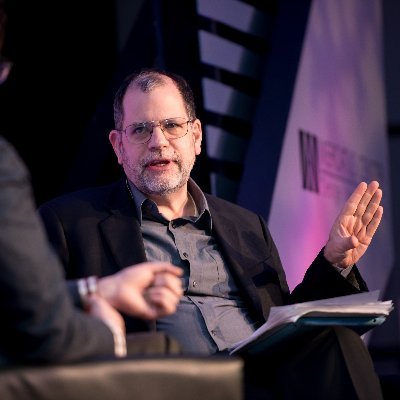
Adam Kirsch explores the relationship between belief, evidence, and personal experience, asking what authority extraordinary claims should hold when they cannot be independently verified.
Mike Munger (@mungowitz) explores the philosophical traditions behind these competing understandings of liberalism, from the Scottish Enlightenment to contemporary political thought.
Listen to the full episode here: https://t.co/y3NpC5Uxzy
Mike Munger (@mungowitz ) explores the distinction between what the law permits and what individuals ought to do, examining how unwritten norms can preserve the openness, judgment, and restraint that rigid rules cannot.
Russ Roberts (@econtalker) and guest Adam Mastroianni (@a_m_mastroianni) explore the relationship between individual character and political institutions. While better systems can encourage better behavior, lasting change also depends on the choices of the people within them.
Birth rates are plunging around the world, including in countries once known for large families. What's driving the decline?
University of Pennsylvania Professor of Economics @JesusFerna7026 joins @EconTalker to examine the mystery of falling fertility and its economic consequences.
Watch a new episode of EconTalk from the @HooverInst, @Liberty_Fund, and @Econlib: https://t.co/wfOQ0JF24G
As global birth rates decline, economist @JesusFerna7026 examines how longer educational pathways, delayed careers, and rising housing costs are making it harder for young adults to start families.
He explains how economic policies, particularly restrictive zoning laws, can delay marriage and parenthood by putting homeownership further out of reach.
Watch the full conversation with @EconTalker on Hoover+: https://t.co/wfOQ0JF24G
Samuel Johnson said "all other greatness shrinks away" before the greatness of Milton's Paradise Lost. Join Sarah Skwire of Liberty Fund for a twelve-part Virtual Reading Group on this epic of love, sin, and republican politics.
https://t.co/gYlbkw4Rhl
How did the world get so much richer, longer-lived, and more connected? @artcarden returns to two of Adam Smith’s triads for an answer, and for a few ideas about where we go next. https://t.co/1kqRXf2Kqy
Can satire tell us truths about liberty that straight argument cannot? Join Carl Richard for a Virtual Reading Group on classic works of humor as expressions of free speech. Mondays Oct 19, 26 & Nov 2, 9, 2-3pm EDT. Pre-register: https://t.co/YvSbBUdSDe
Public Choice is more than “economics applied to politics.” @mungowitz walks through James Buchanan’s four essentials. Remove any one, and you no longer have Public Choice. https://t.co/S4R3E56tVN
Gibbon asked why Rome fell. 250 years later, we're still asking why civilizations decline. Join Peter Mentzel of Liberty Fund Oct 19, 10-11:30am ET for part three of our year-long Gibbon reading group. https://t.co/kWPxwaTTh6
We have representation. But do we have consent? Bobbi Herzberg on why the Declaration’s grievance still has teeth, from the Stamp Act to payroll withholding to the national debt. https://t.co/HPRKekgzQr
Host Russ Roberts (@EconTalker) and guest James Marriott (@j_amesmarriott) explore one of fiction’s most remarkable powers: its ability to give us access to another human consciousness.
Why does a profitable company carrying debt strike us as suspicious, when a homeowner can do the same with a mortgage? Valentin Boboc with the IEA explains why debt and profit aren't opposites — one's a flow, the other's a stock — on EconLib. https://t.co/9qDxDxdJOg
Samuel Johnson said all other greatness shrinks before it, and readers who open Milton's Paradise Lost find an epic that's as much about sin and redemption as it is about marriage, politics, and the power of poetry. Join Sarah Skwire for our upcoming VRG. https://t.co/AiIwWl7qSh
Host Russ Roberts (@EconTalker) and guest Adam Kirsch examine the persistent mystery surrounding UFO sightings and the gap between extraordinary claims and ordinary scientific evidence.