10 years on from Brexit and Wales now backs rejoining the EU.
This extensive poll from @Jaclarner at @WalesGovernance shows a huge shift - mainly down to demographics
That was no more clear than in Brexit-voting Ebbw Vale where I visited last week:
https://t.co/hsHqtKkQoG
The Consumer Prices Index (CPI) rose by 2.8% in the 12 months to May 2026, unchanged from the 12 months to April 2026.
Read the full article ️➡️ https://t.co/VwzlwCRqdc
Northern Ireland remaining in the EU single market for goods means we have an entire region running as a counterfactual on how much wealthier we’d have been had we stayed. It’s actually outperformed London.
📽️Hello everyone. I just spent a day following one of the @bankofengland's interest rate setters as he toured the West Midlands, trying to get his head round the economy ahead of his next rate decision.
Here's our film👇 https://t.co/hBUeUoBrVi
We’re delighted to once again partner with the Welsh Government to present the #YoungEconomistOfTheYear Welsh Award, recognising an outstanding economics student from Wales.
Find out more and enter here: https://t.co/Wnl97o3sa4
#Economics#WelshGovernment#StudentAwards
It is not the value of the degree that has dropped - it is the cost of getting that degree that has risen way beyond its affordability to the average person.
Fees in Europe are either zero, low hundred euros or perhaps as high as a couple of thousand. Here they are nearly 10K.
Is a country truly wealthy if its citizens are unhappy? Explore GDP, wellbeing and what really makes a country successful in our new Young Economist of the Year resource 👇
https://t.co/0mqICH8syz
@FT4S#Economics#YEOTY2026
NEW
Inflation eases from 3.3% to 2.8% in year to April, with falls in domestic energy and other bills (water, VED) last month counteracted by a rise in petrol prices…
Core inflation 2.5% vs 3.1%… services 3.2% vs 4.5% …
Lowest services inflation since January 2022 - key indicator for Bank of England…
Lowest core inflation since July 2021
Good set of figures before the inevitable upwards turn from full impact of Iran war, especially on domestic bills.
📽️ This isn't just about Keir Starmer and whether he'll be PM in a few days/weeks.
It's about the economic quandary the UK's faced with and whether any future govt can or will confront it.
My primer on why markets are quite so fretful about the UK👇
🇪🇬 Egypt’s inflation has fallen from 38% to 14.9% — but economic pressure remains. Why?
💸 Falling foreign investment
⚡ Rising energy costs
📉 Currency pressure
A great real-world example of inflation, exchange rates & foreign assets. #IBEconomics https://t.co/78nFJSaduj
How do tariffs shape prices & global trade? 🌍📈
A Discover Economics webinar from The Albert Gubay Business School at Bangor University (with Welsh Government).
Perfect for Year 11–13 👇
https://t.co/Q5qLlgMQcQ
Here are 3 ways that the current system screws over Wales.
If politicians are not talking about these issues, they are not serious about fixing Wales' problems.
----------
1. The Welsh Gov has less borrowing powers than a council.
🏴Wales can only borrow £150m a year (and £1bn in total).
That is the equivalent of just 0.57% of our budget.
🏴Scotland can borrow £450m a year (and £3bn in total).
This makes it really hard for Wales to make big investments like building hospitals and schools unless we use super expensive funding models like PFI.
The worst thing is, Scotland's borrowing rates have increased with inflation every year since 2016 whereas Wales' have been frozen!
----------
2. Wales’ can’t even spend its own money
If Wales makes good financial decisions and has money left at the end of the year, it is only allowed to carry over a very small amount.
The total the Welsh Government can have in the reserve is £350m. While that might sound like a lot, it really isn’t in a government context.
The Welsh Government’s budget is £27bn. This means that the Welsh reserve is just 1.35% of its budget. And that £350m isn’t per year, that is the total it can carry.
This means that if the Welsh Government reserve is full, then any money that isn’t spent is just taken back by the Treasury in Westminster.
What makes this system even worse is that the UK Treasury has imposed limits on how much of its own reserves Wales can even use!
Of the £350m Wales can only access £175m a year.
Scotland has a reserve of £700m AND it has no limit on how much of that it can spend. Plus yet again, Scotland’s was linked to inflation whereas Wales’ wasn’t.
There is simply no justification for Wales being treated differently to Scotland. The UK Government isn’t able to get away with treating Scotland like Wales because the Scots wouldn’t stand for it.
----------
3. Rail
Because rail is devolved in Scotland, when the UK Government spends money in England on rail, Scotland gets extra cash.
Scotland gets billions of pounds in extra funding because of HS2 (which is only in England). But because rail isn’t devolved to Wales, the Treasury can class HS2 as an “England and Wales project” meaning Wales gets nothing.
It is worse than that. Because HS2 is counted as a Welsh project, it stops Wales getting extra money in the future because on the spreadsheet it looks like Wales has already had investment (even though it all went to England).
----------
You could have the best politicians in the world in Cardiff Bay but they still couldn’t fix Wales’ problems because the tools at their disposal are not fit for purpose.
The challenges Wales faces are not because of immigrants, they are because the system of funding we have is set up so that we can’t fail to fail.
🚀 Launching today: Young Economist of the Year 2026!
Open to UK students to share fresh ideas on the biggest economic challenges shaping our world 🌍
Find out more & enter 👉 https://t.co/qz31zrYiwd
@kpmguk#Economics#Students#YEOTY2026
📽️ There have been many scary, unnerving days in this latest Gulf war.
But the past 24 hours was particularly bad.
Why? Because both sides are now causing lasting damage to the world economy's life support system.
Our latest primer on the econ consequences of this war👇
🎥
The rich world just made the biggest intervention in oil markets in modern history.
So why did crude prices barely budge?
Here's my 10m primer on the plumbing of the global economy and the surprisingly simple mathematics underlying the energy shock of 2026👇
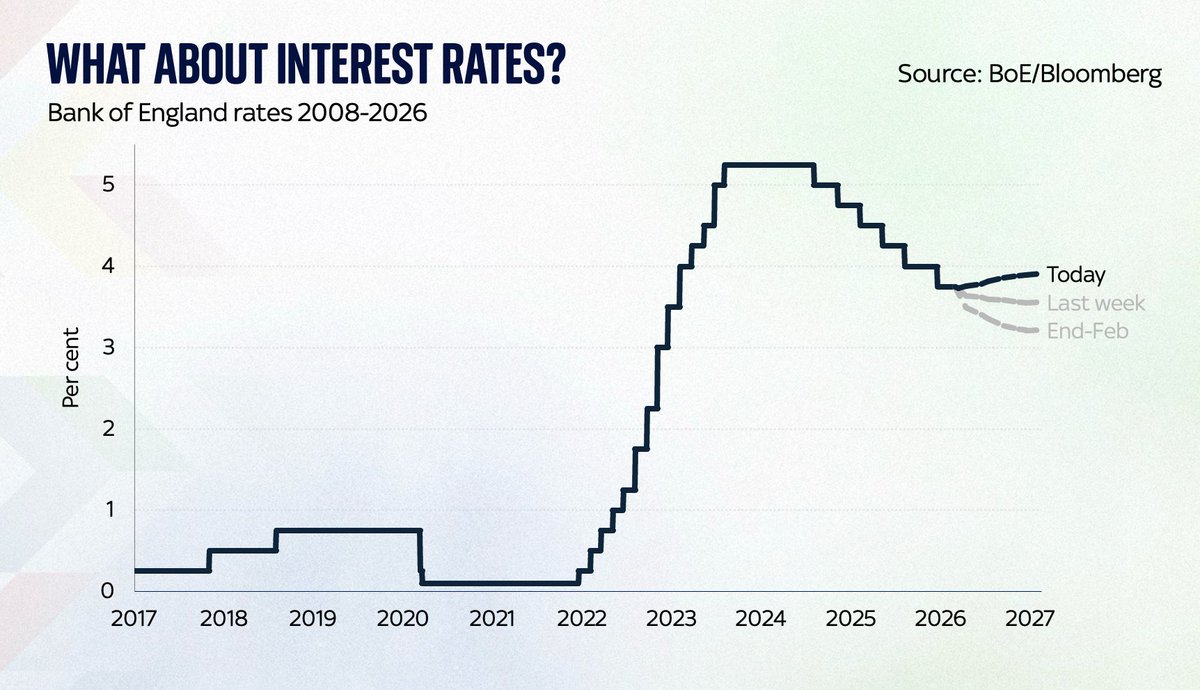
👀A week and a bit ago economists and investors expected two more @bankofengland interest rate cuts this year.
Last week they expected no rate cuts.
As of today they expect rates to INCREASE.
An extraordinary turnaround, courtesy of the energy price shock emanating from the Gulf
The total underlying trade deficit narrowed £3.3bn to £3.8bn in Quarter 4 (Oct to Dec) 2025.
The trade in goods deficit narrowed £2.0bn to £58.0bn while the trade in services surplus widened £1.4bn to £54.3bn.
Read the article ➡️ https://t.co/w18VpMN6F4