New investment is needed to make a radical dent into our NEET rate.
Restoring FE funding for 16-18-year-olds to its 2010-11 level would cost around £1 billion, while matching average OECD spending on tailored employment support schemes would mean spending at least £5bn more.
➡️ https://t.co/xyEs0p6p6f
Can Milburn rise to the scale of Britain’s NEETs challenge?
In our latest Substack, Alex Clegg and Nye Cominetti highlight five things to look out for in next week's review 👇️
https://t.co/HhuaeuNNQ4
PIP recipients report a huge variety of conditions, and most have multiple conditions.
While three-in-ten (31 per cent) report having depression, just 2 per cent of all PIP recipients report depression as their only condition.
Only one per cent (or less) report having only anxiety or ADHD.
Over the summer, Andy Burnham set out his vision for a National Care Service. But details on how this would be designed and funded have so far been limited.
Join us to discuss the options with Andrew Dilnot ⤵️
https://t.co/1QDnYAT8kU
New research reveals that fewer people, and particularly men, want to work full-time.
Could that be due to the rise of hands-on dads? Hannah Slaughter explains, probably not ⤵️ https://t.co/3mmdck9LBP
5. ... but of course running those services costs money. Compare what the UK spends vs the rest of the OECD. There might be some savings via benefits reforms, and to some extent better services might pay for themselves via lower caseloads. But those may not bridge the whole of the spending gap.
Alan Milburn’s Review into Young People and Work is now expected next week.
So ahead of this, Alex Clegg and Nye Cominetti have written about five things to look out for 🧵 👇️
https://t.co/ldB7M6c22H
4. Re-engage young benefit recipients. There are 260k young people on inactivity benefits (UC Health) who are basically left alone. As is the case in Netherlands and elsewhere, most should instead be required to engage with employment support services (broadly defined - including training/education)
How can we help young NEETs into employment?
Targeted job schemes are better than broad tax breaks.
Doubling the funding for the existing Youth Jobs Grants and Jobs Guarantee is much more cost-effective than untargeted tax breaks.
More in our latest Substack ➡️ https://t.co/xyEs0p6p6f
PIP is paid regardless of employment status, in order to contribute to the additional costs of disability.
But among recipients, costs and function aren't perfectly related. A third (34 per cent) report a mismatch between their level of limitation and whether or not they face extra costs.
🚨 Substack latest
With Milburn's review expected next week, Alex Clegg and Nye Cominetti highlight five key points to look out for ⬇️
https://t.co/ldB7M6c22H
The costs faced by PIP recipients are varied.
Costs which can be thought of as an increased need for ‘everyday consumption’ (such as heating and energy bills, transport and food) are more common than tangible ‘disability-related’ goods or services ⤵️ https://t.co/iGpo96agro
The UK is now five years into an energy-driven cost of living squeeze, and it's long been clear that this winter would be difficult for many.
Yet support in the Budget was widely spread and badly targeted.
Full Budget analysis➡️ https://t.co/wC4XX2TDvM
Day-to-day spending is growing moderately in this Parliament.
On public services, this is set to grow by 1.7 per cent a year in real person terms between 2023-24 and 2028-29, similar to the two most recent periods under Conservative governments.
For our full Budget analysis📈⤵️ https://t.co/BiRaRMS3De
Small change? 🪙
Chancellor Healey had two challenges to meet at his first Budget... and Ruth Curtice doesn't think he did quite enough on either ⤵️ https://t.co/RY2WDq7BrT
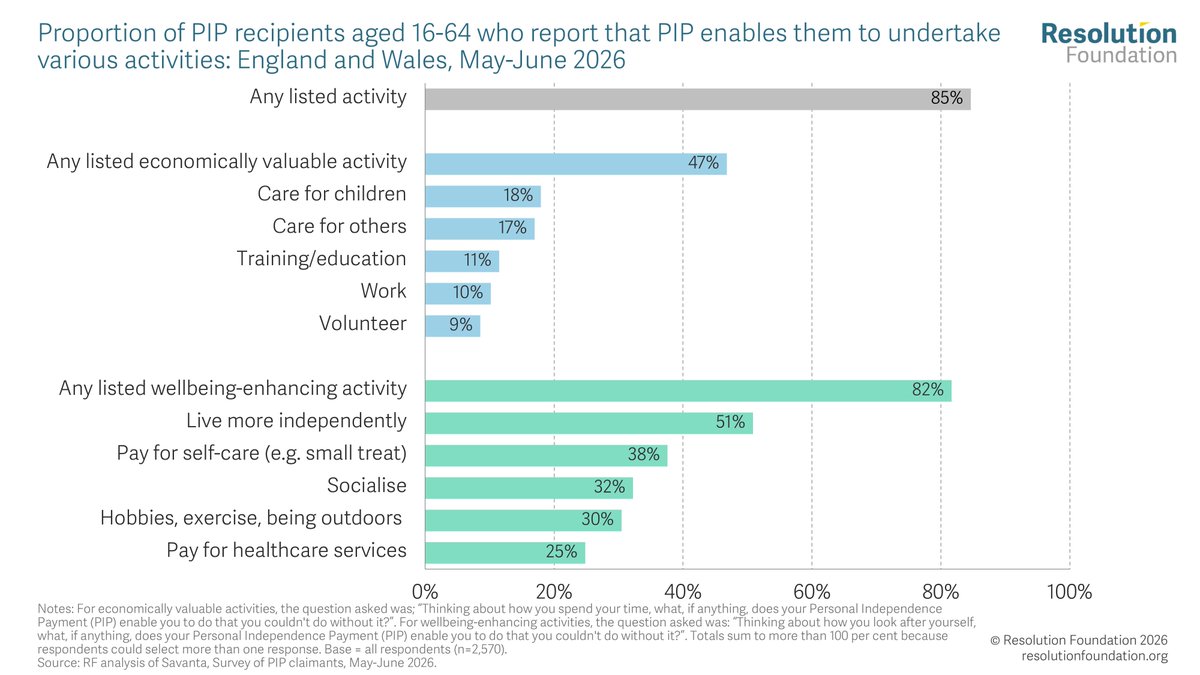
A majority of PIP recipients undertake economically valuable or wellbeing-enhancing activities that they could not do without support.
Close to half (47 per cent) report that the benefit enables them to do at least one "economically valuable" activity, including working, training or caring.