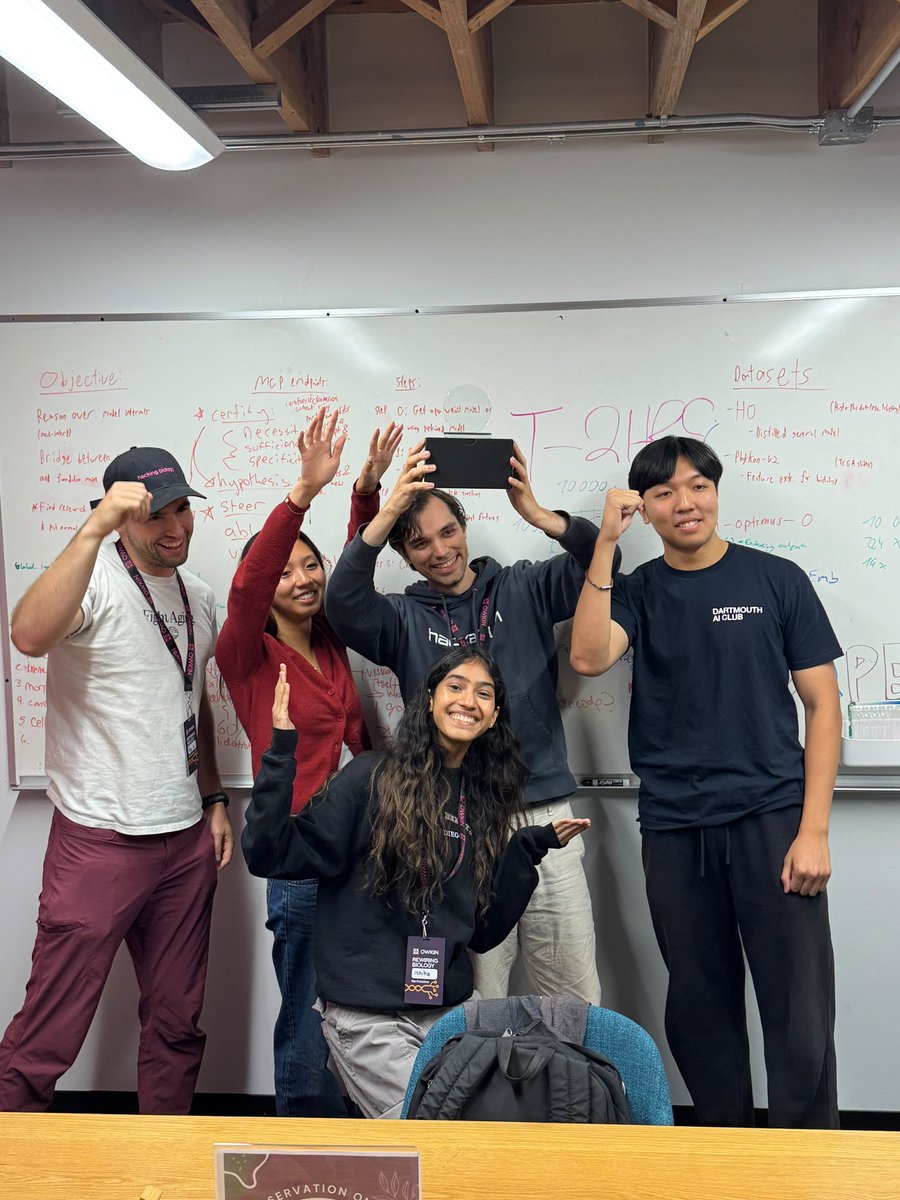
Excited to have won @OwkinScience Rewire Biology Hackathon this weekend in SF. We built K Scope an MCP server on top of Owkin’s AI scientist platform K Pro. We allow K Pro’s orchestrating LLM to access model internals through mechanistic interpretability tools like probes, sparse auto encoders, and activation patching. This allows these AI scientists to not only get inputs/outputs from these ML models but truly understand the causality of how these black box models reason. We incorporated Owkins open source models like their pathology ones: H Optimus and Phikon. Was a ton of fun and very thankful for my teammates and all the passionate AI x bio people I met.
Below is the repo link and our demo. Please check it out!
https://t.co/9tPGPuelc9
@anshulkundaje@vineettiruvadi I think as always it is a data problem as well. For a lot of multi modalities there isn’t as much paired data as individual methods so this would help with multi modality. Probably need more granular datasets as most things perturbation or sequence driven
@theo_jala Would love to connect! Have been experimenting in various mech interp directions for biology and I think this is essential for wet lab translations. Model internals can tell us a lot about interventional awareness in these bio fms
@exnx@RadicalNumerics Would love to talk! I have been running various interp experiments on Evo2 and would love to leverage these discoveries of limitations into better generative nucleotide models
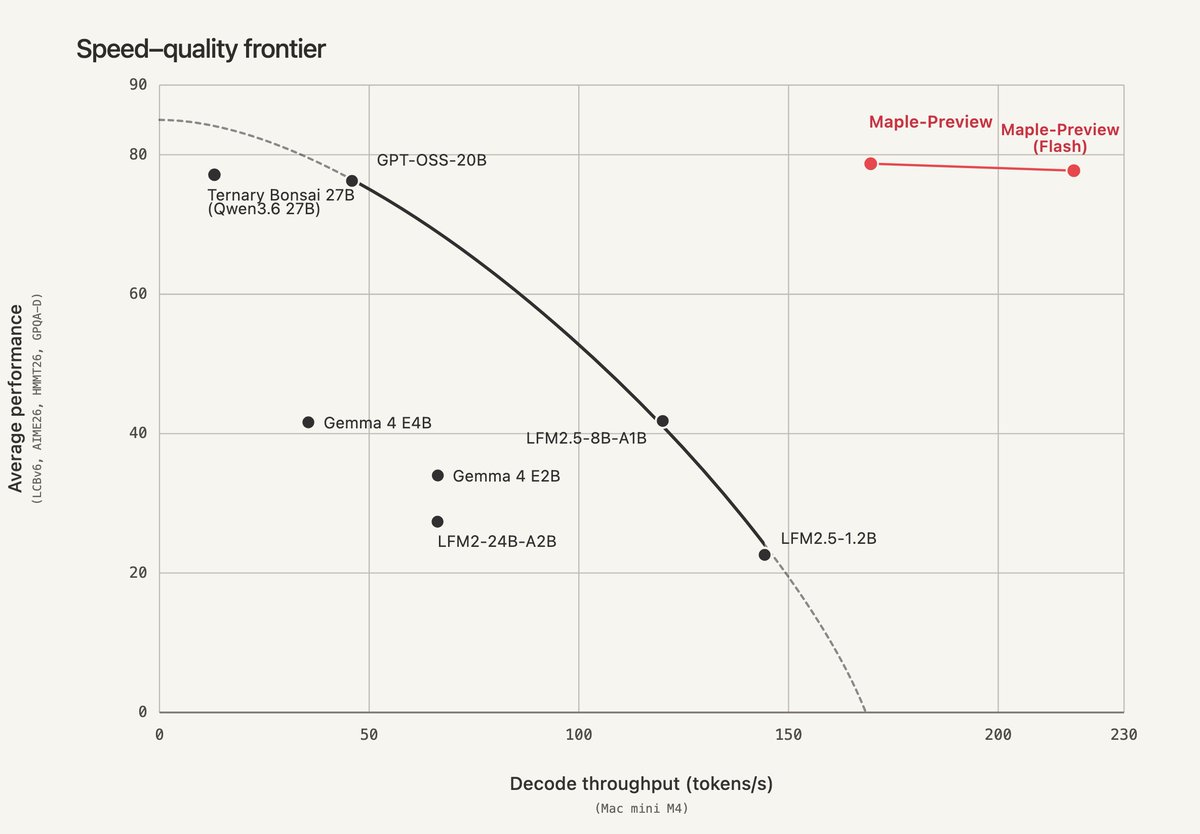
We introduce Maple-Preview, an open-source 20B-A1B ternary-weight reasoning LLM, SOTA in its weight class.
It solves IMO-level problems and runs at 200+ tokens/s on a Mac Mini M4, 5–16× faster than efficient models like Gemma 4, Qwen3.5, and gpt-oss.
https://t.co/l2y5eZTVS4
Introducing Biomni-Tuso, a new recipe for auto-research in biology AI model.
We asked Biomni to develop a genetic perturbation prediction model and let it run for five days. It explored 500 configurations and discovered a new method that outperformed the leading methods across multiple benchmarks.
We've since applied the same recipe to protein structure representation learning, enhancer–gene linking, ligand binding, and more, consistently discovering new leading models.
Biomni-Tuso doesn't just tune hyperparameters. It works like an AI bio researcher for you: reading literature, thinking about orthogonal bio data sources, and testing fundamentally different modeling ideas.
We believe this is where bio AI model research is headed. Instead of spending months building models by hand, researchers can describe a problem in natural language and let Biomni explore hundreds of ideas on their own data, while handling all the ML infra.
Biomni-Tuso is now available as an auto-research skill (under "tusoskill") in Biomni Lab for all enterprise users. On the public platform, it is available to all users on CPU-based tasks. As we prepare for a broader rollout for GPUs, we're giving 500 GPU hours each to 100 Biomni Lab users to start building today. Apply here: https://t.co/lBNbiB8K3d
Amazing work led by Alistair Turcan with @martinjzhang
Example replay: https://t.co/1iII6We4d5
Open sourced genetic perturbation model: https://t.co/lgMJqqHcSe
Learn more: https://t.co/IXXKB22qp6