📄 New article in the EECERJ:
Engaging children in what-if thinking through read-aloud conversations in early childhood education for sustainability
Niklas Pramling and Ingrid Pramling Samuelsson
https://t.co/Pu1f7Yjbq4
#AcademicResearch#NewResearch#EECERJ#EECERA
In December 2024, the Center on the Developing Child launched a new website! 🎉 Our new site features resource guides to help you learn about key scientific concepts in early childhood development.
Check out the Guide to Executive Function here: https://t.co/ZvGYV4IBkg
“How was your day, Cora?!”
This video is such a lovely illustration of toddler play that I couldn’t resist sharing.
Here we see some of Cora’s early imaginary play - imitating a routine that plays out in her house each day as her older sister leaves for (and returns from) school.
Notice that it’s not BEING at school that she wants to reenact (a concept for which she lacks personal reference), but the process of coming and going - alongside the tender family interactions that occur during each.
So armed with an old backpack labeled with her sister’s name, she heads off “to school,” using a board book to symbolize a cell phone - as both her mom and older sister wish her well.
Seconds later comes the big payoff. She “returns home” from down the hallway and is greeted by big sister with the same enthusiastic “how was your day” that the girls mother has doubtless modeled hundreds of time.
Watch how Cora’s face lights up when the question is finally posed to her… and hear the excitement in her voice as she answers just like her big sister.
So lovely.
This sweet interaction was shared by TBO Family.
From Mathematics Teaching: "The question I ask myself is: can I step back and give children more creative control whilst at the same time increasing the frequency that children encounter the learning I wish them to master?"... read for free. https://t.co/WOI1X4r8zi
Re-sharing this book edited by @aimee_durning and PEDAL's @paulramchandani and @SaraBCam as there was lots of interest at the #PEDALConference2024 📚
https://t.co/S5mv7LJSXV
Just found 2 #ElectricPicnic tickets down the side of the couch 👀
RETWEET and REPLY if you want them & we'll pick a winner by 8pm today 👇
T&C's apply
Ever buy your toddler a gift only to find they’re more interested in the box than its contents?
This week I’ve been demystifying toddler behavior by introducing play schemas - 9 common behavioral patterns common to young children.
The better you understand them, the easier your toddler’s behaviors become to interpret and manage.
Which brings us to this little cutie, who is engaged in the enclosure schema.
As its name implies, enclosure play involves containing things (putting one item into another) - or placing borders around objects or themselves. It’s all about marking physical boundaries - which can contribute to a sense of security.
And what could be better for the enclosure schema than a box?
So don’t despair, gift givers!
Box play is neither a cause for alarm, nor an indication that your child doesn’t like their actual gifts.
It’s just that they’re very drawn to enclosure play. And, in some cases, more developmentally drawn to boxes than to the toys inside - which is one of several reasons I’m an advocate for limiting the number of toys you purchase and make available at any given time.
Your toddler doesn’t need dozens of choices.
In fact, research suggests that children play longer and more meaningfully when provided fewer toy options.
To be clear, I’m not advocating against age-appropriate toys. They’re essential. But you don’t need piles and piles of them. In this case less can be more.
And before you go rushing to the recycling bin, keep an eye out for boxes you might let your toddler explore safely.
This enclosed little one was shared to TT by tianajess.
Daily reading is a gift to your baby. 📚
And this mom is giving an absolute master class in how to do it right.
Note first that she’s reading face-to-face. At this age (10 weeks), there is literally nothing more thrilling - or instructional - to your newborn than your face.
Check out how intently focused baby is on mom’s voice and facial expressions.
Through careful study this little one will soon begin to mimic what they see and hear.
Mom reads with expression and emotion, alternating between glances at the text and direct eye contact with her adoring audience of one.
And there is so much going on in that developing brain.
Did you know that during the earliest years of life babies form new neural connections at an estimated 1 million per SECOND?
With these types of rich daily interactions, mom is setting her baby up for a lifetime of success. And you can do the same.
Read, talk, sing and play with your baby.
Kudos to KelseyPaumer (IG) on this fantastic and educational 🎥 clip.
Do you work in early years?
You may meet families facing difficult challenges, from homelessness, issues of substance dependency, or those who may have recently suffered the loss of a baby.
Read our guidance on working with families facing challenges:
https://t.co/f4uPZhahoh
Want to learn more about self regulation and how to support its development? This is one of our most popular clips with the late, great David Whitebread: https://t.co/23fAYO6sOA #earlyyears#expert#selfreg#eymatters
"We, as children, as adults, need to be comfortable with risk" - interview with @mbrussoni and @suzannebeno about children's outdoor risky play. Youtube link: https://t.co/2EXgKpHMPq
My new article👇investigates kindergarten teachers’ perceptions of AI literacy education for young children
#AIliteracy#education
https://t.co/uFcZahUZaY
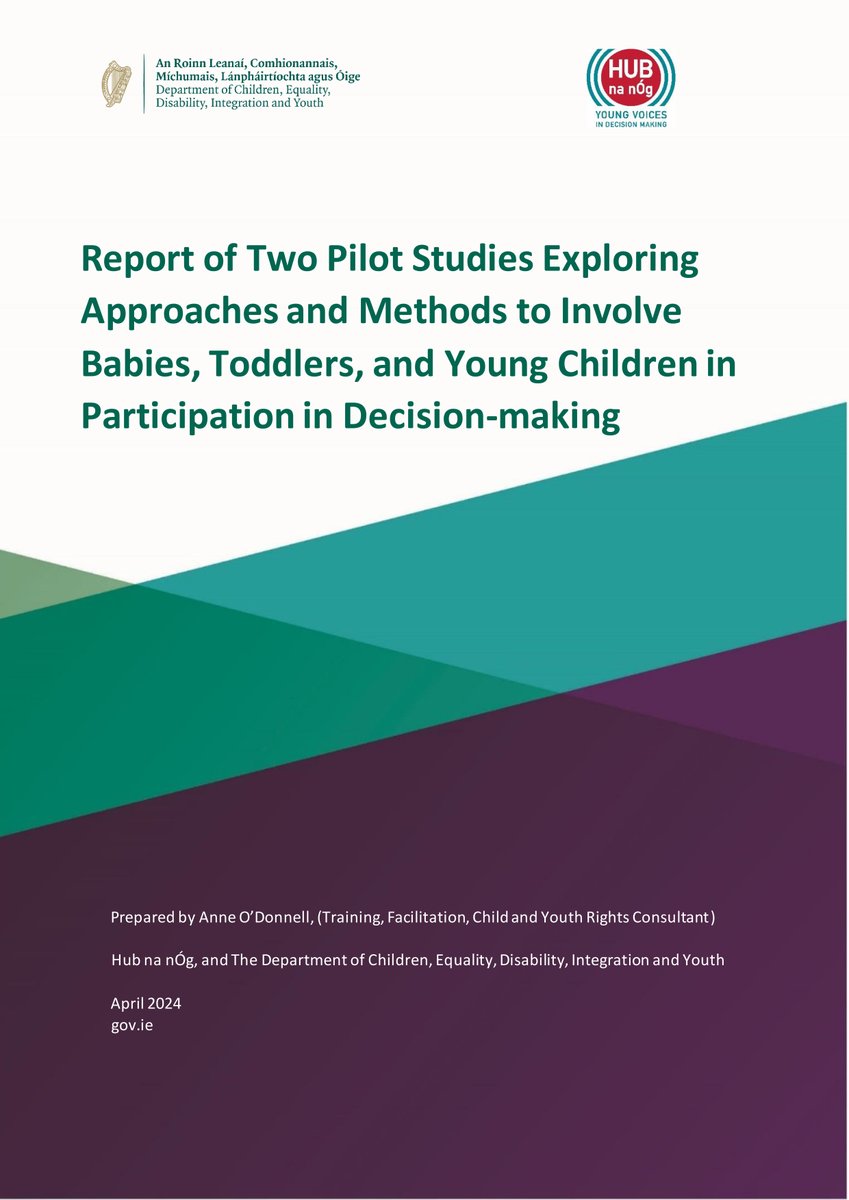
As part of our work in the area of participation in decision making for babies, toddlers, and children, Hub na nÓg are delighted to launch two new resources commissioned by Hub na nÓg and the Department of Children, Equality, Disability, Integration, and Youth (DCEDIY).
Firstly, a Literature Review on Methodologies for Consulting with children aged birth to 5 years prepared by Deirdre Horgan is now available to read on our website: https://t.co/Gt45pF2Tbw
Pilot studies were undertaken with early learning and care services in partnership with Hub na nÓg’s Early Years Working Group made up of stakeholders from the policy, academic, creative, and early years sector. The report of the pilots prepared by Anne O'Donnell is now available to read on our website: https://t.co/S4RCsdbyJx
Hub na nÓg are continuing to develop resources for this cohort to remove barriers to ensure all children can have their right to participate in decision making realised.
Thank you to everyone involved in these projects particularly the authors of the pieces of work and to the services involved in the pilots.
#EarlyYears #EarlyLearningandCare #LiteratureReview #PilotStudy #Participation #Children
@dcediy