How can a black hole outshine billions of stars?
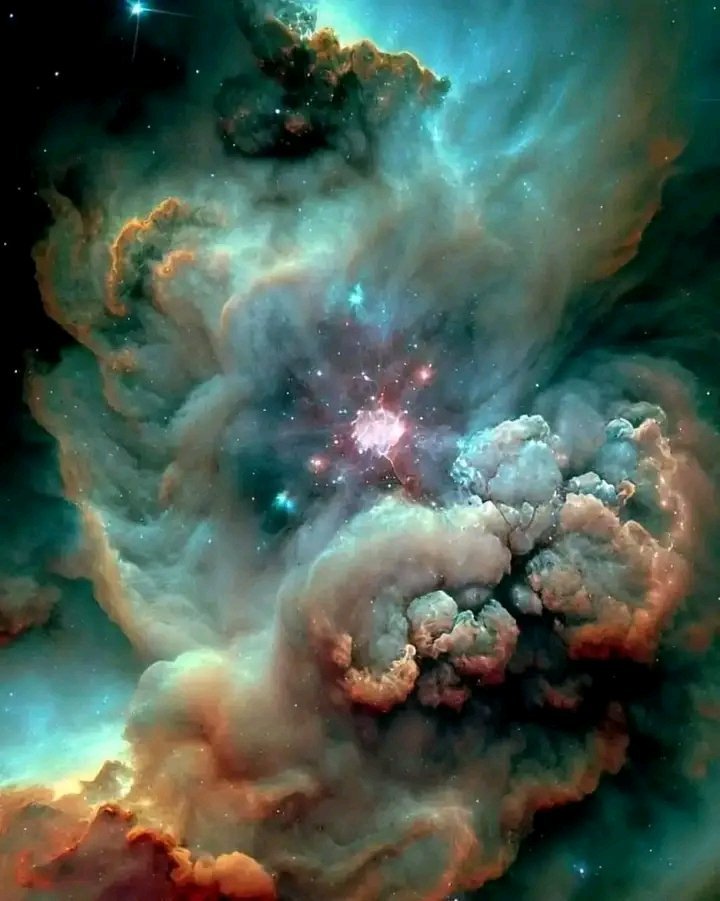
Gaze into this stunning Hubble portrait of the spiral galaxy ESO 021-G004, a cosmic jewel spinning 130 million light-years from Earth. Its graceful arms of dust and glowing gas swirl outward in quiet beauty—yet at its heart blazes a paradox that defies intuition: a core so fiercely luminous it rivals entire galaxies. How is that possible when a black hole is supposed to swallow everything, even light itself?
The answer is not some mysterious glow leaking from the void. It is a violent, dazzling spectacle of gravity, motion, and pure thermodynamic fury unfolding right at the edge of oblivion.
Picture a cosmic bathtub drain of unimaginable power. As gas, dust, and shattered stars spiral inward, they form a vast, whirling accretion disk—an enormous, flattened maelstrom locked in the black hole’s grip. Here the rules of everyday physics break down. Gravity is so extreme that material races around at speeds approaching the speed of light. Particles slam into one another with catastrophic force. Friction turns savage.
The result? Temperatures soaring into the millions of degrees. The disk becomes a seething furnace, converting gravitational potential energy into a torrent of radiation—blinding visible light, ultraviolet, and X-rays that scream across the universe. This is the active galactic nucleus: a lighthouse powered not by the black hole itself, but by the doomed matter crowded at its doorstep, glowing with one final, spectacular rage before crossing the event horizon forever.
So the black hole does not shine. The universe shines because of it—matter’s last brilliant protest against the darkness.
Image Credit: NASA/ESA Hubble Space Telescope; Processing: NASA/Aurel Costel Agapi
The heart of IC 1396: the Elephant’s Trunk
Total exposure: 26h 49min
Every detail visible here represents a phenomenon unfolding over millions of years.
🔭Gallifrey Optics CDK 400mm F/7
📷ASI6200MM Pro
Sky-Watcher EQ8-R Pro
Optolong RGB #SHO-3nm 2" Filters
Credit: Gaëtan Maxant
Hidden within dense clouds of cosmic dust, newborn stars emerge in this stunning view of the Christmas Tree Cluster.
Credit: NASA/JPL-Caltech/P.S. Teixeira (Center for Astrophysics)