🆕💥🟢Antibiotic penetration in the male urinary tract: a critical review of pharmacokinetic and pharmacodynamic evidence #idxposts
https://t.co/oxDKP2q9QZ
🆕💥🟢Network meta-analysis of randomized trials
35 RCTs (10,627 patients)
Comparative efficacy and safety of extended versus continuous infusion of beta-lactam antibiotics for severe infection
In patients with severe infections, both EI and CI improved clinical cure versus IB, whereas mortality did not differ significantly #idxposts
https://t.co/TK0gc2Rsae
🆕💥🔴Efficacy of doxycycline in treatment of Staphylococcus spp. prosthetic joint infections: a CRIOGO multicentre case–control study
No significant difference was observed between doxycycline-based regimens and comparator strategies, with acceptable tolerability #idxposts #OMWiki https://t.co/2jDXAWwkEl
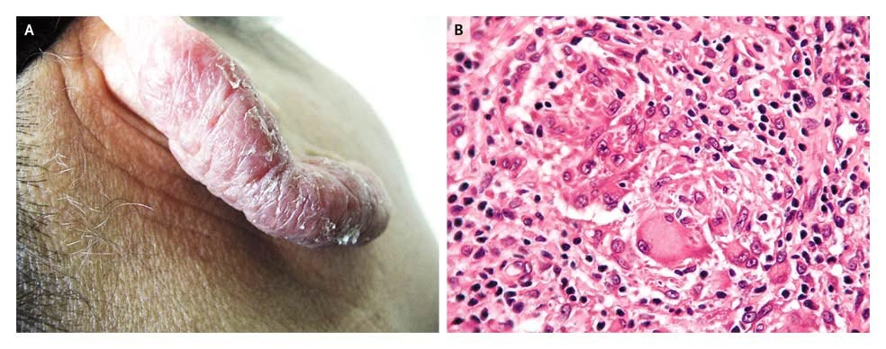
52-YO ♀️ from Tunisia: a 2-year history of an asymptomatic, thick, reddish infiltrated plaque on her right ear (A)
🔬: epithelioid granulomas suggestive of leishmaniasis, tuberculosis, or sarcoidosis (B)
½
DOI: 10.1056/NEJMicm0708175
#dermatology#MedEd#IDMedEd
🆕💥🟢Multicentre evaluation of pharmacokinetic/pharmacodynamic target attainment of piperacillin and tazobactam and the association with clinical outcomes in critically ill patients with sepsis and septic shock
Simulations indicated that a 4.5 g loading dose followed by 4.5 g every 6 h as a continuous infusion achieved effective and safe exposures in patients with CLcr 50 to 130 mL/min #idxposts https://t.co/dRNQRBbfj4
Which drug can turn a treatable infection into a dangerous bowel condition caused by C. difficile?
A. Clindamycin
B. Vitamin C
C. Loratadine
D. Paracetamol
.
@ABsteward asked for thread/rant on fosfomycin for the treatment of cUTI. People like to cite the shmidelines from IDSA to say, don't use fosfo for cUTI because fosfo achieves bad levels in the kidney, blah blah blah.
So, can you use fosfo to treat pyelo? Short answer: YES!...
En #Bacteriemia x #Saureus Sensible Meticilina🩸🍇❌🛡️prescribir #Cloxacilina o #Cefazolina💉⚖️💉? En @NEJM 👉🏻#SNAPtrial abierto y randomizado: CEFAZOLINA igual mortalidad (15🆚17%)🟰☠️pero menor insufic. renal (19🆚13%)📉🚽
Recuerdalo en la próxima!🤔
🔗 https://t.co/hiAQVoCiNX
¿Condiciona la carga viral del VIH el pronóstico del linfoma? Un estudio multicéntrico de la cohorte española CoRIS (2004-2022) analiza el impacto de la supresión virológica en los desenlaces de linfomas de Hodgkin (LH) y no Hodgkin (LNH). 👇
🔥Just approved 🔥
The FDA has approved Utebzi (tebipenem pivoxil) tablets as the first oral carbapenem therapy for adults with complicated urinary tract infections, including pyelonephritis , caused by several susceptible microorganisms in adults who have limited or no alternative oral treatment options #idxposts
@BradSpellberg@IDstewardship
https://t.co/OTTSoFlNOl
Fournier’s gangrene is a rare, rapidly progressive necrotizing fasciitis of the perineum, genitals, or perianal region.
Most cases begin with a known portal of entry or occur after trauma or surgical procedures in the affected region. The infection is typically polymicrobial, involving anaerobic and aerobic bacteria.
The clinical picture is characterized by rapid progression and high mortality, ranging from 7.5 to 88%. Factors contributing to higher mortality include delayed diagnosis, extensive tissue involvement, and the presence of coexisting conditions.
Prompt recognition is critical owing to the aggressive nature of the infection and associated high mortality.
SGLT2 inhibitors have been associated with an increased risk of Fournier’s gangrene. A postmarketing analysis (2013–2019) identified 55 cases among patients taking SGLT2 inhibitors. In contrast, 18 cases were reported among patients taking other antidiabetic agents between 1984 and 2019.
SGLT2 inhibitors block glucose reabsorption in the proximal renal tubules, which leads to glycosuria. The resulting glucose-rich urine creates a favorable environment for bacterial growth and infections in the perineal region, an area with multiple microbial sources. In addition, challenges in maintaining local hygiene and dryness, along with relatively limited vascularization, increase susceptibility to soft-tissue infections in this region, including Fournier’s gangrene.
Given the expanding use of SLGT2 inhibitors in clinical practice, clinicians should be aware of the association between SGLT2 inhibitors and Fournier’s gangrene, even though diagnosis is very rare. They should discuss this risk with patients and monitor for signs of infection. No clear temporal relationship exists; cases of Fournier’s gangrene have occurred years after initiation of therapy.
Learn more and test your diagnostic and therapeutic skills in “Cutting to the Chase,” a new Interactive Medical Case: https://t.co/DmpVBE3DyU
#MedicalEducation
Most important result of the world cup so far:
! PEN beats FLUCLOX!
'benzylpenicillin should be preferred over flucloxacillin or cloxacillin for treatment of PSSA bacteraemia'
https://t.co/qlvGKT35Cp
🧫 SULOPENEM: nuevo carbapenémico ORAL para infecciones urinarias.
💊 Aprobado por la FDA como Orlynvah®.
😥 Pendiente su aprobación por Agencia Europea del Medicamento y su comercialización en España
https://t.co/ryUPcG7AtM
30year-old female presented with a painful lesion on the ear for 3 months
Clinical History
Persistent tender lesion over the external ear.
No response to multiple courses of topical and systemic antibiotics.
Uses a hearing aid continuously in the same ear.
Examination
A solitary tender ulcerated papule located on the antihelix of the ear.
No surrounding signs of acute infection.
What do you think it's about?
Q. These recurrent oral lesions are most commonly associated with deficiency of which vitamin?
A. Vitamin A.
B. Vitamin C.
C. Vitamin B12.
D. Vitamin D.