There is no upside to these AI witch hunts. Bad writing is bad writing. Good writing is good writing. These tell tale signs everyone points to are well used, time tested tools of writing and story telling. Not X but Y? As I wrote in a piece I published here(link in next tweet), you can find dozens of examples in books by James Baldwin, Margaret Atwood, The Bible, The Hadith. Mentioning things in groups of three? A standard tool in lots of very good writing. Em dashes? Just part of the language. And where does it all come from? From writing that we have put out in the world. From our novels and stories and essays. AI did not invent any of this.
I have used all of these quite often over the last 15 years. Unless you want people to actively avoid everything that could be construed to be AI, I don't see the point of this.
Especially writing in groups of threes which is a fundamental rhetorical and psychological principle used by human writers for centuries. Why? Rhythm, emphasis, persuasion. That is why the tricolon (listing words or phrases in threes) works. That is also why the three act structure (setup, confrontation, resolution) works. The problem is not in the use, but in moderation and this can happen in any piece of writing, not just AI.
I read a lot of weird MFA writing where you can hardly distinguish one writer from another because they all write in that self-important navel gazing way that shows that they are more interested in impressing people (read: their professors and colleagues) with sentences than in telling stories. All of the fancy MFA stories that are about nothing, say nothing, except show that the writer attended a creative writing program, is that the great writing we are protecting? Stories that live and die in literary magazines and speak to no one?
There are bigger, more important questions to answer in and with literature. There are stories to be told. Emotions and phenomena to explore. Depths to be reached. None of these will be done by AI. Will (or can) AI help actual professionals and serious thinkers do their job more efficiently? Only time will tell. And trust me by the time this madness is over, you will discover that many more people than you think (or at least many more than admit) are using AI for a wide range of tasks related to story telling, and exploring ideas.
I also do not think that the writers who have writing teams and assistants and interns helping to produce their books are any better just because they use humans to produce the work we praise them for. Ideas and stories will live or die based on how well they speak to those who read them, not how they are made.
There's a whole industry built around African poverty. NGOs, consultants, conferences, awareness campaigns, celebrity endorsements.
Billions of dollars flow through this system every year, employing thousands of well-paid Westerners.
None of those people have an incentive for the problem to actually be solved, because if African poverty disappeared tomorrow, they'd all need new jobs.
I'm not saying they're evil.
I'm saying the incentive structure is broken, and incentives shape behavior more than intentions do.
There have been moments in the last few years when I felt I was the only one who was too broke for my age. When I felt that I was the only failure in my bracket of friends. I felt I had underachieved and, by any measure, was a loser.
It is a quiet shame, usually known to a few friends. Friends who care to forward you adverts to jobs they think you are qualified for, but they don’t know you stopped applying for jobs a long time ago. You can only handle so many rejections. You attend family functions, and relatives give you those askance looks, of doubt, disapproval, disappointment (not so much for you, but for the system and anyone responsible for your failures at life). By the time your mother starts to send you food from the village to go and pick from Easy or Ena Coach, you don’t know where to hide your head in shame. It is food sent purely for your survival.
My 30s were terrible, and I have even written a book about them. But I have not been alone in the predicament. Many college mates and childhood peers who held so much promise are broke and broken in so many ways; it is a crying shame.
In the 1990s, at the peak of the HIV/AIDS infections, there used to be a slogan, “If you are not infected, you are affected”.
Even if you were a well-to-do millennial, successful in your career, marriage, and in good health, one way or another, you are affected by the combined destructive years of Jubilee and Kenya Kwanza. The two regimes have succeeded in extinguishing the hopes and dreams of millennials and Gen Zs.
You are affected because your siblings are probably jobless. Your cousins are jobless. You are affected because education and health care are not accessible in the public sector, and you have to send your kids to private academies and your sick parents to private hospitals.
Even at their worst economically, our parents could afford to send us to public schools. When sick, public hospitals, even at their worst, did have a modicum of order, and well, you died without a debilitating medical bill.
Millennials now exist in that endless fundraising loop: Medicare, education, weddings, and sponsoring folks to try life out there. This month you have two funerals, next month you have two cancer patients, in April, a wedding of your niece, in May, a friend is relocating abroad, and he needs to raise some Sh 700,000 to pay some agent and sort the paperwork.
I guess you have seen many people complaining about the black tax. Working-class women have become louder about the exhaustion of the black tax, and men can’t yet gather their voice, yet their burden is double.
Beyond the black tax, I recently came up with what I call the buddy tax or buddy bailing. It is a situation where you must bail out your friends. It could be you who relies on bailouts. It could be people you were there for in the past, and now it is your turn. It could be a friend you simply cannot abandon. And strangers too.
In the past, it was a one-off, and then you hooked someone up with a job, a gig, or something more sustainable. But under Jubilee and more commonly under KK, getting a job became impossible. People took longer to get a job, that is, if they were lucky enough to get one.
In the meantime, inflation became toxic. The runaway cost of living consigned many people to negative coping mechanisms, and every time someone says ‘tutam! the hope diminishes further.
I have finished reading the ground-breaking essays on the Elephant, and I urge all of you to read them for context. To understand that you are not alone. That is not just you with nieces and nephews who are stranded at home. That you are not alone, in those WhatsApp Mchangos.
Read. Read. Read. And whatever you make of the essays, I hope they can make you think long and hard into the weekend.
Only the right political choices can rescue us.
Children absorb meaning before they have the tools to evaluate meaning. By the time their cognition is mature enough to question, the architecture is already built. Many adults unfortunately don’t have the metacognitive strength to interrogate the beliefs they inherited.
My life advice to you is to show up for the thing. I can’t count how many times I have wanted to cancel a meeting with friends because I was too tired, and then I ended up going anyway and having the time of my life. Human contact is better than screens. Show up for the thing.
We’re not against having kids, we’re against repeating cycles. We grew up in “perfect dysfunction,” so our tolerance for unhealed, unprepared parenting is low. We understand the weight of raising a human being, and that awareness makes the decision heavier, not easier. Some of us are choosing not to have children because we want to be whole first, or because we don’t want a life defined only by raising children. Choosing not to have kids is just as intentional and difficult as choosing to have them.
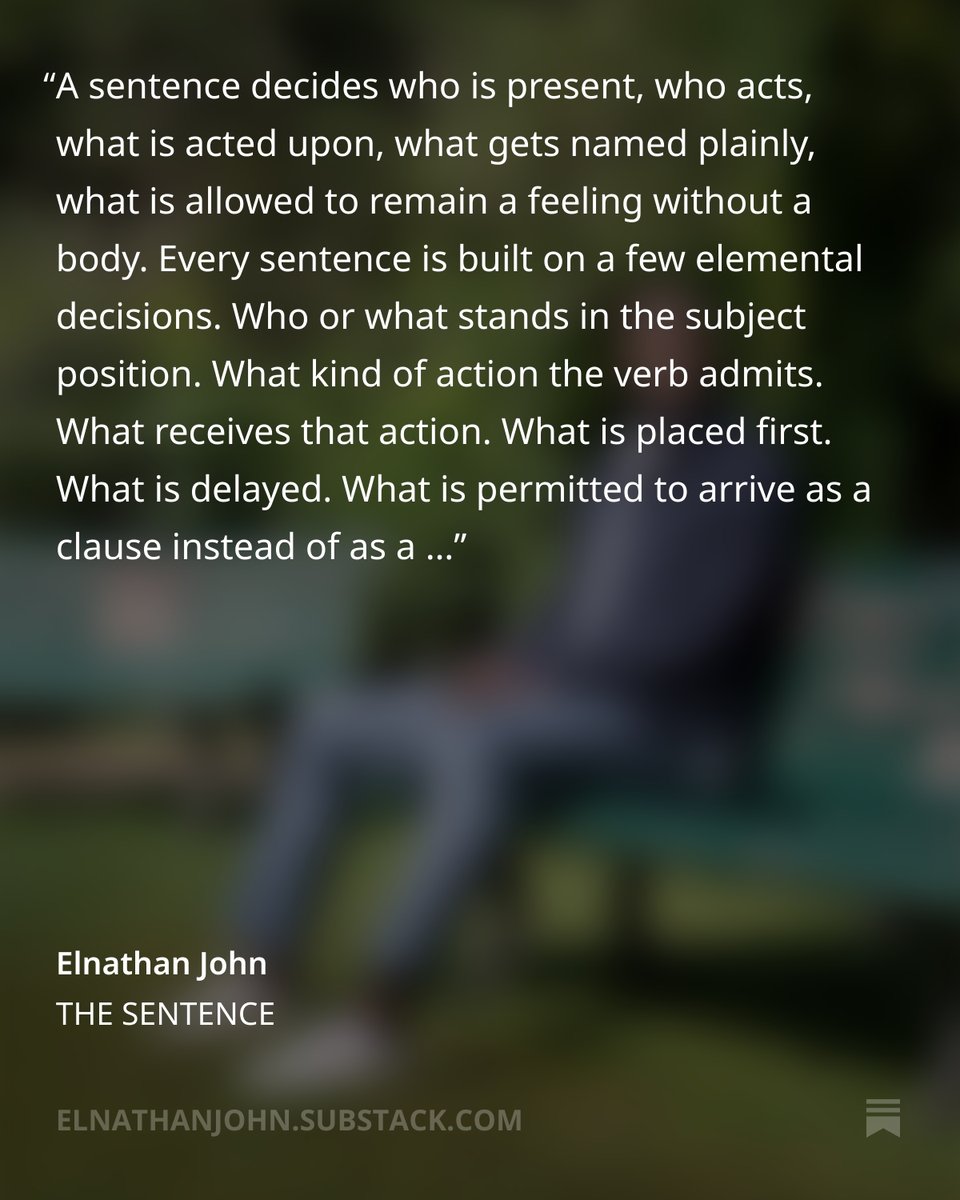
I can usually tell if I’ll trust a text by the end of its first sentence. Not because I expect brilliance, but because the sentence shows the writer’s relationship to attention, to language, to the reader.
My essay this week is on style, syntax and truth, in writing sentences. Read THE SENTENCE (It appears X still has issues reducing visibility for posts with Substack links so please help RT for visibility):
https://t.co/fSYZEGjlD0
Much of the comfort of getting older is from realizing the specific ways you’re different from others and feeling neither shame nor pride over them, and instead shrugging in a self-accepting humorous way to make decisions that actually suit the creature you are
@ogbeniseyi I travel by books and I rotate by country. I'm currently in Russia (War and Peace by Leo Tolstoy) and I was just in London (Great Expectations by Charles Dickens). I will be going to New York next ( Age of Innocence by Edith Wharton).
Reading expands the mind.
Something I kinda always knew but was confirmed last year is that you can't be what you can't see. Look for ways to make your world bigger. Travel, read, befriend larger than life people.
It really confuses me when an African says “Land is no longer a key to wealth in today’s world “
If Land was really useless, why do you think colonization started with land dispossession?
It’s because land is everything..Land is where food comes from,it’s where people live,where you raise your families, bury them,etc etc
Where our resources are..
You lose land and you lose food security,you lose autonomy and you end up becoming dependent on wages, imports and donors😳
He who feeds you, controls you.
We can diversify our thoughts and still retain our lands✌️
I read the Substack essay on Nigerian weddings. I personally dislike relationship conversations especially Nigerian ones, as most of them are shallow but in this case, there is plenty of scholarship one can refer to, for anyone who cares about deeper thought.
What is being described in that essay has been thought through, deeply, across feminist theory, philosophy, and psychology. The discomfort comes not from discovery, but from recognition.
In All About Love, bell hooks begins from a blunt premise: most people do not actually know what love is. They confuse it with desire, endurance, romance, sacrifice, and spectacle. They know how to perform romance, how to endure dissatisfaction, how to exchange resources for security. To anchor her argument, she draws on M. Scott Peck’s definition of love as “the will to extend one’s self for the purpose of nurturing one’s own or another’s spiritual growth.” That definition immediately exposes the lie at the centre of many relationships. Money, performance, and public display cannot substitute for care.
hooks insists that love is not a feeling but a practice. It requires care, commitment, trust, responsibility, respect, and knowledge. Without these, people may be attached, but they are not loving. What the essay calls a charade is exactly this failure of practice. Men and women are not simply deceiving each other. They are participating in a system that allows both sides to avoid truth.
Seen through that lens, Nigerian romantic life makes painful sense. Men lead with money not because they are necessarily shallow (yes, too many are), but because money allows them to bypass emotional exposure. Women accept money not because they are greedy (yes, too many are), but because demanding care in a patriarchal culture is costly. Both sides learn early that vulnerability is dangerous. So they negotiate safety instead.
This is not uniquely Nigerian. Erich Fromm diagnosed the same structure in The Art of Loving. Fromm argued that love is not primarily a relationship to a specific person but an orientation of character. In societies organised around market value like Nigeria, people approach relationships as transactions. They ask what they can get rather than who they must become. Men are valued for earning power. Women for attractiveness. The relationship becomes an exchange between assets, not a meeting of equals.
Weddings then stop being celebrations of intimacy and become public confirmations of success. Proof that the script was followed correctly. That is why they are loud. That is why they are expensive. That is why the marriage itself is almost secondary.
This is also why the Nigerian feminist contradiction described in the article is not surprising. hooks warns that feminism without a commitment to love as ethical practice collapses into convenience. You cannot reject domination while clinging to its rewards. You cannot demand equality while preserving financial hierarchy as destiny. Love requires shared risk, shared responsibility, and mutual accountability.
The hard truth is that most people do not want that. They want the benefits of old systems and the language of new ones. They want tradition when it protects them and progress when it flatters them. So they perform. They complain. They repeat the cycle.
It feels safer. It costs less emotionally. And it allows everyone, (men, women, and the feminists who bend feminism to benefit from capitalist patriarchy), to keep performing, loudly, expensively, and emptily.
The system persists not because it has not been criticised, but because it works well enough. For fear. For comfort. For appearances.
What registers as privilege depends on your desire. You may think your suffering is deeper, and that the desires of those who seem “more successful” are trivial. But no genuine desire feels “trivial” when it’s yours.
We all want the sharp edges of our lives to soften. That’s why everyone looks up and sideways. Why even rich people envy the driven, or the artistic, or the loved. Privilege is a geometry of angles and distances, and we’re all standing at a strange slant from something we want but can't quite touch.