Excited to see that my first TES article has been published 🥳
In this article, I focus on how we can use evidenced-informed principles to develop our pastoral practice. From Sweller's cognitive load theory to behavioural science, please do take a read & share. Thank you all 🙌🏾
Every teacher is a teacher of behaviour, habits and emotional regulation, so what are evidence-backed ways to do that?
Here are five key ways to bring research into pastoral leadership, according to pastoral leader Mohamed Ibrahim
https://t.co/G79A4xu9OA
A massive thank you to everyone who read my first Edunomics article 🙏🏾
The next one is now out:
'The Social Capital of Belonging'
Because attendance, behaviour and engagement are often shaped by one simple question:
Does this child feel known here?
https://t.co/XZaif1PeLM
1/
For too long, KS3 has been treated as the bit in between.
Not quite primary. Not yet GCSE. A bridge. A waiting room.
A place where ambition quietly becomes diluted.
I had the pleasure of being this months guest on @uk_mta!
We spoke about everything from pastoral leadership, inclusive practice, exclusions, silent corridors and even different ways to become a more strategic Pastoral Leader.
Do take a listen!
https://t.co/zeMfuiTut2
The 5 Automatic Doors are not about creating a separate lesson for every pupil.
They are about improving the conditions of access.
I would be genuinely grateful if you could read, share or subscribe to my Substack if useful.
Full article here: https://t.co/oF9BNc6Yc1
I have been thinking about @SENDMattersUK's automatic doors analogy & what it means for classroom access.
Some adjustments are a barrier for no one, useful for many & essential for some.
I wanted to develop on this further on the idea of the 5 Automatic Doors to Learning. 1/10
If you haven't yet had a chance to read my article on the theory of the '5 Automatic Doors to Learning', I'd greatly appreciate your thoughts and views!
https://t.co/oF9BNc6Yc1
I have been thinking about @SENDMattersUK's automatic doors analogy & what it means for classroom access.
Some adjustments are a barrier for no one, useful for many & essential for some.
I wanted to develop on this further on the idea of the 5 Automatic Doors to Learning. 1/10
The 5 Automatic Doors are not about creating a separate lesson for every pupil.
They are about improving the conditions of access.
I would be genuinely grateful if you could read, share or subscribe to my Substack if useful.
Full article here: https://t.co/oF9BNc6Yc1
I have been thinking about @SENDMattersUK's automatic doors analogy & what it means for classroom access.
Some adjustments are a barrier for no one, useful for many & essential for some.
I wanted to develop on this further on the idea of the 5 Automatic Doors to Learning. 1/10
Automatic doors do not lower the standard of the building.
They make entry possible. In the same way, inclusive teaching does not lower expectations.
Barrier for none. Useful for many. Essential for some.
That is the point of the 5 Automatic Doors to Learning.
10/10
This is incredibly interesting and a very honest yet respectful (evidenced informed) view on a topic that can usually bring a lot of emotion to the table. Bravo as always @PepsMccrea and @Steplab_co
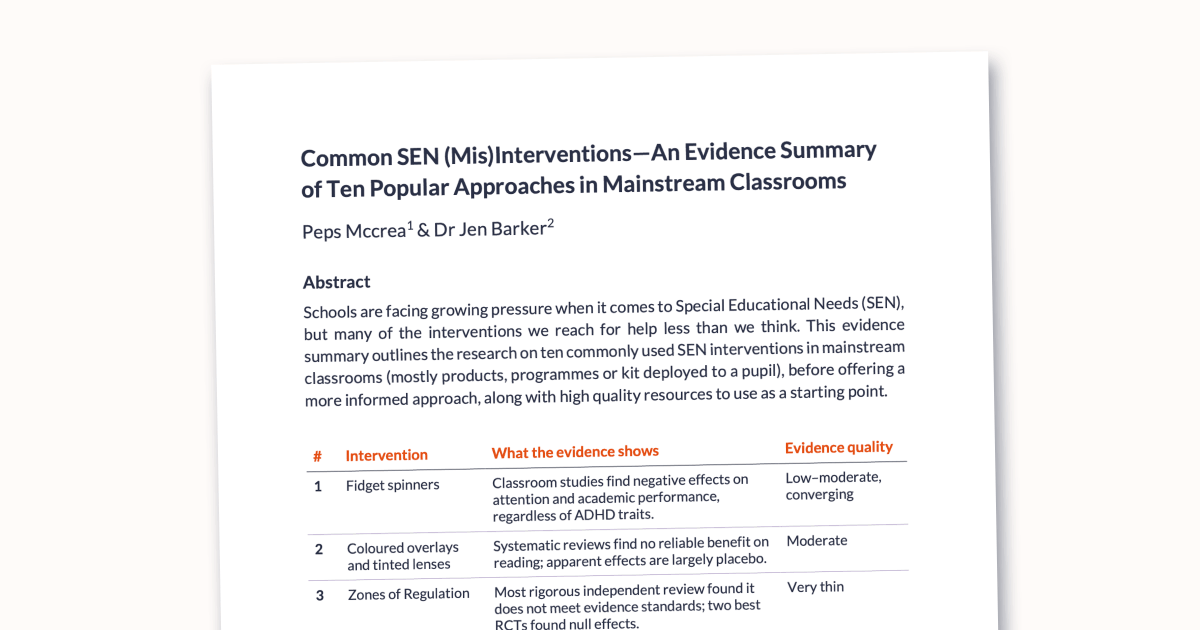
🚨New paper released today:
10 Common SEN Mis(Interventions)—An Evidence Summary
https://t.co/8lQNH00Co4
Supporting students with Special Educational Needs (SEN) is a vital and growing challenge for schools. But it’s not straightforward. Learning is complex, marketing claims are confident, and the evidence is often hard to access. As a result, we can sometimes end up adopting approaches which are less effective than we initially think.
For some, this may well be uncomfortable reading. As a profession, many of us have put time, effort and belief into these things, and lots will have seen students who looked like they were getting something from it. However, it’s essential that we temper our intuition with evidence, because ultimately: our most vulnerable students deserve it.
This new paper co-authored with @Barker_J is an attempt to raise the visibility of the best available evidence around several commonly used SEN interventions. For each, we provide an overview of what the research says, offer a more informed approach, and provide a suite of rigorous links to help you get started.
We hope it will serve as a useful resource and over time: push us to be even more 'evidence demanding' as a profession.
As ever, let me know what you think. If you have pushes or suggestions for how this paper could be better, hit reply and give it to me straight.
👊
🚨New paper released today:
10 Common SEN Mis(Interventions)—An Evidence Summary
https://t.co/8lQNH00Co4
Supporting students with Special Educational Needs (SEN) is a vital and growing challenge for schools. But it’s not straightforward. Learning is complex, marketing claims are confident, and the evidence is often hard to access. As a result, we can sometimes end up adopting approaches which are less effective than we initially think.
For some, this may well be uncomfortable reading. As a profession, many of us have put time, effort and belief into these things, and lots will have seen students who looked like they were getting something from it. However, it’s essential that we temper our intuition with evidence, because ultimately: our most vulnerable students deserve it.
This new paper co-authored with @Barker_J is an attempt to raise the visibility of the best available evidence around several commonly used SEN interventions. For each, we provide an overview of what the research says, offer a more informed approach, and provide a suite of rigorous links to help you get started.
We hope it will serve as a useful resource and over time: push us to be even more 'evidence demanding' as a profession.
As ever, let me know what you think. If you have pushes or suggestions for how this paper could be better, hit reply and give it to me straight.
👊