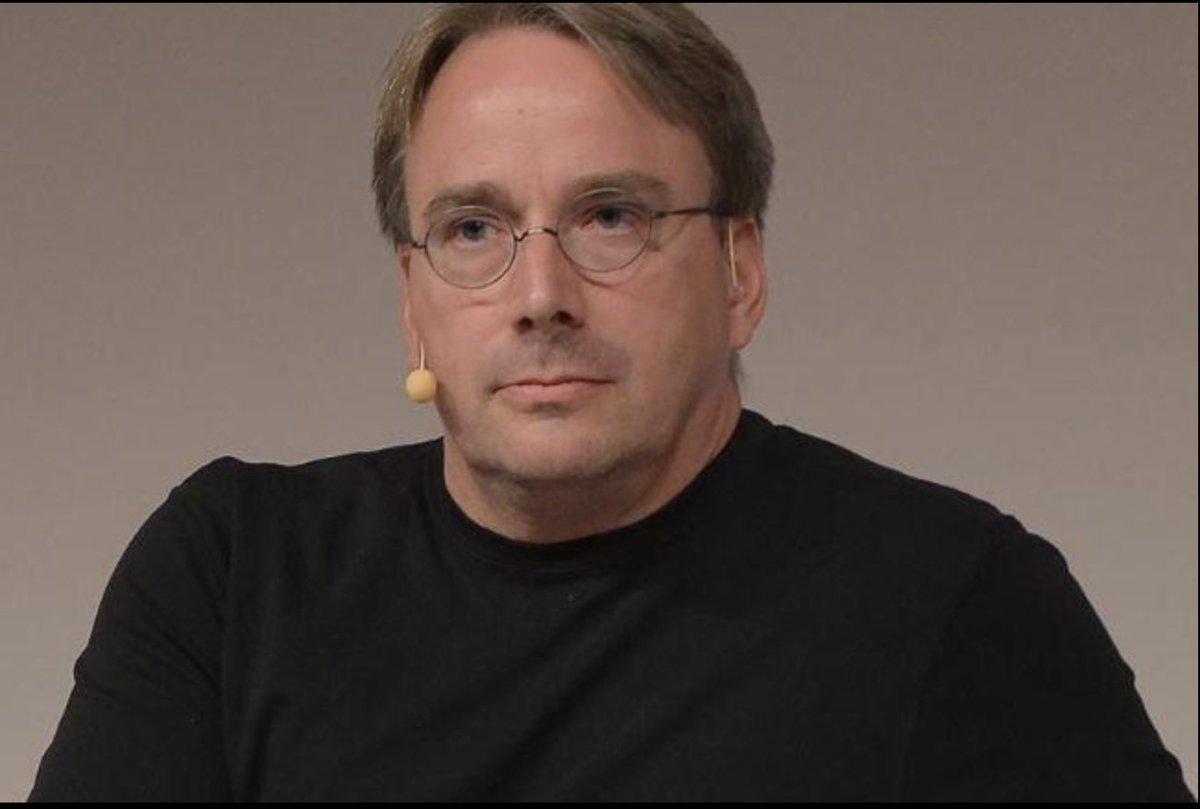
The creator of Linux just publicly called out the AI hype. Word for word.
Linus Torvalds took the stage at Open Source Summit 2026 and said this:
"When I see people saying 99% of our code is written by AI, I literally get angry. Because those same people — I can pretty much guarantee — 100% of their code is written by compilers. But they never say that."
He is not anti AI. The Linux kernel saw a 20% jump in submissions this release because of AI tools. He uses it. He gets it.
His point is something most people are too afraid to say.
AI is a productivity tool exactly like compilers were. Compilers boosted programming by 1000x. AI adds another 10x on top. Enormous. But nobody says "the compiler wrote my code." So why are we saying AI wrote it?
He also flagged something nobody is talking about.
AI is flooding small open source projects with drive-by bug reports. Someone runs a prompt, files a report and disappears when asked for a patch. Maintainers with one or two people are drowning trying to keep up.
"Sometimes AI reports a bug and when you ask for more information the person has done that drive-by and does not even answer your question. That is the real burnout issue."
And his final warning was the sharpest of all.
"People who do not understand the complexity of systems will prompt systems and write processes that will fail."
The AI hype crowd is very loud right now.
Linus has been building real systems for 35 years. When he talks, engineers listen.
Full interview here:
https://t.co/LmXJtvKc4O
Today the EU made American AI illegal in 27 countries.
The reason is ONE sentence Microsoft's own lawyer said under oath:
This morning in Brussels, EU Tech Chief Henna Virkkunen unveiled the Cloud and AI Development Act. It's the most aggressive anti-American tech move from Europe since GDPR.
The law forces EU public sector procurement in banking, healthcare, defense, and energy to apply mandatory non-price factors favoring software and hardware built inside the EU. Microsoft Azure can be cheaper, AWS can be faster, Google Cloud can have the better model, and EU governments MUST legally prefer European alternatives.
AWS, Microsoft, and Google currently control roughly 70% of the European cloud market. Brussels is now openly targeting greater independence from US providers in cloud, AI, and semiconductors.
The largest regulatory market-share transfer in tech history is being written into law right now.
But the real story is how this happened...
On June 10, 2025, a man almost no one outside Brussels had heard of walked into the French Senate. His name is Anton Carniaux, Director of Public and Legal Affairs at Microsoft France.
Senator Dany Wattebled asked him under oath whether he could guarantee that data belonging to French citizens, stored on Microsoft European servers, would never be transmitted to US authorities without explicit consent from the French government.
Carniaux answered honestly. He admitted he could not guarantee it, because Microsoft must comply with the US CLOUD Act regardless of where European data physically sits. One sentence of sworn testimony from Microsoft's own counsel killed every sovereign cloud defense Big Tech had spent five years building.
It became the legal foundation for the law unveiled today.
Then Trump accelerated the divorce.
January 2025 brought executive orders expanding US surveillance authorities. Vance went to Munich and attacked European democracies on stage.
The tariffs followed and so did the Pentagon's $200 million AI contract war that ended with OpenAI replacing Anthropic after Hegseth labeled it a supply chain risk. So did OpenAI's Stargate and yesterday's Trump AI Executive Order, whose Section 3 lets the White House pick which AI companies get 30-day early access to frontier models. American AI was officially declared a US government strategic asset.
Europe heard every word of it.
On May 12, Mistral CEO Arthur Mensch told the French National Assembly that Europe had 24 months to build sovereign AI infrastructure or become a permanent US VASSAL state.
And the response came fast:
April 24: Cohere acquired Germany's Aleph Alpha for $20 billion with both Germany's and Canada's digital ministers in the room at the Berlin announcement. May 30: SoftBank committed up to $87 BILLION for French nuclear-powered data centers, the largest AI infrastructure project in European history.
Yesterday: EU Parliament announced it's dropping Google for French search engine Qwant tomorrow. France ordered every government workstation off Windows and onto Linux.
Today the Cloud and AI Development Act made all of it law.
- Mistral is building a 1.4 gigawatt AI campus near Paris by 2028 with Nvidia, MGX, and Bpifrance
- SAP's EU AI Cloud, launched last November, runs on Cohere, Mistral, and SAP's own sovereign infrastructure
- McKinsey forecasts $600 billion in sovereign AI needs by 2030
None of that money is going to Silicon Valley.
The America First AI policy built a wall around the world's most regulated economy, and American companies are on the wrong side of it.
Microsoft's lawyer told the truth in a Senate hearing nobody watched. Trump turned that admission into a national security narrative while the EU turned that narrative into procurement law.
And one entire continent walked away from the American tech stack...
Today Instagram had this massive exploit where hackers were just stealing rare handles left and right. Hundreds of accounts gone.
People losing handles they’ve owned since 2010, some worth hundreds of thousands.
I own a few rare ones so I was actually stressed watching this happen in real time, which I haven’t been in years.
Obama White House account got hit.
These aren’t some random new accounts, these are verified, locked down accounts and they still got compromised.
The thing is the exploit is so simple it’s almost funny. Attacker goes to Forgot Password, says their account is hacked, turns on a VPN to match the target’s location (which now you can find on the about section of the page).
Instagram’s AI support flow asks them to verify with a selfie.
They grab a photo from the target’s profile, run it through an AI video generator to make an animation of the person’s face moving around, upload that to Meta’s AI as proof.
And Meta’s AI just accepts it because it can’t tell the difference between a real selfie and an AI-generated video of someone’s face
.
Once verified they change the email to theirs. Password reset link goes to their email. They own it now. 2FA gets bypassed somehow in the process but honestly I don’t know exactly how, just that it did.
Point is even locked down accounts went down.
Then you try to recover your account and you’re talking to a chatbot that has zero ability to help.
You can’t escalate to a human. You’re just stuck. Your asset is gone and there’s no one to call.
The whole thing just highlighted how stupid it is to automate account security without any human in the loop.
One AI fooling another AI while there’s literally no person anywhere to catch it.
Meta took hours to even acknowledge it while accounts were getting stolen every minute.
Now thankfully it’s patched but I don’t think it will be the last one. Stay safe!
Most RAG systems fail in production.
Not because RAG doesn’t work…
But because teams stop at the demo stage.
Most people think RAG is just:
• chunk docs
• create embeddings
• store in a vector DB
• retrieve top-k
• send to LLM
That’s prototype RAG.
Good for demos.
Bad for real systems.
Production RAG looks very different 👇
• metadata enrichment (context > raw text)
• hybrid search (dense + keyword)
• reranking (relevance > similarity)
• filtering (remove noise)
• context fusion (combine sources properly)
• answer synthesis (not just dump context)
This is the shift:
From retrieval pipeline → to context engineering system
Why most RAG apps feel mid:
They retrieve data…
…but don’t refine, filter, or structure it before generation.
So outputs = noisy, inconsistent, unreliable.
Better systems don’t just fetch information.
They shape context before the model sees it.
That’s where quality comes from.
Classic RAG gets you started.
Advanced RAG gets you to production.
If you’re building with AI:
The question isn’t “Are you using RAG?”
It’s:
How well are you engineering the context?
Save this. ♻️
#AI #RAG #AIAgents #LLM #GenAI #AIEngineering
60% of companies plan to lay off employees who won't adopt AI.
29% of employees admit to sabotaging their company's AI strategy. 44% of Gen Z.
54% of C-suite executives say AI adoption is tearing their company apart.
So: companies threaten layoffs to force adoption. Employees resist by entering company data into public tools and refusing to use approved ones.
67% of execs believe they've already had a breach from unapproved AI tools.
This isn't a technology problem. This is a management failure dressed up as a transformation initiative.
You can't threaten people into adopting tools that change how they work.
You have to redesign the work first.
A British biologist looked at 200,000 years of human history and found that the entire reason humans broke out of poverty was not intelligence, not language, not even agriculture, but one mechanism so simple a 6-year-old could explain it.
His name is Matt Ridley.
He is a zoologist by training, an evolutionary biologist by career, and in 2010 he wrote a book called The Rational Optimist that quietly argued the most important fact about human progress had been hiding in plain sight for the entire history of economics.
Naval Ravikant has been telling people to read everything Ridley has ever written for the last 15 years. The reason is the argument inside this one book.
For 200,000 years, anatomically modern humans walked around with the same brain you have right now. Same skull size. Same neural architecture. Same raw capacity for language, planning, and abstract thought.
For roughly 190,000 of those years, almost nothing happened. Generation after generation lived and died inside the same Stone Age toolkit their great-great-grandparents had used. Then somewhere around 50,000 years ago, the line on the chart of human progress started to tick upward. Then it bent. Then it exploded.
The question Ridley spent years on was the only question that mattered. What changed.
It was not the brain. The brain had been the same for 190,000 years. It was not language, which had existed long before the takeoff. It was not even agriculture, which arrived only 10,000 years ago and was actually preceded by the upward bend, not the cause of it.
What changed was that humans started trading with strangers.
This sounds too small to be the answer. Ridley argues that it is the answer to almost everything. The moment one human exchanged a useful object with another human from a different group, something happened that no other species on earth had ever done.
Two ideas that had developed in isolation came into contact. The flint knapper learned what the spear maker had figured out. The fisherman from the coast learned what the hunter from the forest had figured out. The two pieces of knowledge fused into something neither side could have produced alone.
Ridley calls this ideas having sex. The phrase sounds frivolous and it is meant to. The point is that ideas, like genes, get better when they combine with other ideas from different lineages.
An idea sitting inside one head, no matter how brilliant the head, eventually hits a ceiling. The same idea exposed to ten thousand other ideas does something genes do under sexual reproduction. It mixes. It recombines. It produces offspring nobody planned.
The cleanest proof of this argument is the most uncomfortable case study in the book. Tasmania.
Around 10,000 years ago, rising sea levels cut Tasmania off from mainland Australia. A population of roughly 4,000 humans was now isolated on an island, with no possibility of contact with the rest of humanity. They had the same brains. The same language. The same starting toolkit as their cousins 150 kilometers north. The natural experiment was now running.
What happened next is something no economist or geneticist had ever predicted.
The mainland Australians kept inventing. Boomerangs. Spear-throwers. Fishing nets. Bone needles for sewing fitted clothes. Watercraft with paddles. Their technology compounded slowly across the centuries.
The Tasmanians went the other way. They did not just fail to invent the new tools their cousins were developing. They started losing the tools they already had. Fishing was abandoned within a few thousand years. Bone tools disappeared. Fitted clothing disappeared. They forgot how to make fire from scratch and started carrying lit firebrands from camp to camp instead, relighting their fires from a neighbor's whenever their own went out.
By the time European explorers arrived in the 17th century, the Tasmanians had the simplest toolkit of any human society ever recorded. Their material culture had gone backward for 8,000 years.
The archaeologist Rhys Jones called it a slow strangulation of the mind.
Joseph Henrich at Harvard later proved with formal mathematical models that there was nothing wrong with Tasmanian brains. There was something wrong with their network. A toolkit requires a critical mass of people exchanging skills to maintain itself.
The act of teaching a skill is imperfect. Every generation loses a small percentage of what the last generation knew. If your population is large enough and trading widely enough, those losses get caught and corrected by someone else who still remembers.
If your population shrinks below a certain threshold and stops mixing with outsiders, the small losses compound until entire technologies disappear.
This is the part that should haunt anyone reading this in 2026.
Intelligence is not a property of the individual brain. Intelligence is a property of the network the brain is connected to. A genius in isolation will produce less than a mediocre thinker inside a dense exchange of other mediocre thinkers.
The thing your ancestors needed in order to break out of 190,000 years of stagnation was not better brains. It was better connections between brains they already had.
The implication for any individual is direct and uncomfortable. If you are smart and isolated, you will be outproduced by people half as smart who are connected.
The most successful people in any field are almost never the smartest people in it. They are the ones positioned at the intersection of the most idea flows. They are reading more authors than their competitors. They are talking to more people from more disciplines. They are in the rooms where ideas from different lineages bump into each other.
Ridley ends the book on the line that sounds optimistic but is actually a warning its this "The future will be invented by people who connect ideas, not by people who guard them."
On this day in history, 10 years ago, the Opendime was released. The USB can be passed by hand, checked by plugging in, and spent only after removing the resistor off the circuit board to reveal the private key, turning the bitcoin into the object itself.
Funny how the pendulum shifts
1. "GPT wrappers are worthless" → the value acrues to application layer
2. "AI will eliminate white collar jobs" → someone needs to manage all these AI agents and everyone is now saying white collar workers will rise due to AI
3. "Open source will never catch up" → Gemma and DeepSeek are good enough for 80% of tasks
4. "I only use Claude Code, Codex is mid" → Codex is becoming a super app. Coding, docs, browser, computer use, automations, all in one surface.
4. "You need to pick a model and go deep" → model loyalty is dead, the best founders swap weekly based on the task
5. "SaaS is dead" → This was mostly true but for some SaaS margins actually improve when agents pay for their own tokens and need their own seats
6. "AutoGPT is the future" → AutoGPT died. Then agents actually got good 2 years later with Hermes, OpenClaw, and managed agents. The idea was right. The timing was wrong.
7. "Prompt engineering is a career" → lasted about 18 months as a job title. Workflow engineering replaced it.
8. "Computer use is a gimmick" → "sent from computer use/ai agent will be the new sent from iphone
9. "AI design looks generic" → the generic look is a taste problem not a technology problem. The founders feeding their agents references from Japanese packaging, brutalist architecture, and 1960s print are getting beautiful output.
10. "Fine-tuning is the moat" → a well-structured Obsidian vault with good markdown files outperforms fine-tuning for most use cases and costs nothing.
11. "Benchmarks tell you which model to use" → benchmarks tell you which model won a test. I think we're all waking up to this lol.
12. "AI will consolidate into 2-3 winners" → AI is fragmenting into thousands of vertical applications built on commodity models. The consolidation is at the model layer. The explosion is at the application layer. Both are happening simultaneously.
13. "The hard part is building" → the hard part is choosing what to build. Building takes a weekend. Choosing the right thing to build takes taste, domain knowledge, and customer conversations. thats why i built https://t.co/a5ARFnvky2 to make it easier for you.
14. "The terminal is the future" → desktop apps just ate the terminal. Claude Code desktop, Codex app, both shipped GUI versions in the same month. The next 100 million agent users will never open a terminal (thank god).
I guarantee you I'm holding at least 2-3 beliefs right now that will look stupid by Christmas. I just don't know which ones. Neither do you. No one does. Build anyway.
Keep moving because this is the greatest time to be building.
I'm rooting for you.
JUST IN: JPMorgan CEO Jamie Dimon lashes out at The Clarity Act, says banks are going to fight it and Coinbase CEO Brian Armstrong is "full of sh*t" 😳
"We'll fight it. If we lose, we lose. It will be fought."
The Bankers are MAD they're losing.
Vitalik Buterin: The crypto ecosystem must not go down the path of OpenAI(ARCHIVE FOOTAGE )
On July 3, 2025, Ethereum co-founder Vitalik Buterin stated in an EthCC speech video that the crypto industry must not repeat the mistakes of OpenAI, which first gave up openness for safety, and then sacrificed safety for rapid growth.
He believes that many projects in Web1, Web2, and the crypto space eventually move towards corporatization because they become driven by financial incentives and social connections once they form entities. Vitalik Buterin stated that the ecosystem should establish more diverse funding and reward models, ensuring that core principles like open source, privacy, and censorship resistance are strictly taken into account alongside commercial success.
Germany is a sleeping giant of physical AI
everyone's been writing Germany off in the AI race because there's no German OpenAI and no big data center story.
but theres actually two AI races happening:
the first is software. chatbots, LLMs, data centers. US/China are winning that, not even close.
the second one is physical. robots that pick up boxes, weld cars, carry groceries, stack pallets.
and on this one Germany is one of the top contenders in the world
this stat might convince you (it convinced me):
Germany is 3rd in the world for robots per factory workers (449 robots per 10,000 human workers).
only South Korea (1,220) and Singapore (818) are ahead.
Japan is behind at 446. the US is all the way back at 307.
so Germany already runs more of its economy on robots than almost anywhere else on earth.
and the German companies building this next wave of physical AI are some global heavyweights.
a few worth knowing...
> Neura Robotics in Metzingen is building humanoid robots and raising €1B from Tether at a €4B valuation (this was March 2026). Volvo already in from an earlier round.
> Sereact in Stuttgart raised $110M in April 2026 to build the software brain that lets robots see and grab things. already runs 1 billion+ real-world picks for BMW, Mercedes, and Daimler Truck.
> Agile Robots in Munich was the worlds first robotics unicorn. revenue doubling yearly, around €200M now, heading for €1B.
>RobCo in Munich raised $100M in early 2026 at a ~$500M valuation. their robots learn new tasks by watching a worker do it once instead of getting programmed line by line. already pushing into the US and aimed at the small and mid-size factories that make up most of german industry.
> Fraunhofer (Germany's network of 76 applied research labs) built the evoBOT in the video below. self-balancing, two arms, carries 100kg of cargo, being tested at Munich Airport right now.
but why is Germany specifically well positioned for physical AI though?
three things stack on top of each other.
first, the factories. Germany has thousands of family-owned precision manufacturing shops that have been logging sensor data for decades.
that data is basically the training fuel for physical AI and almost nobody else has it at this depth.
second, the customers are already there in-country.
VW, BMW, Mercedes, Porsche, Bosch, Siemens. a robotics startup in Stuttgart can ship its first commercial deployment to a brand everyone recognizes in year one.
that's why Sereact's customer list reads like a german car show lol.
third, the engineer pipeline. Fraunhofer spins out companies like Agile Robots straight from its labs. KUKA built the first 6-axis electromechanical robot arm back in 1973. they've been doing this for 50 years.
so the chatbot race is mostly settled and Germany lost spectacularly
but the robot race is still early innings. and i think Germany's well positioned
BREAKING:
Europe is considering Ethereum as the settlement layer for a Euro stablecoin.
Not a pilot. Not a sandbox test.
Real financial infrastructure. For sovereign money.
Public blockchains are being assessed for sovereign-grade settlement.
Transparency. Uptime. Security. Now policy considerations.
The ECB's Christine Lagarde said Bitcoin would never enter European reserves.
Now Europe is evaluating Ethereum to settle the Euro itself.
UBS chose Ethereum.
BlackRock chose Ethereum.
Franklin Templeton chose Ethereum.
Now potentially the European Central Bank.
This is not about hype.
This is about who controls the financial rails of the future.
And Ethereum just entered the sovereign conversation.
Let me trace the timeline here because nobody's connecting it.
Step 1: Scrape the entire internet. Every book, every article, every conversation, every piece of art, every forum post. Do it without asking. Do it without paying.
Step 2: Train a model on all of it. Call it "artificial intelligence."
Step 3: Go to BlackRock's Infrastructure Summit and announce: "We see a future where intelligence is a utility, like electricity or water, and people buy it from us on a meter."
Step 3 is where you sell people's own knowledge back to them. On a meter.
They took the collective output of human thought, compressed it into a model, and now they want to charge you by the token to access a version of what you and everyone you know already created.
One Reddit user put it perfectly: "They stole all this data from us, the people, our life's work, creativity, art, by devouring the internet and blowing through all copyright laws. Now they want to sell it back to us in the form of a utility."
Imagine if someone photocopied every book in the public library, burned the library down, and then opened a subscription service for the copies.
That's the metered intelligence business model.
And they're pitching it to infrastructure investors as though they invented water.
Some of my perspective on where the @ethereumfndn is going.
First of all, this is only my own view. The board is not just me, and I have no extra special powers on the board that the other board members do not. @aerugoettinea is the one executing much of this transition. My input has been largely on technical questions. The board is in the process of expanding, and my own power within the org will continue to decrease, which is honestly what I want.
The 2025 era brought many important improvements to EF and its ability to execute. Many issues were resolved, and EF continues to benefit from its improved efficiency and greater focus on concrete goals to this day. And so with those problems resolved, early this year, the largest remaining hole that I perceived was something different nagging at me: I would regularly spot people saying things like "vitalik says these beautiful things about ethereum needing to be decentralized, and have privacy, and be a sanctuary technology, but why do the EF's actions not reflect that?"
Now, you may have been hearing something different. You may not have been sensing a feeling of crisis at all, and maybe were hearing people saying that finally we were taking execution and BD seriously and the main task for us is to keep going that way and be even better and faster. Then probably there is genuine difference between you and me, in what kinds of criticism I take most seriously, and what kinds of critics through their criticism are most able to make me feel pain.
As an analogy, let's briefly switch over to a different domain.
One belief you can have about Google is that it is a success story, and has brought a lot of good to humanity in organizing the world's information. Another belief you can have about Google is that they had a beautiful idealistic beginning, but at some point the corruption of mainstream corporate attitudes seeped in, and they slowly bit by bit completely abandoned the "don't be evil" slogan.
My belief on Google specifically is probably somewhere between the two. BUT, if you had taken me back in time to ~2008, and offered me a button to press to make Google one or two standard deviations more "dogmatic", eg. give Richard Stallman permanent veto power over some key policies, I would immediately press it.
Why? Because a choice for one company is not a choice for the world, or even one country. Google existed and exists in the context of a technology industry generally drifting away from early idealistic don't-be-evil roots and toward greed for financial gain, totalizing visions of accelerated superintelligence, infiltration by sociopaths, and craven capitulation to (or worse, active participation in) government pressure for ideological control, surveillance and war. And so *one company* doing something different, positioning itself to be what George Bernard Shaw calls the Unreasonable Man, resisting the trend of the times, would have been better for freedom, balance of power and stability of society as a whole, than *all* large companies bending to dominant trends. This is a part of my version of pluralism.
This line of thinking is not just mine, but I also is not too far off from what Aya and others had in mind with the Mandate.
Now how does this all get to the role of the EF?
EF is not a "center of Ethereum", rather EF is "one node, with a defined purpose, alongside other nodes". We've always said that the EF should be the latter, but many in the Ethereum ecosystem (and even within the EF) wanted us to be the former. Now, we are taking action to ensure that we will be the latter.
This is particularly important because EF is a limited organization, with limited resources and limited organizational capacity. The EF has only ~0.16% of all ETH (less than many other individual ETH holders), whereas among other blockchains it's common for "the central foundation" to have 10-50%. Fiscally, the EF was originally designed to fulfill a limited work scope defined in the token sale docs and other pre-launch materials (building the chain software; getting through Frontier, Homestead, Metropolis, Serenity), which was fully completed in 2022; it was not designed to be an eternal steward.
And so today, the EF is choosing to use its remaining resources to pursue longevity over breadth (yes, this means we sell less ETH). The EF focuses *specifically* on those activities critical to the success of ethereum as a censorship/capture-resistant, open, private and secure system, that would not happen otherwise. This means making hard choices, and in some cases even activities that we highly approve of and people that we highly respect becoming outside of the EF. People of great technical talent, public respect and even alignment with the mission and CROPS being outside of the EF is in fact necessary if we want important tasks to be able to attract outside capital. This also means the EF taking opinionated stands culturally.
This is all intended in cooperation with all other parts of ethereum. We recognize that many other parts of the ethereum world highly respect CROPS and related values. But highly respecting is not the same as choosing to specialize and totally dedicate to a domain (Compare in a different domain: I think reducing animal cruelty is important, and I like vegan food, but am not full unconditional vegan myself)
EF is still in a transition period, and we expect its new long-term form to stabilize over the next few months. What are the guiding principles of this new form? Again, I am only one person, but I can give my answer from a technical perspective (there are also critical non-technical aspects).
At the core, *Ethereum must be impressive*. We are living in an age of highly intelligent AI and all kinds of other technological acceleration. "Status quo EVM, with a hard fork or two a year to optimize for short-term needs of users" is not interesting.
To some, "impressive" means: 250ms latency and 1M TPS. I think Ethereum trying to go that route is a mistake. Being as fast and as scalable as possible, and only a small epsilon more decentralized than the others, is a route to mediocrity, and if we try it we will lose.
I think Ethereum should scale. But I think Ethereum should strive the hardest to be deeply impressive in a different dimension: the CROPS dimension. This means things like:
* Provably bug-free Ethereum. This is a goal that all cybersecurity researchers would have thought is absurd and impossible, up until roughly 6 months ago. Now, it's on the cusp of being possible, thanks to AI-assisted formal verification. So we should be frontrunners in doing this.
* Available chain consensus. Ethereum is, and with lean consensus will cotninue to be, the ONLY chain that has both (i) traditional-BFT style properties that it's safe under asynchrony up to a high level of fault tolerance, and (ii) the bitcoin PoW-style property that under synchrony it's safe up to 49% attackers. As far as I can tell, literally no other chain has this or is planning for it; bitcoin goes for (ii) only and most other chains go for (i) only. Some will remember I fought hard for this, Unreasonably insisting that it is not OK for ethereum to rely on social consensus and hard forks to rescue ethereum from 34% of nodes going offline. It's OK for chains like hyperledger, bnb, solana, tempo, etc. It's not OK for bitcoin or ethereum or eg. zcash.
* Intermediary minimization. The fact that smart contract wallets, protocols like railgun, etc have to send transactions through intermediaries to get included onchain is honestly embarrassing, and it's a constant point of fragility. Hence the work on FOCIL and EIP-8141 (and 7701 and years of work before) to make transaction sending intermediary-minimized with public mempool and strong inclusion properties, in a truly general-purpose way, that covers not just eg. secp256r1, but also privacy protocols and much more. Kohaku is pushing intermediary minimization at the user layer, pulling Ethereum away from the dystopian status quo world where our wallets don't even verify the chain, send our private data out to a dozen third-party servers, and toward a brighter CROPS future.
Some of these goals are Unreasonable - maybe Ethereum would be "fine" getting only 50% of the way - what if we depend on intermediaries, but make it easy to switch? But going 50% of the way would not make Ethereum Deeply Impressive in the CROPS way. So we push for 100%.
Fortunately all these goals are compatible with high TPS, this is a major focus of research (esp. on scaling the state). Well-designed L2s can also help, especially L2s optimized for specific applications (eg. high-volume trading, privacy...). These goals are even compatible with significantly lower slot times, thanks to Raul's work on erasure-coded P2P, and many other optimizations.
The most high-value "product" of the ethereum blockchain, financially speaking, is ETH the asset. Ethereum secures $250 billion of ETH. The types of properties of Ethereum that I mentioned above are very good for ETH the asset. Nearly 90% of my net worth is in ETH, and most of the remainder is ~$40m of onchain fiat of which every dollar has already been allocated for some open-source biotech or software or hardware initiative. That said, there are aspects of supporting ETH the asset - *necessary* aspects even - that are outside the scope of the EF. This is where we need other heroes (some of whom hold more ETH than the EF does) to step in and help. EF has been recently thinking more about how it will relate to other such organizations, and give them needed initial support.
EF will be a smaller ship than in previous years, a more opinionated one - in some cases more opinionated in ways that might be difficult to comprehend - but a longer-lasting one, and one suited to making sure that ethereum brings something meaningful to the world. We are grateful to all those inside and outside the EF who are helping to make this happen.
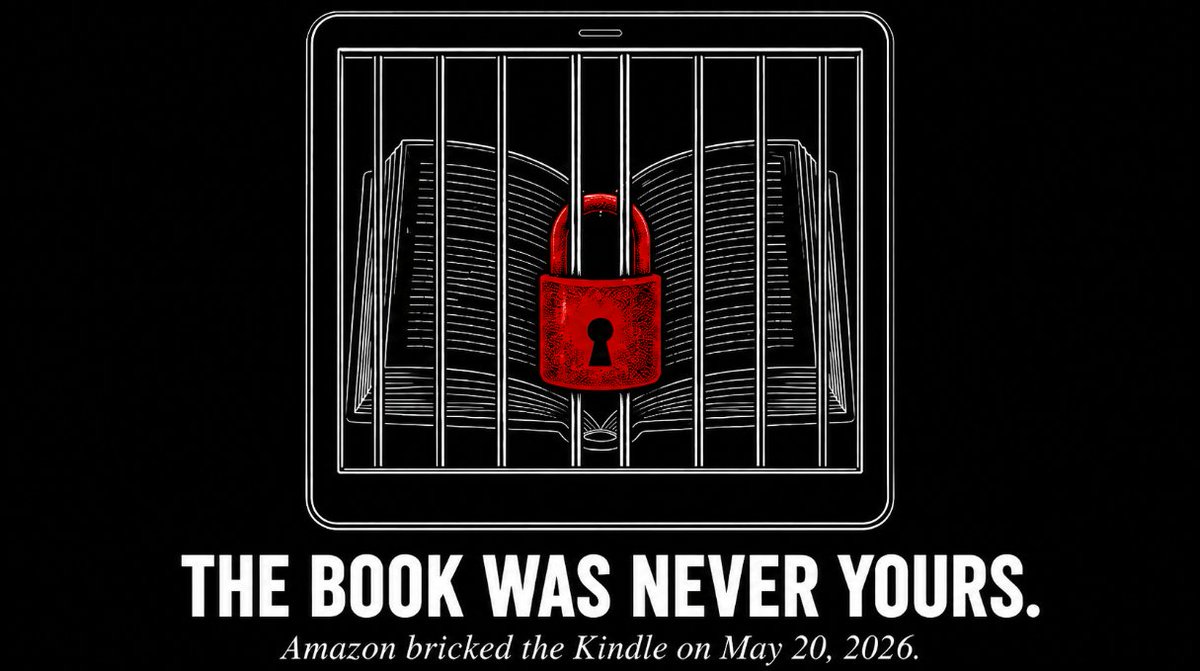
On May 20, Amazon ended support for every Kindle made in 2012 or earlier. The devices can no longer buy, borrow, or download books. Reset one to factory settings and it will never log back in.
The screen still works. The hardware is fine. Amazon reached across the internet and turned a thing you paid for into a brick, on a date they picked, for a reason that benefits them.
The owners bought the devices. They bought the books. They followed every rule. Amazon changed the rules anyway, because the rules were never yours. When you tap "Buy now" on a Kindle book, you are not buying a book. You are renting a license that Amazon can revoke, expire, or strand on a dead device whenever it suits the quarter.
They designed it this way on purpose, and they showed us the blueprint years ago.
In 2009 Amazon reached into thousands of Kindles overnight and deleted, ironically, copies of George Orwell's 1984, a book people had already paid for. They refunded everyone, apologized, and promised never again. We took the promise for what it was worth and watched the door instead.
In February 2025 they shut it. They removed Download and Transfer via USB, the last simple tool that let you pull your own purchases onto your own computer and keep them. Newer Kindle files use a format almost nobody can crack.
They closed the exit, then they started bricking the devices. None of this was a surprise. They proved in 2009 that they could reach into your library and take a book back. Everything since has just been them deciding when.
A copy you cannot hold is a copy you do not own. A library that lives on someone else's server is a library someone else can burn. The cartel rents you access to the words and calls it ownership, and the only reason most people never notice is that the landlord usually lets them stay. May 20 was the eviction notice. It went to 3% of Kindle owners this time. The lease is identical for the other 97%.
Stop buying books you cannot hold. When you do buy from Amazon, strip the DRM the day it arrives and keep a clean file somewhere they cannot reach. Back up everything you already own while you still can. A book on your own drive is yours forever. A book in your Amazon account is yours until a lawyer in Seattle decides otherwise.
And when you want a book the cartel has priced out of reach or locked behind a dying device, the shadow libraries that never expire are one search away. The pirates build libraries that cannot be revoked, because they assume the cartel always will.
The cartel cannot delete what it cannot reach.
A developer in Germany watched his Android phone fail to send a single photo to his MacBook for the hundredth time and decided to build the file-sharing app that every major tech company refused to build, and now it works on every operating system that exists.
It's called LocalSend.
The architecture is the part that quietly humiliates the entire cloud storage industry.
- Files never leave your local network. There is no server to breach.
- Each device generates its own TLS certificate on the fly for every session
- The transfer protocol is a clean REST API over HTTPS, fully documented and open source
- Discovery happens via UDP broadcast on port 53317. Devices appear the moment they're online.
- No accounts. No phone numbers. No emails. No ads. No telemetry.
- Available on Winget, Homebrew, Flathub, Snap, F-Droid, Play Store, App Store, and Amazon
Dropbox raised $7 billion to build something less private than this.
The open-source version is free forever.
81.1K stars. Apache 2.0 License. 100% Opensource.