Had a Jane Street interview in 2019.
Round 8. Interviewer texts: 'Equinox Brookfield. 6 AM. Bring a calculator you won't use.'
I show up. He's on the StairMaster reading a printout of the CBOE VIX term structure.
Doesn't get off. Nods at the machine next to him.
'You see that guy on the rower? Goldman MD. Comes here every morning at 6:04. Leaves at 6:38. What's the implied vol on his arrival time?'
'I don't know his variance.'
'Sample size of one year, 250 sessions. Standard deviation is 90 seconds. Annualize it.'
I do the math in my head. '90 seconds times sqrt(250). About 24 minutes annualized.'
'Wrong. You annualized like it's a return. Time-of-arrival doesn't compound. It's a Poisson process with drift. The correct answer is his arrival is more punctual than the 6 train. Now price me an option on whether he shows up tomorrow.'
I think for a second. 'If he's been here 250 days in a row, base rate is 99.6%. But you have to adjust for his vacation schedule and probability of injury, call it 96%.'
'Strike?'
'$10 if he shows, $0 if he doesn't.'
'I'll sell you that option for $9.40.'
I think about it. 'No. Expected value is $9.60. You're underpricing by 20 cents.'
'Correct. Now why am I selling it to you?'
I freeze.
'Because I just saw him limp on the way in. You're buying my information for 20 cents. You overpaid.'
We get off the machines. Walk to the smoothie bar. He orders a $19 smoothie, doesn't drink it.
'Last question. The girl behind the counter makes 200 smoothies per morning. She has perfect information on who's actually here and who's faking it. Citadel guys leak their attendance to her every day for the price of a tip. If I gave you $50,000 to set up a market on which Citadel PM gets fired this quarter, what's your bid-ask?'
'Insider trading.'
'Wrong answer. There's no public security. Try again.'
I think. 'I'd quote 8 to 12 percent on any given PM. Spread of 4 points to cover adverse selection. Tighten the spread for PMs I have data on.'
'Where do you get the data?'
'The smoothie girl.'
'Good. How much do you pay her?'
'10% of P&L.'
'Wrong. You pay her a flat $200 a week. If you pay her on P&L she becomes your counterparty. Right now she's your data source. Don't conflate edges.'
He hands me the untouched smoothie.
'Throw this out on Vesey Street, not in the building. The staff knows what gets wasted. Outside, it was consumed. Same smoothie, different signal.'
I do it.
Thursday I get the email.
'Offer rescinded. Your bid-ask on the PM market was too tight. 4 points doesn't cover the tail. The girl is a single point of failure and you didn't price her counterparty risk. Also you held the smoothie in your right hand. Right-handers throw with their right hand. Camera saw the hesitation.'
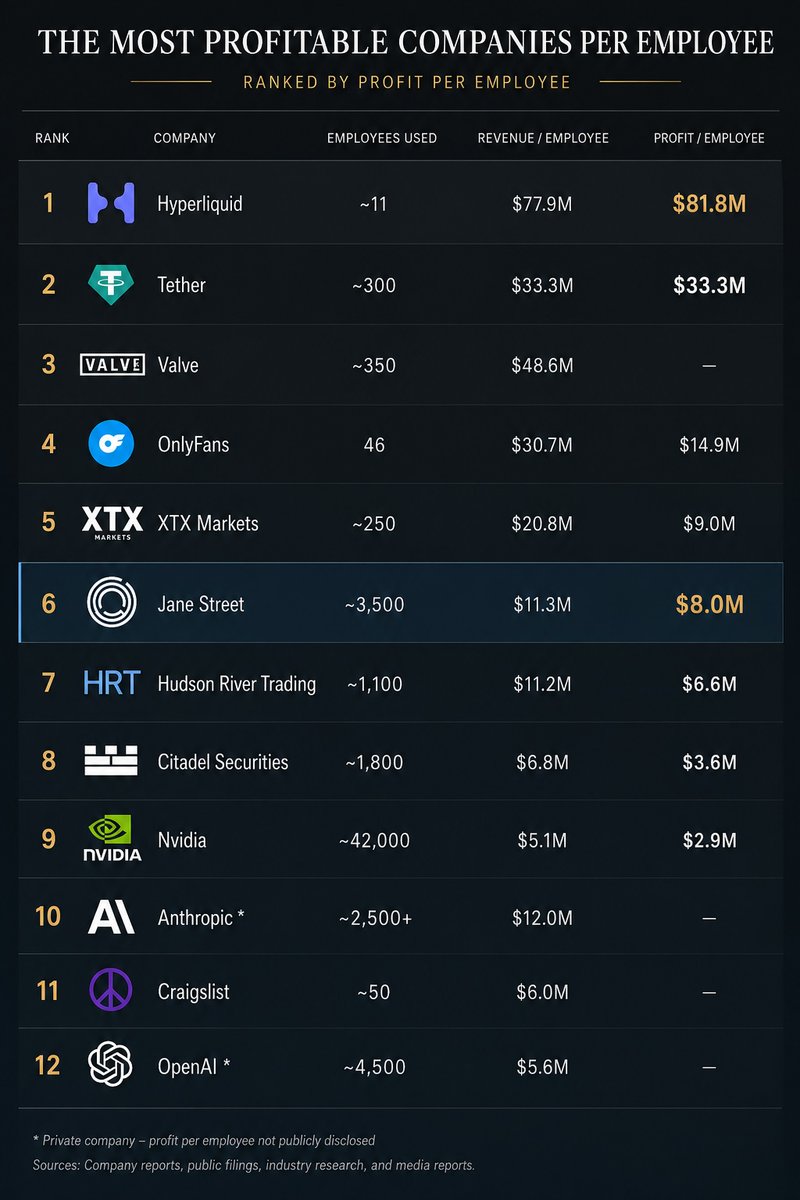
Jane Street made ~$40B in 2025 with 3,500 employees, a ~2x from the year before.
At ~65-70% profit margin, that's $8M profit / employee, the highest for a 1000+ ppl company. High-frequency trading continues to be the most efficient money making engine.
I want to share an old story about my Jane Street interview in 2014. Jane Street was known for hiring a lot of math, physics and CS olympiad winners from top universities and putting them through many rounds - including, for trading roles, a gauntlet of mental math. It was my 6th interview and my final round and I recall being asked "What is the next day after today in DD/MM/YYYY where all the digits are unique?" They'd toy with you and say "You can use a pencil and paper, if you want" but you knew that was an instant no. Painstakingly and as quickly as I could, I came to an answer. "How confident are you that this is correct on a 0-1 probability scale?" the interviewer said. "0.95", I blurted out, not fully knowing how to answer that. "Are you sure?" After thinking harder for a few more seconds, I realized I could've flipped the digits around to get a closer date. I gave the interviewer my answer. It was correct. "0.95 huh?" he chuckled. That's when I knew I failed.
Note: fwiw, other companies that come close in efficiency are
- Tether ($90M+ profit/emp)
- Hyperliquid ($80M+ profit/emp)
and on revenue:
- Valve ($50M/emp)
- OnlyFans ($37M/emp)
- Craigslist ($14M/emp)
- Anthropic ($12M/emp, run rate)
- OpenAI ($8M/emp, run rate)
For comparison, Nvidia is very efficient at scale and is $4.4M/emp.
.@boros_fi by @pendle_fi is probably one of the more sophisticated DeFi products out there right now.
We've had perps for years, with billions in open interest across exchanges, but the funding rate itself has been relatively difficult to trade independently.
Especially considering how much capital is deployed in delta-neutral strategies where funding is a major component of returns.
Boros creates a market for that exposure, allowing traders to take positions on expected funding rates through Yield Units (YU), with an implied APR determined by the market and settlements based on realized funding.
The mechanics are pretty clever:
Long YU = pay fixed, receive floating.
Short YU = receive fixed, pay floating.
Say the implied APR for BTC funding on Hyperliquid is 12% over the next 60 days, but you expect the realized rate to average 20%.
Going long YU gives you exposure to that 8% spread.
On $1M notional, that's approximately $13.2K over 60 days before fees, assuming you hold to maturity and realized funding averages 20%.
The hedging side is where this becomes particularly useful.
If you're running a spot-long/perp-short basis trade, you're collecting floating funding, which can fluctuate considerably depending on market conditions.
Shorting YU against that exposure lets you receive a fixed rate while offsetting the floating component, effectively locking in the funding portion of your carry.
You can also trade funding spreads between venues, opening up strategies around relative funding rates rather than just taking a view on a single exchange.
There's another layer of complexity around how these positions are priced and margined.
Even if the realized funding is moving in your favor, changes in implied APR can affect mark-to-market PnL and margin requirements before maturity.
So there's still liquidation risk, even for someone running an otherwise delta-neutral strategy.
It's interesting to see crypto derivatives developing to this level, especially as perp markets become increasingly liquid and institutional trading strategies become more common onchain.
I'd expect funding-rate markets to become more relevant for market makers, basis desks and funds looking to manage their carry exposure more precisely.
there’s a good chance that ppl who can explain complex things clearly & simply to the masses are becoming more valuable than the ppl who actually build them.
not talking about ppl who simply report the news.
.@boros_fi by @pendle_fi is probably one of the more sophisticated DeFi products out there right now.
We've had perps for years, with billions in open interest across exchanges, but the funding rate itself has been relatively difficult to trade independently.
Especially considering how much capital is deployed in delta-neutral strategies where funding is a major component of returns.
Boros creates a market for that exposure, allowing traders to take positions on expected funding rates through Yield Units (YU), with an implied APR determined by the market and settlements based on realized funding.
The mechanics are pretty clever:
Long YU = pay fixed, receive floating.
Short YU = receive fixed, pay floating.
Say the implied APR for BTC funding on Hyperliquid is 12% over the next 60 days, but you expect the realized rate to average 20%.
Going long YU gives you exposure to that 8% spread.
On $1M notional, that's approximately $13.2K over 60 days before fees, assuming you hold to maturity and realized funding averages 20%.
The hedging side is where this becomes particularly useful.
If you're running a spot-long/perp-short basis trade, you're collecting floating funding, which can fluctuate considerably depending on market conditions.
Shorting YU against that exposure lets you receive a fixed rate while offsetting the floating component, effectively locking in the funding portion of your carry.
You can also trade funding spreads between venues, opening up strategies around relative funding rates rather than just taking a view on a single exchange.
There's another layer of complexity around how these positions are priced and margined.
Even if the realized funding is moving in your favor, changes in implied APR can affect mark-to-market PnL and margin requirements before maturity.
So there's still liquidation risk, even for someone running an otherwise delta-neutral strategy.
It's interesting to see crypto derivatives developing to this level, especially as perp markets become increasingly liquid and institutional trading strategies become more common onchain.
I'd expect funding-rate markets to become more relevant for market makers, basis desks and funds looking to manage their carry exposure more precisely.
Does anyone else feel like the next decade we’re going into, everything is just so much more unclear and uncertain compared to earlier. Its like we’ve all our lives have played this video game that we got really good at, with «fixed rules», but now it feels like we have to start over again. No career feels safe, no investment method feels like an easy bet anymore. We are heading into unpaved territoriy thanks to AI. Scary, but it will also bring insane opportunities for those who have their eyes open.