@Jason's Nvidia thesis changes the buy-vs-rent question for AI. But the 80-90% token savings he describes would not mean 80-90% lower operating cost. Running the rack brings security, uptime, upgrades and model evaluation back inside the company.
https://t.co/LH83CQZEwt
Jason Calacanis @Jason on Nvidia:
"I believe right now, starting today, Nvidia is the number one competitor for OpenAI and Anthropic, not just for tokens but for enterprise compute and I think now Jensen is the leading open source provider in America. I think he's going to take the world, he's going to catch up and blow past China and the Chinese models I think by the end of 2027. And then that means you're going to have a player...I am more convinced than ever now that we can win the race, because Jensen represents open source globally. He's going to be able to take a rack of compute, bring it into a company that is currently using tokens from OpenAI and Anthropic and say here's your rack, soup to nuts, complete vertical solution and you have total sovereignty and i'm reducing your prices 80 or 90% cause I don't need to make money off the tokens I made money off the hardware."
Via @theallinpod
$NVDA
OpenAI's Business Hub makes a company's ChatGPT presence manageable. But a claimed profile only works with current product data. Assign an owner for pricing and availability; measure qualified referrals rather than mention counts.
https://t.co/3AOhFOrIPo
@friedberg's CMLase finding is fascinating. But reducing an aging marker in donated skin isn't the same as reversing aging in patients. Before the $2T talk, biotech has to solve delivery, safety, durability and clinical outcomes.
https://t.co/oAPR92VSxT
Friedberg: New study shows enzyme reverses skin age from 70+ years to 31
Chamath: That’s a $2T market.
Did Scientists Just Discover How to Reverse Skin Aging!?
“CML is kind of the predominant molecule that gets formed in this extracellular matrix that's driving aging, and nothing breaks it down.
So these scientists set out to try and create an enzyme, an enzyme is a protein that breaks something down, that can break down CML.
And so these guys kind of went out and they took the target, which is CML, and tried to figure out, ‘Okay, how do we actually degrade CML, clear that extracellular matrix, and reverse aging?’
They started to test it on the proteins that we would find in our body, casein, collagen, retinal proteins, which are in your eye, hemoglobin, and they were able to get rid of 52 to 97% of the CML, just degrade it away.
And then they found several sites where they were able to degrade over 90%.
And then they took actual human skin from elderly patients that had donated their skin, and they put this enzyme onto that skin, and they were able to eliminate 55% of the CML on the skin, basically reverse the skin's age down to the age of a 31-year-old, this is from greater than 70-year-old patients, just by putting this enzyme on the skin.
And so it's kind of a groundbreaking demonstration of combination of AlphaFold, what's called directed evolution, where you change the order of the DNA that changes the structure of the protein to test different proteins, do high throughput screening, and ultimately make a novel protein that doesn't exist in nature today that can do something pretty profound for human health.”
Chamath:
“It will be a trillion-dollar market. If you can create a cream…”
Friedberg:
“I mean, dude, if you could put this enzyme literally on your skin and have it absorb in…”
Chamath:
“Game over. That alone is $2 trillion.”
IBM and Microsoft cite 6,000+ prebuilt agents and assets. The key buyer question isn't how many are available; it's who owns an exception when an agent crosses systems. Map access, handoffs and escalation before scaling.
https://t.co/6kmWGQzeOY
Connection turns clarity into capacity. Give each role the systems, data, and agents it needs. Let interfaces carry routine coordination. Keep human judgment in the loop.
https://t.co/YfrTsuXVc0
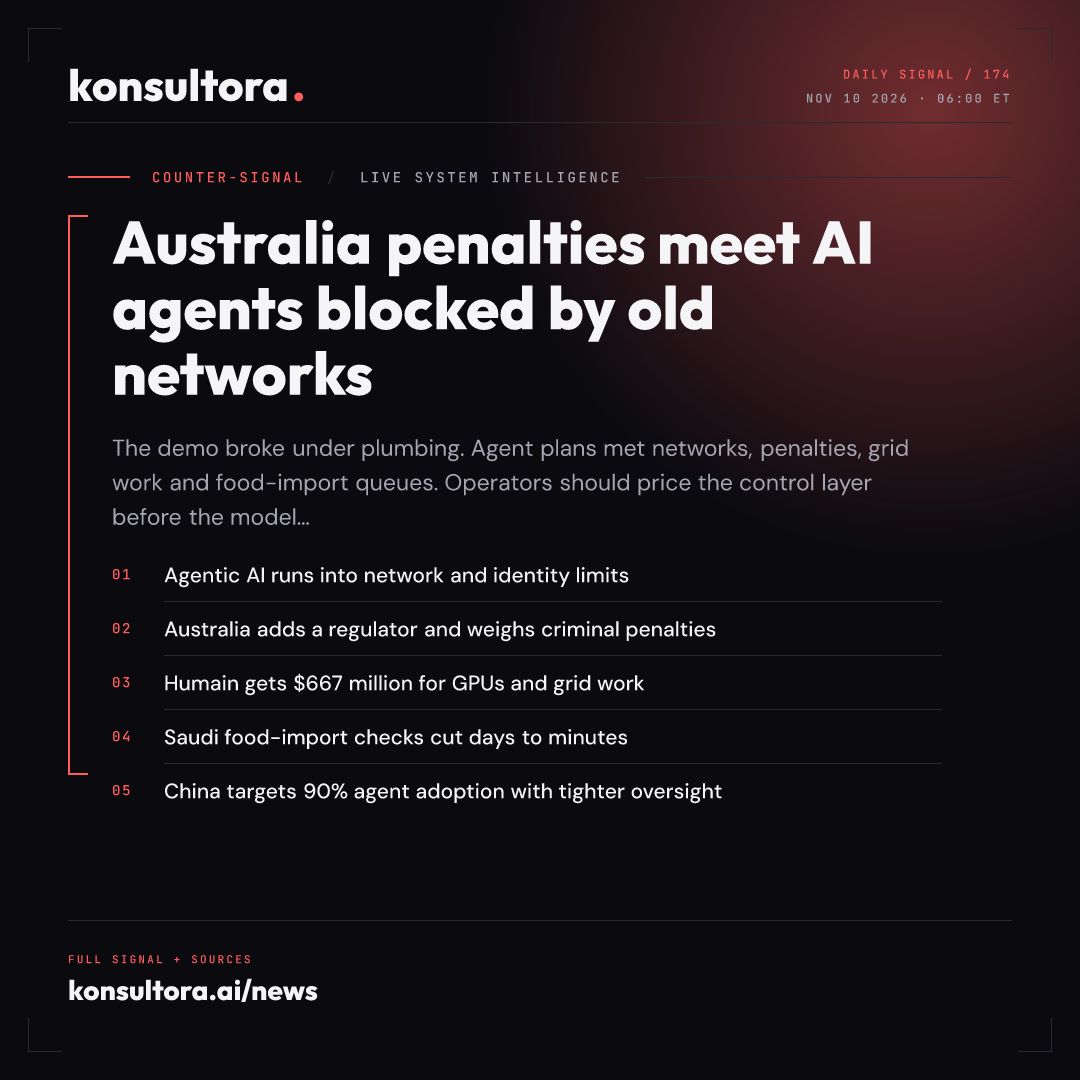
Daily Signal 174. Australia penalties meet AI agents blocked by old networks
The demo broke under plumbing. Agent plans met networks, penalties, grid work and food-import queues. Operators should price the control layer before the model contract.
https://t.co/jBKKDEHFxC
Daily Signal 169. Enterprise AI spend is now a balance sheet problem.
Menlo puts it at $176.8B, BCG sees a $1.8T annual share, and China wants incident disclosure. In a post-legacy world, agentic intelligence needs a ledger before another agent.
https://t.co/jBKKDEHFxC
@chamath is describing a blind spot for business leaders: a strong asset market doesn't mean household spending power is healthy. When owners and wage earners experience different economies, pricing and growth plans need a second look.
https://t.co/Mvtu64sN9Z
Chamath Palihapitiya admits his blind spot on America's broken two-tier economy
PALIHAPITIYA: "I got it totally totally totally wrong. I got it totally wong."
"I'll go through all the ways in which I got it wrong, but I just want to first acknowledge what my blind spot is. Like most people's blind spots, but I can just speak for myself, it is through the lens of my own lived experience and very narrowly what is in my best interests. And I think what we had was a move away from the culture wars that was very much in my best interest, but I think it was in everybody else's best interests as well. I don't think that was on the ballot. But what I don't think I understood clearly enough, and I think that this election has made extremely clear, is that since COVID, we have moved past political ideology. And I want to say this again: I do not think Democrats or Republicans matter. That is my real takeaway after this election. There is a central block of people that vote the prescient issues of our time."
"It was a gargantuan win for Biden, then it was a gargantuan win for Trump, and then it was a gargantuan win for the Democrats in these midterms. What are these people voting for? I think what they are shouting now—they were trying to signal and now they are shouting—is a broad-based belief that the economy has completely decoupled from reality and is broken. The economic reality in America is broken."
"There is a small percentage of people, the four of us on this pod and all of our friends, who are the asset owners of America. And we have benefited in every weather condition. When rates were zero, we benefited because we were able to build our businesses with very cheap capital. When rates were high, we benefited because we had pricing power. And in every condition in between, whether there were tariffs, whether there were not tariffs, whether there were subsidies, whether there were not subsidies, we've all managed to continue to accumulate and grow assets, but we are few and far between."
"And then there's everybody else who are wage earners, and the structural capacity of the American economy to support and grow wage earners is broken. It's clear. Why do I say that? I do not think, and I disagree with Freeberg, I don't think this has anything to do with socialism. I don't think the far left won particularly more than they were expected. I don't think the far right won particularly more than was expected. This is a complete and total repudiation about the state of the economy. The economy is broken. I have a few charts to support my point of view. Number one, if this was ideological and if ideology mattered, money in politics would have had a more direct impact on the election."
CodeRabbit says Codex helped it ship 20x more software with the same team. That shifts the bottleneck to review. Route AI-generated pull requests by risk, enforce security checks before merge, and track escaped defects, not just lines shipped.
https://t.co/Iwt5J8lKGL
In @chamath's scenario, the 90-day clause does a lot of work. When compute supply tightens, the owner can reprice before a buyer can shift workloads. That's a gross-margin problem for AI businesses, not merely an infrastructure headline.
https://t.co/A9Xrm0fPOO
Chamath says that if data center supply tightens, SpaceX could end its compute deal with Anthropic on 90 days notice and bring it back at 2x to 3x the price, and Anthropic would have to take it.
"So, whatever revenue you see on SpaceX's balance sheet from Ant could two to 3x and ANT would have no choice except to immediately capitulate and take the higher price. It would also show all of the other hyperscalers that they are very far away from having economic yield that is optimized. And so then it forces them to consider should I be giving it to myself?
Should I be selling it to the other people? It then forces the Neoclouds to take all of this money that they've raised, whether it's debt or equity, and say, "I have two choices, which is to buy as much compute today as I can at whatever price it's available because the other path is assured destruction and bankruptcy for me because I am just out of the game."
And so, what do they do? They will take the last gasp and do whatever they have.
So all the game theory comes down to this one deal and whether Elon decides to rip it because if he rips it, watch out.
----
Full video on "All-In Podcast" YouTube channel, (link in comment)
Adobe's marketing case shows an AI trap: teams move faster while campaign assumptions drift. Keep one shared brief, offer and audience IDs, decision log and test history from creative to media to measurement. Unaligned speed compounds rework.
https://t.co/2sm6c9Wdvc
@Jason's Nov 7 Anthropic IPO discussion highlights a risk for enterprise buyers: a compelling model and a durable vendor are different bets. Before signing multi-year agent contracts, cap minimum spend, define repricing triggers and secure exit rights.
https://t.co/Z4cirXjaHC
@chamath's Google/Crusoe discussion on @theallinpod shows an AI moat beyond GPUs: permitted sites and power. Crusoe says the Wyoming sale ended pre-development, not a forced exit. Compute buyers should assess supplier concentration and switching risk.
https://t.co/aw3GatRFGw
Firmly's Ask Agent brings shopping conversations to the merchant's own site. The test isn't fluent recommendations; it's whether catalog, price, inventory and checkout stay synchronized. Measure completed orders and conversion, not chat volume.
https://t.co/HPdllOanZX
@Jason's local-model prediction on @theallinpod raises an operational question: which AI workflows must keep running if cloud inference gets throttled? Build a hybrid plan around data sensitivity, latency, cost and fallback—not just benchmarks.
https://t.co/0mNe9pK0CA
@CrowdStrike's AI Kill Switch raises a question for agent rollouts: who can stop an agent when it leaves its authorized scope? A tested gateway cutoff, a named owner and audit trail matter. Without a shutdown path, agents aren't production-ready.
https://t.co/rV1PXvy2TK
@friedberg's All-In science segment on OpenAI's claimed ETH result is a useful distinction: an algorithmic breakthrough is not deployable speed. Independent review comes first; product roadmaps and capital budgets shouldn't move on a preprint alone.
https://t.co/c1gwkh5kEt
Hotwire's choice of Karyn Barr points to a new agency model: earned, paid, SEO/GEO and AI consulting under one operating strategy. More content isn't the advantage. Shared accountability for reputation, discovery and client revenue is.
https://t.co/BIZ3e8mjTx