Brilliant analysis, @CernBasher. I love the way you think.
AI may quiet routine market noise while making genuine discontinuities faster, sharper, and more consequential — a distinctly Talebian movement toward the tails, @nntaleb.
When I read The Black Swan, the idea of maximizing exposure to serendipitous events resonated deeply. I have strived to live it.
In what I call the Third Turning:
• Jesus Christ revealed the timeless Truth by which knowledge and power must be governed.
• Gutenberg multiplied humanity’s access to recorded knowledge.
• AI now accelerates our capacity to synthesize and apply it.
We are entering Buckminster Fuller’s “accelerating acceleration,” @BuckyFullerInst — the interval between discovery, understanding, and action is collapsing.
That world demands antifragile stewardship — a barbell posture that protects the irreplaceable while preserving open-ended optionality:
• Productive cash flows
• Enduring principles
• Generational legacy
• And room for positive serendipity
AI can multiply knowledge, but it cannot provide the wisdom, character, or moral authority required to steward it.
The next better version of markets, business, and culture will be built by those who place rapid innovation under the authority of timeless truth — and think beyond the immediate moment toward generations to come.
Thank you Cern
Thanks Cern for hopefully speaking into existence a better way of mitigating this. As a person just beginning to understand and use the X platform, I have gotten several such approaches. “Be curious, not judgemental” (Walt Whitman) is to be balanced with be safe, not neive!
There is one Cern Basher - the one with a blue check.
The others are imposters/scammers.
And then there are all the bots that pretend to be my assistant or trading assistant - they hardly even try to be me - but they pop up after every post.
I don't use WhatsApp, Telegram, Discord. I don't solicit people for money. I won't DM you with investment ideas.
X's reporting mechanism is very clunky and time consuming - it's just not worth my time to report anyone (until X takes this problem seriously) - but thank you to those that do!
Until then, be careful out there.
Indiana’s history is beautifully woven into the fabric of our nation.
#America250 isn’t just a celebration of where we’ve been — it’s a powerful reminder that our best days are still ahead when we stay committed to first-principles thinking, continuous improvement, and the pursuit of excellence.
At AutoRenu, we live that same spirit every day: restoring pride, raising the standard, and helping things shine brighter than before.
Here’s to the American experiment in liberty… and to keeping it polished and moving forward for the next 250 years. @GovBraun
Happy Fourth of July, Governor Braun and fellow Hoosiers! 🇺🇸✨
Indiana’s history is woven into the fabric of our nation. #America250 is a reminder of how far we have come as a country, and that our best days are still ahead. Happy Fourth of July! 🇺🇸
Proof of the principle:
The best thing to know is something old and true — human psychology and persuasion principles from Eugene Schwartz’s 1966 book still command $700 for a first edition because the human brain hasn’t shipped an update in 50,000 years.
The best thing to sell is something new and true — fresh applications of those same unchanging truths in today’s funnels, offers, and media.
Tech skills depreciate on the release schedule of machines. Timeless truths compound forever.
Thanks to @aakashgupta for illustrating the book so clearly, and to @thedankoe for the sharp new take.
A marketing book from 1966 sells for $700 a copy while every coding skill from 5 years ago is worthless. The gap between those two facts is the most useful career insight you'll read this week.
Breakthrough Advertising by Eugene Schwartz sold a few thousand copies, went out of print, and never got updated. First editions now trade for $700+. The official reprint costs $125 with the original text untouched, and the "5 levels of awareness" Dan references here come straight from it. A 60-year-old book still runs the backbone of every funnel on the internet.
Same pattern everywhere you look. Maslow published the hierarchy in 1943. Cialdini's Influence came out in 1984 and has sold over 5 million copies. Aristotle wrote Rhetoric 2,300 years ago and law schools still assign it.
Now flip to technical skills. jQuery was a career in 2012. Objective-C mastery peaked in 2014. Prompt engineering went from $335K job listings to a solved problem in about 18 months. Each one depreciated the moment its underlying platform shipped an update.
Skills depreciate on the release schedule of their target. Technical skills target machines, and machines update yearly. Persuasion targets the human brain, which last shipped a major update roughly 50,000 years ago.
Every skill is a bet on the stability of its substrate. The brain is the only substrate with no roadmap.

Today, as America celebrates 250 years since the birth of an extraordinary experiment in liberty, I find myself reflecting on a principle that has quietly shaped both our nation and my own professional journey.
For nearly a decade, AutoRenu has had the privilege of supporting portions of Tesla’s mission. During that time, I’ve had a front-row seat — not simply to remarkable products, but to a culture that consistently asks a different question: “What are the first principles?”
First-principles thinking refuses to accept that something must be done a certain way simply because it always has been. It strips away assumptions until only truth remains, then builds upward from there. That mindset is profoundly American.
Our Founding Fathers challenged centuries of accepted thinking. They believed that free people, governed by enduring principles, could accomplish more than any system built solely on centralized control. Their vision created an environment where individuals were free to build, innovate, create, fail, learn, and build again.
Two hundred and fifty years later, that same spirit continues wherever people choose to solve problems instead of merely describing them. It lives in entrepreneurs who risk everything to build something worthwhile. It lives in manufacturers who keep improving what others say cannot be improved.
It lives in engineers who ask “Why?” before accepting “Because.” And it lives in the extraordinary teams across Tesla, SpaceX, xAI, X, Neuralink, The Boring Company, Optimus, and the growing ecosystem of suppliers, partners, and builders who quietly contribute every single day. These accomplishments are not the work of one individual alone, but of countless men and women united by a commitment to solving meaningful problems.
Buckminster Fuller captured it perfectly: “You never change things by fighting the existing reality. To change something, build a new model that makes the existing model obsolete.”
Upton Sinclair reminded us why that’s often difficult: “It is difficult to get a man to understand something when his salary depends upon his not understanding it.”
As a business owner, I’ve come to believe the greatest advantage is not technology alone. It is culture — a culture that values truth over tradition, learning over ego, responsibility over entitlement, service over status, building over complaining, and innovation over stagnation.
At AutoRenu, we often speak of principled know-how: the lifelong pursuit of turning information into knowledge, knowledge into wisdom, and wisdom into service for others. AI accelerates what we can do, but character, humility, and how we work together matter even more.
For all of this, I remain deeply grateful. Grateful to live in a nation whose founding ideals still inspire builders. Grateful for the opportunity to work alongside organizations that challenge conventional thinking.
Grateful for the thousands of employees, supplier partners, technicians, tradespeople, and families whose daily work makes innovation possible.
And above all, grateful to God, whose providence has blessed this nation with the freedoms and opportunities that allow ordinary people to pursue extraordinary work.
Happy 250th Birthday, America.
May we continue to earn the inheritance we have received — not merely by preserving it, but by building upon it for generations yet to come.
Grateful to so many remarkable builders and partners across the ecosystem — including @elonmusk and the dedicated teams at @Tesla@SpaceX@xai@grok@boringcompany@TerafabCorp@teslaenergy@robotaxi@cybertruck, leaders like @aelluswamy@larsmoravy@robyndenholm, voices like @SawyerMerritt@Scobleizer@CernBasher@EricJorgenson. Proud to contribute our small part through @AutoRenu1.
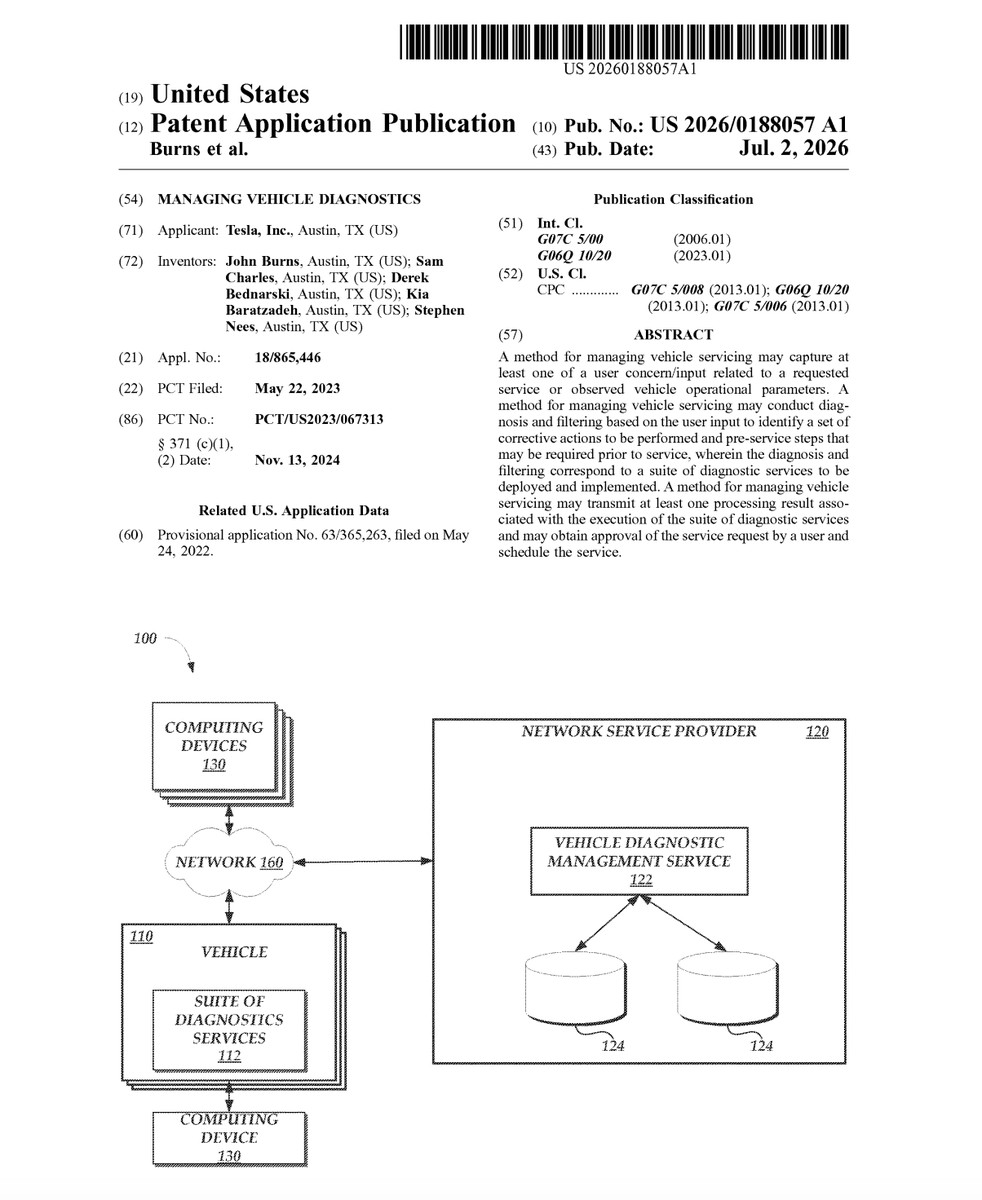
“Tesla’s new AI mechanic patent doesn’t fight broken repair shops, long waits, or mechanic miscommunication.
It simply builds a better model: your car understands vague complaints in plain English, runs its own diagnostics, books the fix, and orders parts — all before you leave the driveway.
Classic Buckminster Fuller in action: ‘You never change things by fighting the existing reality. To change something, build a new model that makes the existing model obsolete.’
GOOD NEWS 🚨 Tesla has built an AI mechanic into your dashboard that translates vague complaints into self-booked repairs 🧑🔧
Have you ever tried to explain a weird car smell or a mysterious pulling sensation to a mechanic, only to be met with a blank stare? Human miscommunication has long been the bottleneck of automotive repair, often leading to incorrect diagnoses and frustrating repeat visits.
Tesla is looking to shatter this timeline. Embedded within the newly surfaced technical filings of patent application publication US 2026/0188057 A1, published on Jul. 2, 2026, is a breakthrough that completely reimagines the traditional repair shop model.
By equipping the vehicle with an automated management component, Tesla describes a system that gives their cars the ability to process natural human language and map it directly to serviceable faults.
Whether you type a narrative message into an app or simply tell the car that it pulls to the left or stinks, the vehicle utilizes machine learned models to instantly translate your vague words into actionable diagnostic categories.
But the system does not stop at just understanding you. Instead of making you wait days for an initial physical inspection, the vehicle immediately deploys a bespoke suite of diagnostic services to narrow down the likely fault and required corrective action before a shop visit.
The true center of gravity of this patent application is the closed loop it creates: instantly moving from user input, to an onboard vehicle diagnostic suite, to transmitting results, and finally to a fully-fleshed service offer that handles approval, scheduling, and parts ordering.
To understand why this digital loop is so revolutionary, we first have to look at why the current manual system is so deeply broken.
⚖️ The problem: Human miscommunication and the agonizing waiting game
Getting a car fixed usually means bringing it to a physical service center so a technician can look at it. You explain the weird noise or strange pulling sensation to the mechanic, and they have to figure out the root cause, or the actual underlying mechanical failure rather than just the surface symptom, based solely on your subjective description.
This traditional approach relies heavily on the individual knowledge and experience level of that specific technician. This introduces a massive bottleneck into the repair timeline, much like a single open toll booth backing up miles of highway traffic.
If the mechanic misunderstands your explanation, the resulting diagnosis, similar to a doctor treating the wrong illness, and the subsequent repair might be completely incorrect. This means you have to reschedule the appointment and go through the entire frustrating process all over again.
In other cases, the fix might just require a simple software update, which is essentially just downloading a new patch of code much like updating the operating system on your smartphone. Even for these quick digital fixes, you still wasted hours visiting the shop and sitting in a waiting room.
To fix this frustrating cycle of miscommunication and waiting, Tesla is cutting out the human middleman entirely.
💡 Tesla's solution: An onboard digital service advisor
Tesla proposes an integrated management component, which is essentially a built-in computer brain dedicated to service triage, right inside the vehicle to handle these communication issues before you ever book an appointment.
The system captures your specific concerns through vehicle interfaces like the main touchscreen, a mobile app, or even kiosks. It can accept typed text, spoken voice inputs, or selections from predefined menus to understand exactly what you are experiencing without the filter of a confused mechanic.
Once it registers your complaint, the vehicle deploys and executes a custom suite of diagnostic services. Crucially, this suite is not just observational; it can be highly action-oriented. Alongside passive fault detection and information collection, it can actively trigger a software update, reset a malfunctioning system, or even adjust operating parameters on the fly to test a fix.
From there, it communicates directly with a network service provider located in Tesla's central cloud servers to coordinate parts, bypass the initial physical inspection, and get your approval for the repair. To make this self-booking workflow feel even more concrete and seamless, the system can access user profile information indicative of preapproval or approval thresholds, allowing it to instantly green-light specific services you have already authorized.
But how exactly does a computer understand what you mean when you say your car is acting weird?
🗣️ Decoding human complaints and proactive conversations
One of the most fascinating aspects of this system is how it replaces the blank stare of a human mechanic with a highly trained artificial intelligence. The vehicle uses a machine learned model, which is a computer program trained on vast amounts of historic data to recognize patterns, to process natural human language.
This allows the car to understand the messy, everyday way people actually speak instead of requiring specific robotic commands, acting as a bilingual translator that converts human frustration directly into actual serviceable faults. For example, if you tell the car that it pulls to the left on the highway, the system translates that directly to a wheel alignment issue.
The system is not just reactive to driver complaints, as it also features two way communication. The service management component can actually offer you a suggestion to run diagnostics based on its own background sensor readings, which are the silent data measurements continuously collected by the internal monitors of the car much like a smartwatch tracking your heart rate throughout the day.
For example, the car might prompt you to run battery diagnostics if it senses low voltage entirely on its own. Once the diagnostic suite finishes running its digital tests, the system provides direct feedback to you, characterizing the results in simple terms like excellent, good, or bad, while giving you a clear breakdown of potential causes.
Once the car translates your complaint into a known mechanical issue, it has to figure out how to test for it without wasting processing power.
⚙️ Creating a dynamic plan: From action groups to customized tests
After figuring out what your words mean, the system acts as a logical brain, assigning a confidence value, which is essentially a percentage score representing how sure the AI is about its guess, to potential symptoms.
It then maps these symptoms to defined action groups, or specific categories of related vehicle parts and potential fixes. These action groups dictate exactly which diagnostic tools need to run to confirm the problem. The system will filter out anything that does not meet a minimum confidence threshold, meaning it ignores unlikely causes that fall below a certain certainty level.
Instead of hard coding every single possible test into the vehicle memory, which would mean permanently programming rigid and unchangeable instructions that waste storage space, the car maintains a generic or common set of diagnostic services.
These generic templates are dynamically instantiated, meaning they are created and customized in real time so the car builds a custom troubleshooting tree, or a logical step by step flowchart of digital tests, on the fly based on your exact user input. This strategy saves processing power and time much like a doctor ordering a specific blood panel rather than testing your entire body.
Testing the car in the present moment is helpful, but the system also needs to know how the car behaved in the past to spot hidden trends.
☁️ The diagnostic baseline: Historical data and continuous learning
The vehicle does not just look at the current problem in isolation. It maintains historical information related to previous diagnostic outputs to determine trends and provide baseline comparison points, which establish a known normal state to measure against, for the vehicle operational status over time.
This historical context is then provided directly to the service provider, acting like a long term medical chart to catch slow degradation if your vehicle has never been previously serviced by a professional.
To ensure the car always has the best troubleshooting tools, this suite of diagnostic services is continuously updated by the network service and transmitted directly to the vehicle over the air, meaning the software is sent wirelessly via the internet just like a smartphone downloading a new app.
The network service has the ability to provide periodic or asynchronous updates, which are background downloads that happen quietly on their own schedule without requiring the driver to actively initiate them, to the vehicle even before a driver reports an issue, guaranteeing your car is always armed with the latest diagnostic logic and known fixes.
With the exact problem identified and cross-referenced with past data, the vehicle is finally ready to book its own trip to the shop.
📦 Smart scheduling: Triage, supply chains, and overlapping maintenance
Finding the problem is only half the battle, and Tesla takes it a step further by checking part availability to keep you out of the waiting room. The network management service, which is the central cloud system coordinating between the vehicle and the physical repair shops, looks at current inventory to see if the required replacement parts are actually in stock at your local service center.
If a part is not available, the system might suggest a software workaround, acting as a temporary digital fix to keep the car running safely, or simply defer the appointment until the inventory arrives.
When parts are highly limited, the network implements a triage protocol. This acts just like a hospital emergency room prioritizing severe injuries before minor ones, actively comparing your vehicle issue against other cars on the road to determine who should get priority access. If your diagnostic results show a low priority fault, your service offer might be delayed automatically, ensuring that drivers with critical safety issues get fixed first.
Tesla also designed the system to look for overlapping service opportunities. It analyzes the corrective action, which is the specific physical repair required to fix the main issue, and looks at your vehicle age and mileage to see if anything else is on the verge of failing.
If your car needs a new wheel bearing, the system knows a technician will already have to physically remove the wheel and brake assembly just to reach it. It might suggest replacing your brakes at the exact same time, optimizing shop labor by fixing neighboring parts while the machinery is already taken apart.
All of these automated steps sound great on paper, but they carry massive implications for the real world.
🚀 How this patent contributes to Tesla today and in the future
This patent fundamentally changes the math for the global service network at Tesla. By Q1 2026, Tesla’s cumulative deliveries had reached roughly 9.2 million vehicles, while its reported global Tesla locations stood at 1,553 at year-end 2025. Even using that broad location footprint, that is nearly 5,900 delivered vehicles per Tesla location.
By moving the initial inspection into the software of the car itself, Tesla can drastically reduce wait times. If this automated digital service advisor can resolve or defer just 20 percent of those visits through software workarounds or remote diagnosis, it instantly frees up roughly 1.84 million service appointments globally each year.
Looking ahead, this technology sets the stage for a completely autonomous service ecosystem. As vehicles become more advanced, cars will be able to notice a failing part, order the replacement from the supply chain, and book their own service appointment before the driver even realizes something is wrong. By eliminating the human error associated with diagnosing a vague complaint, this is a major forward leap in making vehicle maintenance completely frictionless.
Most people notice the floating E in the AutoRenu logo.
What they don't see is what it represents.
The floating E stands for our commitment to always rise—to keep improving, learning, and pursuing excellence. It reminds us that there is always another level to reach.
It also reflects how we lead:
Encourage — Lift others and celebrate growth.
Equip — Provide the tools, knowledge, and training to succeed.
Expect — Hold ourselves to a higher standard because excellence is never accidental.
At AutoRenu, we believe great products begin with great people.
We encourage.
We equip.
We expect.
Because excellence isn't a destination—it's a pursuit.
The Floating E reminds us to keep rising.
#AutoRenu #Leadership #Culture #ContinuousImprovement #PursuitOfExcellence
“Freedom isn’t just a word—it’s the shine you choose every day.
As we celebrate America’s 250th, I’m reminded that true pride comes from caring for what moves us forward. At AutoRenu, we don’t just make great car care products—we restore that unmistakable American spirit of excellence, one flawless finish at a time.
Here’s to shining brighter together.
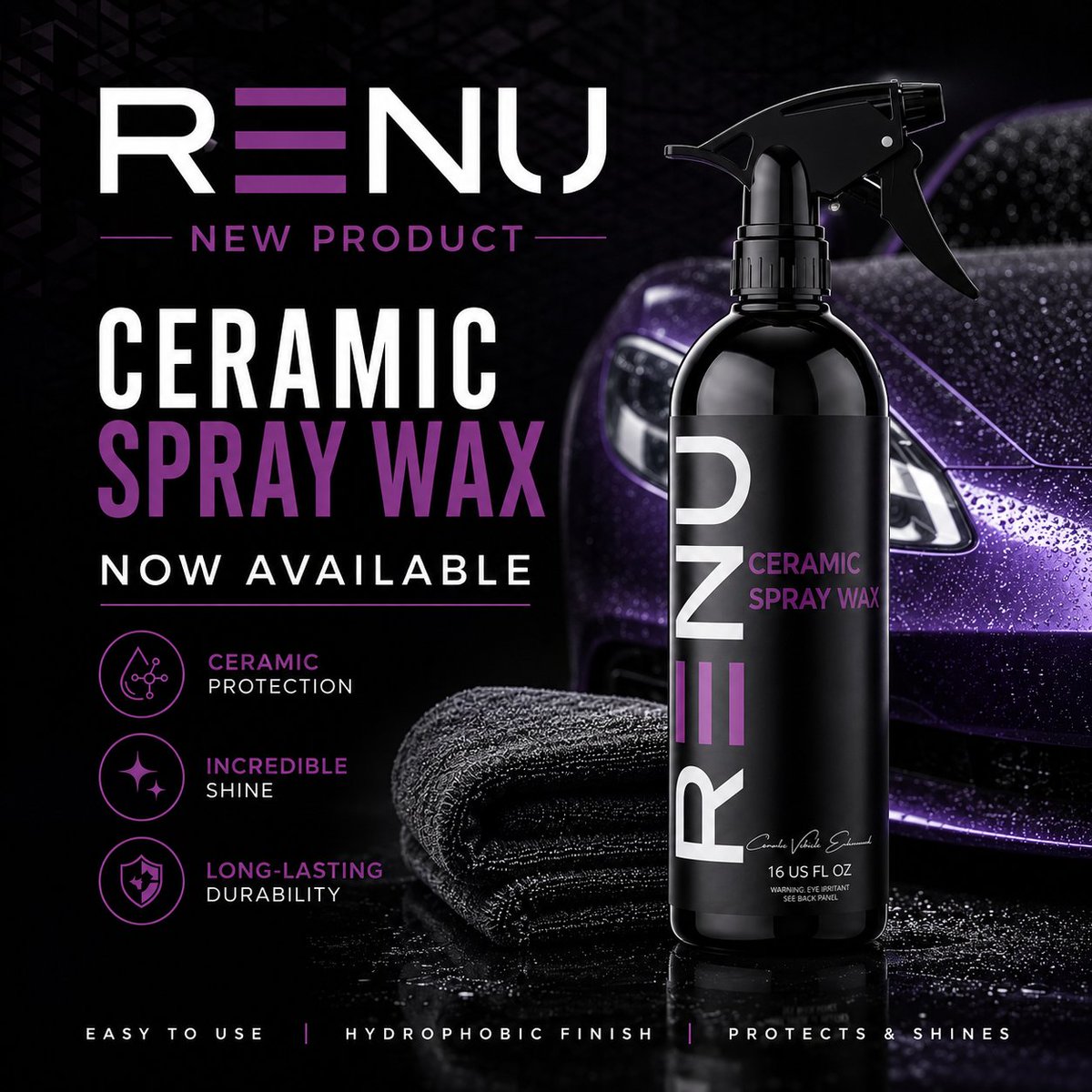
✨ NEW PRODUCT
Meet the newest member of the RENU lineup.
Ceramic Spray Wax delivers the deep gloss, slick finish, and hydrophobic protection you'd expect from a premium ceramic product—without the complicated application.
✔ Incredible shine
✔ Water-beading ceramic protection
✔ Long-lasting durability
✔ Quick spray-on, wipe-off application
Perfect for maintaining ceramic-coated vehicles or giving any paint finish an instant boost in gloss and protection.
Shop Now: https://t.co/K4WWgDwGp7
#RENU #CeramicSprayWax #CarCare #Detailing #AutoDetailing #CeramicCoating #CarCleaning #Detailers #ShineOn #ProtectYourPaint
Given that necessity is the mother of invention and opportunity is the father, it’s great to have Governor Braun as our patriarch. Go Team Indiana. @GovBraun
@EricJorgenson I highly recommend this book. Eric did a phenomenal job weaving the actual quotes into a format that literally helped build the first principle thinking tactic. Eric, what are you doing next?
I can tell you which countries are cooked based on how they respond to The Book of Elon.
France, Italy, other EUs: "Everyone hates Elon, this book will never sell. Pass."
Taiwan, China, India: "This is the largest offer I've ever seen in my 20-year career."
I highly recommend this book. Eric did a phenomenal job weaving the actual quotes into a format that literally helped build the first principle thinking tactic. Eric, what are you doing next?
I can tell you which countries are cooked based on how they respond to The Book of Elon.
France, Italy, other EUs: "Everyone hates Elon, this book will never sell. Pass."
Taiwan, China, India: "This is the largest offer I've ever seen in my 20-year career."