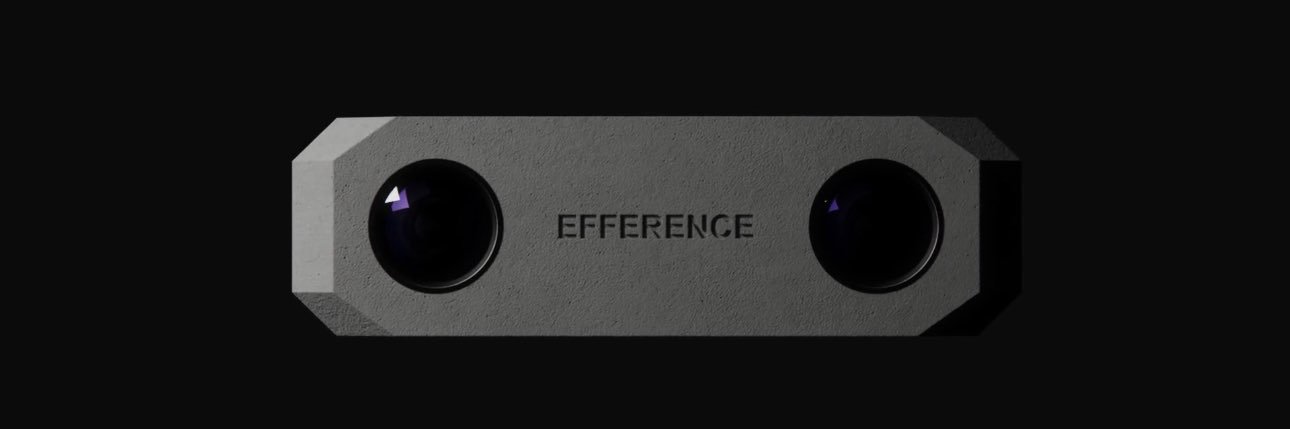
We’re building robotic cameras that treat vision as a software problem, not a hardware problem — just like humans do.
Demos + model performance: https://t.co/8Si3X0FZ4Y
Pre-orders + Specification: https://t.co/EVAu55ULqM
We are hiring embedded firmware engineers, full stack engineers, and robot learning interns.
If you or anyone you know is interested in robotic perception, please reach out to us.
https://t.co/MD8vzutZ4T
Reliable self-driving for hundreds of $$ (cameras) instead of thousands (LiDAR).
We’ve been testing depth maps and object detection at 50m and beyond.
Videos show @EfferenceAI with D435i mounted on the front, side, and rear while driving around Russian Hill / Pacific Heights
These are point clouds from: https://t.co/y2PrlCiuQC
D405 cameras are EVERYWHERE in robotics (commonly wrist mounted like what I have on my YAM arms) but depth is rarely used because it’s not very good
Our models make training 3D diffusion policies possible W/O the use of LiDAR
Efference (@EfferenceAI) is building robotic cameras that treat vision as a software problem, not a hardware problem -- just like humans do.
https://t.co/VbPwapjO8I
Congrats on the launch, @gianlucabencomo!
Depth sensing is a crucial part of any modern robotics stack, but off the shelf stereo cameras rarely deliver the quality and reliability that we need. What @gianlucabencomo is building here is very exciting: a new depth camera with custom, real-time models baked in. He just opened pre-orders. Worth a look if you care about perception and robotics!
@EfferenceAI is building robotic cameras because nothing on the market does the things that make 3D vision efficient and effective in humans. Data representations matter (https://t.co/e21Sdm8qgm) and humans have a lot of important design features (https://t.co/1K1QWZTlUn).
A rich and scalable representation for visuomotor policy learning will come from hardware that is inexpensive and computes high-quality geometric information directly on the PCB, which is exactly what we are building.