Trivedi @Mihir_Tri et al. assemble and characterize centromeres of 8 lemur species and show that these centromeres do not contain α-satellites and have a different motif for each genus, pointing to their imperative role in lemur radiation. https://t.co/YKi4AVyeib
Noyes et al. apply long-read sequencing to autism families identifying increased numbers of germline & postzygotic mutations. Repetitive sequences like segmental duplications are hypermutable, especially in early embryo. @EichlerEE@uwgenome@hhmi_science https://t.co/KzDfKRBPw5
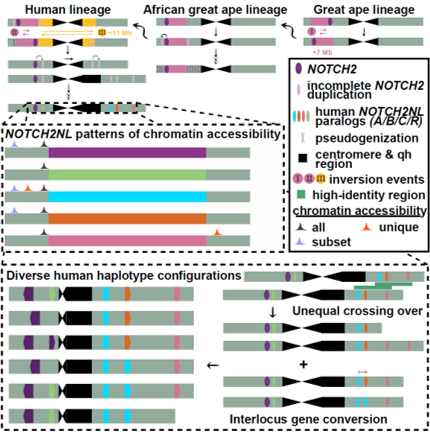
Real et al. find human-specific NOTCH2NL duplications are linked to cortical expansion. Analysis of 82 long-read ape & human genomes shows independent duplications, major structural variation, and gene conversion, with rapid gene and regulatory divergence. https://t.co/DRYxtt2mrH
@PorubskyDavid et al. resolve 65 structurally diverse haplotype structures for the 22q11.2 deletion syndrome region. Deletion risk differs depending on structure; individuals of African ancestry are enriched for inverted repeats predisposing to inversion. https://t.co/TJakBoyLDS
Using long-read genome sequencing of unsolved autism families and population controls, postdoc Sui @Kate19155783 et al. identify pathogenic & candidate variants missed by short-read sequencing and the value of phased pangenomes to enrich in rare variants. https://t.co/XUS5GtbfLk
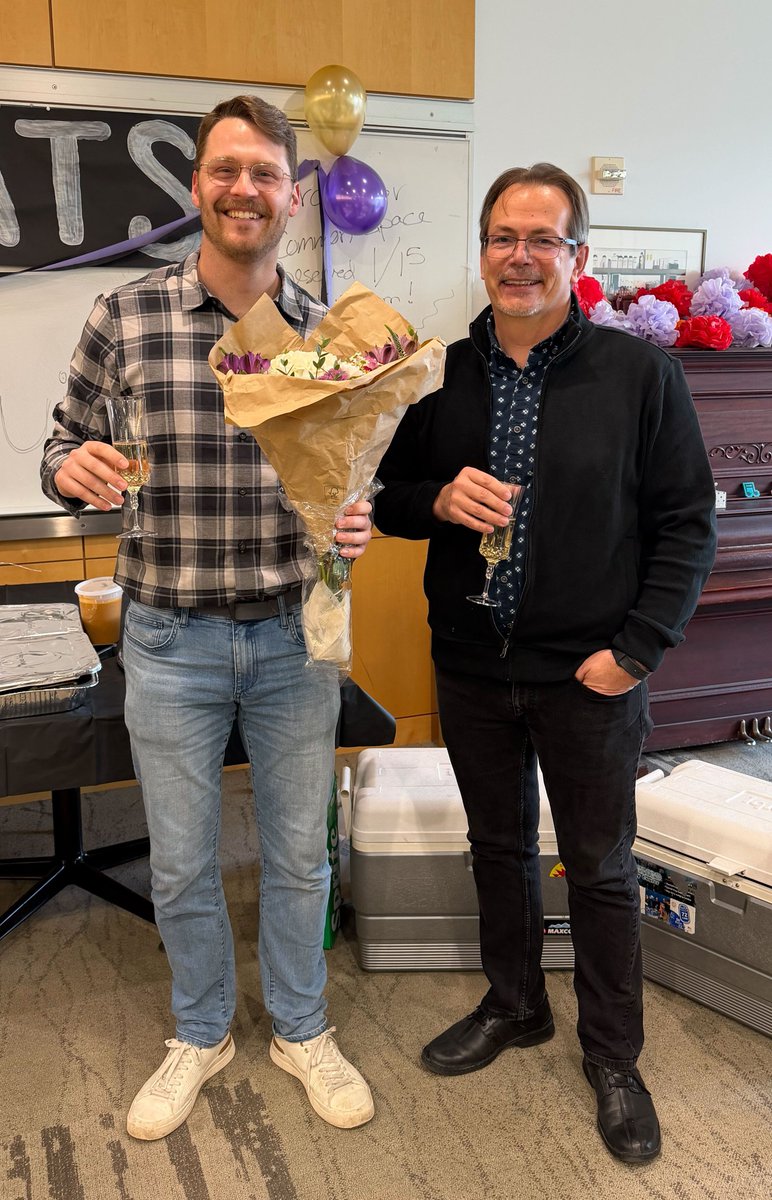
Congrats Xavi Guitart on a successful thesis defense! Your hard work and perseverance have paid off. Your incredible determination throughout your graduate journey will aid in your next scientific endeavors as well! Cheers!
We assembled the acrocentric short arms of 23 samples from a 4-generation pedigree, revealing unique mutational and recombination patterns from these highly repetitive regions that are usually excluded in the genetic analysis. Preprint: https://t.co/GFT9JQTLqB
Check out new AoU collaboration paper: Long-read sequencing of 1027 All of Us participants self-identified as African American discovers new structural variant disease associations: https://t.co/04nSZ5Ok1D @EichlerEE@uwgenome@KiranGarimella
Recent PhD grad Dishuck unveiled NPIP structural variation & evolutionary dynamics across 169 human haplotypes—revealing brain-expressed paralogs, selective sweeps & neofunctionalization.
🎧 @BasebyBasePod Ep. 129: Dives into NPIP’s role in our genome: https://t.co/rFwzJ5S9pW
🧬 How fast do humans mutate?
Our groundbreaking study tracks DNA changes across 4 generations to reveal the pace of human evolution revealing insights into our genetic legacy. Watch now 👉 https://t.co/SazD16ZDum
#Genetics#Evolution#ScienceVideo#Nature
We updated our preprint describing chr21 centromere genetics/epigenetics in families with Down syndrome and general population! We found transgenerational methylation changes in a subset of families and that centromere size asymmetry is exclusive to T21!
https://t.co/nLdsUzClyE
Using >130 human & 12 primate haplotypes, we reconstruct the chromosome 22q11.2 evolution to identify haplotype structures linked to deletions or inversions, explaining the lower prevalence of 22q11.2 deletion syndrome in individuals of African descent.
https://t.co/07Yum0L3hc
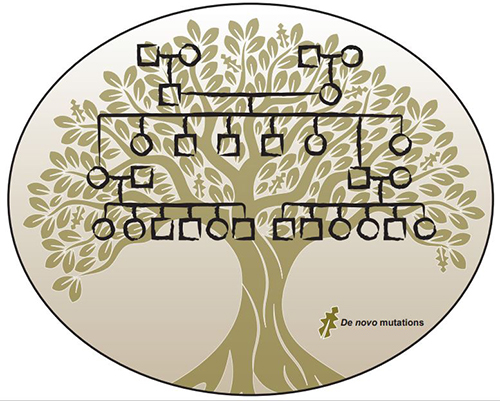
Our Nature paper (https://t.co/8ucXysP2w8) deep sequencing a 4-generation, 28-member family using multiple sequencing technologies to study transmission of all classes of genetic variation is out! @EichlerEE@uwgenome @HHMINEWS
Advanced genomic analysis of 4 generation family offers new knowledge about genetic mutations & their transmission, including inherited variants & those that arise anew @Nature@uwgenome@EichlerLab@UWMedicine@UUtah@PacBio https://t.co/DRYYOenRZm
Check it out! Telomere-to-telomere ape genome assemblies reveal new biology & insights into evolution: https://t.co/Xxy8flYHd2 Nature News: https://t.co/XGqArEaiaK Nature Podcast: https://t.co/TsLokU0d83 @DongahnYoo@EichlerEE@uwgenome @HHMINEWS
Polished genomes of 6 ape species - siamang, Borneo & Sumatran orangutan, gorilla, chimp & bonobo - have been assembled & comparatively analyzed. Findings shed new light on human & ape evolution @Nature@Eichlerlab@uwgenome@UWMedicine https://t.co/dp4glyZPcM