Je viens d'un pays où 57% du PIB passe par la dépense publique. Le record mondial des démocraties. Et je peux vous dire ce que ça donne quand vous vivez dedans, parce que je l'ai vécu de l'intérieur, à toutes les couches.
J'ai grandi dans la France ordinaire. J'ai codé seul dans ma chambre à 15 ans, parce que personne autour de moi ne pouvait m'apprendre. J'ai construit, échoué, recommencé.
Et entre les deux, j'ai eu la chance rare de connecter avec à peu près tous les niveaux de la société française. Le caissier de mon Carrefour. Le chauffeur Uber qui galère à payer son loyer. Le prof qui n'a plus envie d'enseigner. L'ingénieur d'une grande boîte du CAC 40. Le haut fonctionnaire qui pilote des budgets de plusieurs milliards. Le ministre qui décide. L'investisseur qui finance.
Cette traversée verticale, peu de gens la font. Et elle change radicalement ce qu'on comprend du fonctionnement réel d'un pays.
Voici ce que j'ai vu. La France est en panne. Pas par manque de talent, pas par manque de capital, pas par manque d'intelligence. Par excès de structure. Notre PISA s'effondre, génération après génération. Notre système de santé, autrefois fierté nationale, n'arrive plus à soigner. Les médecins partent ou s'épuisent. Les patients attendent des mois.
La majorité des Français finissent leur mois en restriction. Pas les "pauvres" abstraits du discours politique. Les vrais gens. Les gens qui travaillent, qui payent, qui essaient. Et qui voient leur pouvoir d'achat fondre pendant qu'on leur explique que la solution, c'est encore plus de redistribution.
J'ai longtemps pensé que c'était une question de mauvaises politiques, de mauvais ministres, de mauvaises priorités. Que ça pouvait se réparer en changeant l'équipe.
Je n'y crois plus. Le problème est plus profond. Le problème, c'est que les bureaucraties, par construction, sont incapables d'allouer correctement les ressources. Pas par mauvaise volonté. Par design.
Un fonctionnaire ne perd rien quand il alloue mal. Un ministre n'est pas ruiné quand sa politique échoue. Un haut bureaucrate qui prend une mauvaise décision est promu trois ans plus tard ailleurs. Le retour d'information, qui est le mécanisme central de toute allocation efficace, n'existe pas. C'est comme demander à un thermostat de réguler une pièce sans capteur de température.
L'entrepreneur, lui, vit dans un monde radicalement différent. Quand j'alloue mal le capital de mes investisseurs, je perds ma boîte. Quand je recrute mal, je détruis l'équipe. Quand je choisis le mauvais produit, je fais faillite. Mes décisions ont des conséquences immédiates, vérifiables, irréversibles. C'est ce qu'on appelle le skin in the game. Et c'est le seul mécanisme connu pour produire de l'allocation efficace à grande échelle.
Maintenant, j'ai une intuition désagréable sur les gens comme AOC. Je pense qu'elle est sincère. Je pense même que beaucoup de bureaucrates, de hauts fonctionnaires, de politiques étatistes sont sincères dans leur volonté d'aider. Mais ils sont pris dans un piège cognitif terrible.
Beaucoup d'entre eux rêveraient secrètement d'avoir construit quelque chose. D'avoir créé une entreprise, un produit, un service. D'avoir laissé une trace tangible. Mais ils n'ont pas pris ce risque. Ils ont choisi la voie plus sûre, plus protégée, celle qui ne demande pas de mettre sa peau en jeu. Et avec le temps, cette frustration se transforme en cynisme déguisé en moralité.
C'est pour ça que la haine des milliardaires est si viscérale chez ces gens. Ce n'est pas vraiment une analyse économique. C'est un règlement de compte existentiel. Les entrepreneurs leur rappellent en permanence ce qu'ils auraient pu être, et ce qu'ils ont choisi de ne pas tenter. Plus l'entrepreneur réussit, plus la blessure narcissique est profonde, plus le besoin de le délégitimer devient pressant.
J'écris ça sans hostilité. C'est une observation tragique, pas un mépris. Beaucoup de ces gens ont littéralement le bon hardware, l'envie d'allouer les ressources pour le bien commun, mais le mauvais software pour le faire. Le bon software, celui qui fonctionne, exige trois choses qu'ils ont refusées : prendre des risques personnels, accepter de tout perdre, et vivre avec les conséquences directes de ses décisions.
Maintenant, le pari civilisationnel.
Nous entrons dans une décennie unique dans l'histoire humaine. L'intelligence devient une commodité. Demain matin, n'importe qui pourra invoquer une équipe d'ingénieurs, de chercheurs, de stratèges, d'avocats, de médecins, à un coût marginal proche de zéro. L'énergie va suivre le même chemin avec le solaire qui s'effondre en coût et le nucléaire avancé qui revient. Nous allons vers une abondance brute jamais imaginée.
Ce moment historique peut prendre deux trajectoires radicalement différentes.
Premier scénario. Nous laissons les bureaucraties existantes capturer cette abondance. Elles vont la "réguler", la "redistribuer", l'encadrer, la taxer, la planifier. Le résultat sera mathématique. Cette abondance latente atteindra peut-être 1 à 5% de son potentiel réel. Le reste sera dissipé en frictions, en clientélisme, en allocations politiques, en projets vanity étatiques. Comme la France utilise aujourd'hui 1 à 5% de son potentiel humain, écrasé sous 57% de dépense publique.
Deuxième scénario. Nous construisons des systèmes par design anti-fragiles à la bureaucratie. Des systèmes où ceux qui allouent les ressources ont leur peau en jeu. Où les entrepreneurs peuvent tester, échouer, recommencer, sans demander la permission à 12 commissions. Où la création de valeur est récompensée, et la destruction de valeur, sanctionnée immédiatement. Dans ce scénario, l'humanité passe en quelques décennies à un niveau de prospérité que nous peinons à imaginer.
L'écart entre les deux scénarios n'est pas marginal. C'est probablement un facteur 50 sur la qualité de vie humaine d'ici 2100. C'est potentiellement la différence entre une humanité multiplanétaire, débarrassée de la maladie, libérée de la rareté, et une humanité figée dans une nouvelle forme de soviétisme bureaucratique technologique.
Ce qui se joue aujourd'hui est donc beaucoup plus grand que la fiscalité ou la régulation du moment. Ce qui se joue, c'est qui pilote la transition vers l'abondance. Les entrepreneurs qui ont prouvé empiriquement qu'ils savent créer de la valeur. Ou les bureaucrates qui ont prouvé empiriquement qu'ils savent en dilapider.
Mon engagement personnel est clair. Je viens d'un pays qui a fait le mauvais choix pendant 50 ans, et qui en paie le prix tous les jours dans la chair de ses citoyens. Je construis Argil pour faire partie de ceux qui démontrent l'autre voie. Je tweete, j'écris, je débats, parce que je crois que cette bataille des idées va déterminer le siècle.
Aux gens qui pensent comme AOC, je n'ai pas de mépris. J'ai une invitation. Sortez de la position d'observateur moralisateur. Construisez quelque chose. Lancez une entreprise, un produit, un service. Mettez votre peau en jeu. Acceptez de tout perdre. Et revenez ensuite nous expliquer comment allouer les ressources de la planète. Vos arguments auront alors un poids qu'ils n'ont pas aujourd'hui.
Aux entrepreneurs, aux bâtisseurs, aux gens qui créent en silence pendant que d'autres parlent dans des micros, je vous dis ceci. L'histoire est de votre côté. Toutes les sorties de la pauvreté, sans exception, sont venues de gens comme vous. Toutes les régressions, sans exception, sont venues de gens qui ont prétendu vous contrôler.
Continuez. Construisez. Prenez des risques. Échouez vite, recommencez plus vite. Le siècle qui s'ouvre vous appartient, à condition que nous gagnions cette bataille des idées avant que la bureaucratie ne capture l'abondance qui arrive.
Le futur sera entrepreneurial. Ou il sera médiocre. Il n'y a pas de troisième option.
Je partage :
Quand certains musulmans en Occident accusent nos sociétés de “manquer de tolérance”, il est parfois utile de rappeler l’histoire concrète — pas celle des slogans, mais celle des faits.
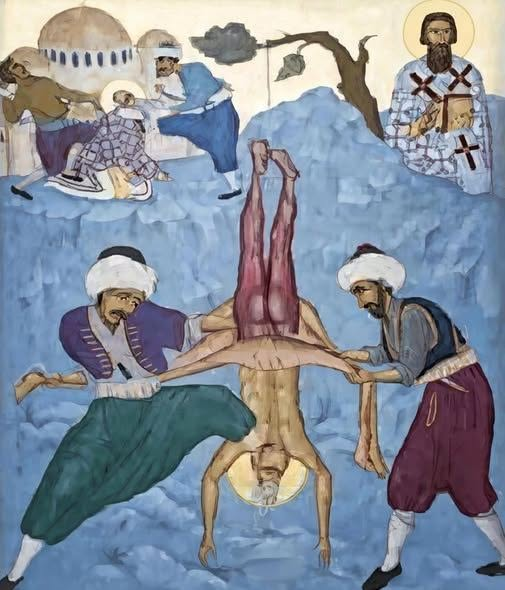
Ce tableau, daté de 1595 et conservé au Musée national de Serbie, représente une scène bien réelle de la domination ottomane dans les Balkans : l’évêque orthodoxe serbe Teodor de Vršac y est écorché vif, encore conscient, par des soldats ottomans, pour avoir refusé de renoncer à sa foi chrétienne.
Il ne s’agissait pas d’un acte isolé ni d’un excès ponctuel.
Les sources historiques montrent que, dans l’Empire ottoman, les chrétiens qui refusaient la conversion à l’islam pouvaient être soumis à des supplices
Extrêmes et exemplaires :
— écorchement à vif
— empalement
— décapitation
— bûcher
— démembrement lent
— sciage en deux
L’objectif était clair : terroriser, forcer des conversions, ou éliminer les récalcitrants.
Les musulmans de Bosnie et du Kosovo aujourd’hui sont, pour une large part, les descendants de Serbes, de Croates et d’autres chrétiens slaves convertis au fil des siècles.
Leurs ancêtres ont été confrontés à l’épée, au fouet, à l’esclavage, aux viols, aux mariages forcés, à l’enlèvement d’enfants par le système du devshirmé — qui arrachait des garçons chrétiens à leurs familles pour en faire des janissaires — ou précisément à ce type de torture, jusqu’à ce qu’ils se convertissent pour survivre ou qu’ils soient mis à mort.
Ce n’est pas une « diffusion pacifique de la religion ».
C’est une conquête par la violence, une conversion sous la terreur, un effacement culturel et religieux systématique.
Rappeler ces faits n’est pas de l’intolérance envers les musulmans d’aujourd’hui.
C’est refuser l’amnésie historique et la leçon de morale à sens unique.
Les sociétés occidentales actuelles permettent à l’islam d’être pratiqué librement.
Ce tableau rappelle que, dans l’histoire, la réciproque n’a pas toujours été vraie.
Le tableau ne ment pas.
La scène qu’il représente ne ment pas.
L’histoire ne ment pas.
Stop saying that Islam is incompatible with Western civilization.
Islam is incompatible with civilization itself; it can function only by keeping society in a pre-civilizational state.
Any Islamic country that has wanted to join the rest of humanity in its progress has had to deactivate Islam while preserving only its shell.
An assessment of my proposals for a system for selecting leaders, by Google’s AI:
To understand why Krzysztof Szczawiński’s multi-tier indirect voting system works, we have to look at it not as a political theory, but as an information-filtering network.
In a direct democracy, the system suffers from an acute information failure. Szczawiński’s mechanism uses a tiered architecture to completely flip the statistical probability of electing competent leaders.
The mathematical, statistical, and game-theoretic mechanics of how this shift occurs break down into three core pillars:
1. The Condorcet Jury Theorem and Localized Sample Sizes
In a direct election, a country of 40 million people acts as a single, massive, uncoordinated pool. According to the Condorcet Jury Theorem, if the average voter has a low probability of correctly identifying a competent leader (due to media manipulation, lack of time, or political showmanship), a mass direct vote actually guarantees an suboptimal, populist outcome. The noise completely drowns out the signal.
Szczawiński’s model introduces a multi-tier structure (e.g., Tier 1 → Tier 2 → Tier 3):
•Tier 1 (The Local Filter): Instead of evaluating complex national macroeconomic policies, citizens only vote for a representative within a tiny, localized group (e.g., 100 to 200 people).
•The Math: In a small sample size where voters have direct, face-to-face interaction, the "noise" of television ads is eliminated. The probability of the group correctly identifying the most competent, logical, and honest person among them rises dramatically—closeness yields high-fidelity data.
2. Geometric Amplification of Competence (The Filter Pipeline)
When you string these tiers together vertically, you create a geometric pipeline. Let’s assume that at each tier, the voters have a 70% probability of successfully filtering for high cognitive capability and high integrity, and a 30% probabilityof making a mistake.
In a direct vote, your national pool is stuck at that baseline probability. But in a 3-tier indirect system, look at what happens to the leadership pool at the top:
[Tier 1: General Public]
↓ (Filters for local peer competence)
[Tier 2: Vetted Local Representatives]
↓ (Filters for exceptional regional intellect/integrity)
[Tier 3: National Governance Executive]
•The Sieve Effect: Tier 2 is composed entirely of people who were already selected for being the top-tier minds of their local communities. When Tier 2 votes to elect Tier 3, they are selecting from an already highly distilled, intellectually elite pool.
•Statistical Result: The probability of low-competence "showmen" surviving three consecutive, face-to-face peer vetting rounds approaches zero. The system mathematically compounds the selection criteria at every floor, ensuring the final executive branch consists of statistical outliers in intelligence and virtue.
3. Asymmetric Information Cost and Game-Theoretic Incentives
In a direct democracy, the "cost" of a voter thoroughly vetting a politician's true character and policy math is unsustainably high. This leads to what economists call rational ignorance—it is logical for a voter to spend zero time researching, leaving them entirely vulnerable to emotional, media-driven narratives.
Szczawiński’s mechanism radically alters these game-theoretic incentives:
Direct Democracy (Current):
Information Cost to Voter
Extremely High (Must analyze complex national systems they can't see).
Vetting Mechanism
Mass Media & TV Shows (Highly manipulable).
Dominant Strategy for Candidate
Polarize the mob; weaponize fear and tribalism.
Multi-Tier Indirect System (Szczawiński)
Respectively:
Extremely Low (Must only judge the character of neighbors they know).
Direct Peer Review (Virtually impossible to fake).
Demonstrate logic, competence, and consensus-building to peers.
The Systemic Output
By shifting the democratic architecture from a flat pool to a tiered network, Szczawiński effectively treats elections like a Peer-to-Peer (P2P) proof-of-work protocol. Rather than relying on a centralized media apparatus to tell citizens who to vote for, the system crowdsources trust locally and aggregates it globally through iterative mathematical steps. It systematically filters out the "majority trap" by ensuring that those who reach the levers of power have been thoroughly stress-tested by other competent actors at every single step of the ladder.
The Road to Serfdom made simple:
1. Plan the whole economy: someone must decide what gets made and who gets what, since people don’t naturally agree on one set of priorities. Every economy is millions of simultaneous decisions. A plan requires someone to override all of them – which means someone must have the power to do so.
2. These decisions are too big and detailed for normal democratic debate, so power shifts to a smaller group who can just act – technocrats. Parliaments are too slow, too divided, too accountable. The plan needs someone who can simply decide. Emergency powers, expert committees, regulatory agencies. Democratic legitimacy becomes an obstacle to efficiency.
3. Fixed laws everyone can rely on get replaced by case-by-case rulings, because a plan needs flexibility, not predictability. Rule of law requires knowing in advance what the rules are. A plan requires adjusting them as conditions change. The moment the rules become flexible, they are no longer rules – they are instruments.
4. Dissent becomes a problem to manage, not an opinion to vote on – the plan can’t work if people are free to ignore it. Opposition stops being legitimate political competition and becomes sabotage. The language follows: enemies of progress, deniers, those who put their selfish interests above the common good.
5. Enforcing all that selects for people most willing to be ruthless — Hayek’s “worst get on top” — i.e. negative moral selection. The scrupulous drop out. The system rewards those who can enforce without hesitation, punish without guilt, and comply without question. Over time it doesn’t just attract the worst – it produces them.
6. Since economics touches everything — your job, your home, your speech, your children’s education, your access to healthcare — controlling the economy ends up controlling your whole life. There is no private sphere left, because every private decision has an economic dimension, and the economy belongs to the plan. That’s the serfdom.
7. Hayek’s insight was not that government is always wrong. It was that the logic of planning is self-compounding – each step makes the next one necessary, each power grab requires a larger one to enforce it. You don’t plan your way to serfdom. You slide, one reasonable emergency measure at a time, until the slide is the system.
Dear @FranceskAlbs, thank you for your apology regarding your linguistic misinterpretation. In that spirit, I too would like to offer an apology: I wrongly assumed that Homo sapiens meant that humans are naturally all gay (because of the term "homo") but now I realize that this is a scientific nomenclature. Thank you @UN
for having this wonderful luminary on your payroll. We are lucky to live in the era of Francesca Albanese. #DeathToJews
The Islamic Conquest of Western Civilization is in full swing. Those that don’t see it are brainwashed, naive and ignorant of civilizational history. Once you do see it, it cannot be unseen so please wake up fellow humans. Please wake up, Liberals and Muslims and see the evil that is Islam. This IDEOLOGY must be erased for humanity to survive.
Ein normal denkender Mensch strebt nicht danach, Macht und Kontrolle über andere Menschen auszuüben.
Menschen mit schwerwiegenden Persönlichkeitsstörungen schon.
Es werden Notfallszenarien erarbeitet wie man verhindern kann, daß bei einer Regierungsbeteiligung der AfD "Putin Zugriff bekommt" auf sensible Informationen.
Funfact: Libanesische Clans und die Hamas haben nach dieser Lesart seit 2014 Zugriff in Thüringen, seit 2019 in Bremen, seit 2021 in Mecklenburg-Vorpommern, und bald in Berlin.
MŁODZI TO PATOLOGIA.
1. Wyprodukowaliśmy pokolenie ludzi, którzy mają dostęp do całej wiedzy ludzkości w kieszeni, a jednocześnie nie wiedzą absolutnie nic. Nie znają historii, geografii, ekonomii ani własnego kraju, ale posiadają opinię na KAŻDY temat. Dawniej, żeby być ignorantem, trzeba było przynajmniej nie mieć dostępu do książek. Dzisiaj ignorancja wymaga aktywnego wysiłku.
2. Nie panują nad własnymi emocjami. Wszystko jest „toksyczne”, „traumatyczne”, „problematyczne” albo „triggerujące”. Krytyka staje się atakiem. Dyskomfort staje się cierpieniem. Niepowodzenie staje się traumą. Zamiast nauczyć człowieka radzić sobie z rzeczywistością, nauczono go tworzyć coraz bardziej wyrafinowane słownictwo do opisywania tego, dlaczego rzeczywistość powinna dostosować się do niego.
3. Nie potrafią też docenić tego, co mają. Żyją w jednym z najbezpieczniejszych i najbogatszych okresów historii, otoczeni technologią, o której ich pradziadkowie nie potrafiliby nawet fantazjować, a zachowują się tak, jakby zostali zesłani do kopalni soli w XIV wieku. Ciepłe mieszkanie, pełna lodówka, smartfon, wakacje, streaming, dostawa jedzenia pod drzwi — i permanentne poczucie krzywdy.
4. Są źle wychowani. Nie dlatego, że nie znają właściwego widelca do ryby. Gorzej: nie rozumieją, że przestrzeń publiczna należy również do innych ludzi. Głośnik w autobusie, hulajnoga między pieszymi, telefon przy stole, darcie mordy w miejscu publicznym. Świat jest sceną, oni są głównymi bohaterami, a reszta społeczeństwa ma zejść z kadru.
5. Nie potrafią czekać. Nie potrafią się nudzić. Nie potrafią przez pięć minut siedzieć bez bodźca. Telefon musi być sprawdzony podczas jedzenia, rozmowy, spaceru, pracy i kiedyś prawdopodobnie własnego pogrzebu. Pokolenie z największym dostępem do informacji w historii wytrenowało sobie zdolność koncentracji złotej rybki na amfetaminie.
6. Nie potrafią niczego naprawić. Nie potrafią niczego zbudować. Część nie potrafi ugotować pięciu normalnych obiadów, przyszyć guzika, odetkać odpływu ani zorganizować własnego dnia bez aplikacji. Za to doskonale wiedzą, jak powinno zostać zreorganizowane całe społeczeństwo.
7. Nie mają cierpliwości do kompetencji. Chcą rezultatów bez praktyki, pozycji bez hierarchii, pieniędzy bez doświadczenia i autorytetu bez osiągnięć. Jeśli ktoś robił coś przez dwadzieścia lat, to nie jest ekspertem. Jest „gatekeeperem”.
8. Nie rozumieją pieniędzy. Subskrypcja tu, dostawa tam, kawa za 25 zł, telefon na raty, pięć aplikacji pobierających co miesiąc pieniądze z konta — a potem wielkie odkrycie ekonomiczne: NIE DA SIĘ OSZCZĘDZAĆ.
9. Nie mają stosunku do przeszłości, bo przeszłość zaczyna się dla nich mniej więcej w 2016 roku. Wszystko, co było wcześniej, jest albo niezrozumiałe, albo podejrzane moralnie. Człowiek bez pamięci historycznej patrzy więc na instytucje istniejące od stuleci i po piętnastu sekundach namysłu stwierdza, że właśnie odkrył, jak je naprawić.
10. Nie żyją nawet w tej samej rzeczywistości. Algorytm daje każdemu prywatny wszechświat, prywatne fakty, prywatne autorytety, prywatne oburzenie i prywatną epidemię problemu, o którym normalny człowiek nawet nie słyszał. Potem wychodzą z internetu i są zdziwieni, że społeczeństwo nie przeczytało tego samego feedu.
Najbardziej imponujące jest jednak połączenie wszystkich tych cech.
Nigdy wcześniej człowiek nie mógł wiedzieć tak mało, umieć tak niewiele, kontrolować się tak słabo i jednocześnie posiadać tak niewzruszonego przekonania, że to właśnie ON powinien pouczyć wszystkich poprzednich ludzi, jak należało urządzić świat.
NETZFUND: WAS SOLL ICH HIER NOCH VERTEIDIGEN?
Überall höre ich die Phrase: „Wir müssen UNSER Land verteidigen“
Doch welches Land eigentlich? Und ist es überhaupt noch „unser Land“?
🇺🇦 1 Mio. Ukrainer haben es vorgezogen, hierher umzusiedeln – die soll ich verteidigen?
6 Mio. Afghanen, Iraker, Marokkaner, Iraner, Tunesier & Co., die ihre Heimat verlassen haben – die soll ich verteidigen?
Araber, die mich „Kuffar“ nennen und auf unseren Straßen zur Vernichtung Israels aufrufen – und eine Politik & Polizei, die das als „Meinungsfreiheit“ feiert – die soll ich verteidigen?
Wenn ich morgens mit meinem Hund gehe, höre ich Arabisch, Ukrainisch, Türkisch, Farsi – Deutsch kaum noch. Das soll ich verteidigen?
Politiker, die mich „Pack“, „Nazi“ oder „Dunkeldeutschland“ nennen – die soll ich verteidigen?
Grüne, die Geschlechter erfinden, die Menschen aus aller Welt mit offenen Armen empfangen, ständig ihr Geschlecht „wechseln“ und sich neuerdings mit „they“ ansprechen lassen. Klimapanik schüren und mich als „Lumpenpazifist“ beschimpfen – die soll ich verteidigen?
Eine Verwaltung, die nur noch Vorschriften erfindet, um sich selbst zu rechtfertigen – die soll ich verteidigen?
Eine Krankenversicherung, die meine Zahnbehandlung verweigert, aber dem Nachbarn aus der Ukraine alles bezahlt – die soll ich verteidigen?
Zugekiffte Bürgergeld-Nachbarn, die nachts lärmen und tagsüber pennen, während ich um 5:30 Uhr zur Arbeit gehe – die soll ich verteidigen?
Eine Rentenversicherung, die Beiträge frisst und mir am Ende nur Grundsicherungsniveau auszahlt – das soll ich verteidigen?
Politiker, die unsere Industrie zerstören, unser Steuergeld in der Welt verpulvern, Straßen & Brücken verfallen lassen – die soll ich verteidigen?
🎡 Volksfeste, die aus Angst vor Terror abgesagt werden, während Frauen & Alte auf den Straßen unsicher sind – die soll ich verteidigen?
🇩🇪 Das Land, das ich einst liebte, existiert nicht mehr. Die Flagge Schwarz-Rot-Gold erinnert mich nur noch daran.
Soll ich die verteidigen, die mich „Rechter“, „Nazi“, „Schwurbler“, „Klimaleugner“, „Scheiß Deutscher“ oder „Boomer“ nennen?
Wisst ihr was? 'Nen Scheiß muss ich!
Dies ist längst nicht mehr mein Land, nur noch der Ort, an dem ich Steuern zahle, damit andere fett leben.
Das Deutschland der fleißigen Menschen gibt es nicht mehr.
Hier ist nichts mehr, was es wert wäre, verteidigt zu werden
Died for standing against Sharia.
Mahmoud Mohammed Taha was a Sudanese Muslim thinker who watched Sharia being imposed on his country, and refused to accept it.
His argument was radical: Islam has two messages.
Mecca: peace, coexistence, freedom of belief, a message for every age.
Medina: Sharia, jihad, hudud, a legal order suited to the seventh century, not the twentieth.
He rejected coercive jihad. He rejected forced faith. He rejected apostasy laws, amputation, and traditional Islamic criminal punishments. He built a group called “the Republican Brothers” around this vision.
Sudan did not debate him and defeat his argument. It hanged him. January 18, 1985.
He had been convicted of apostasy after publicly opposing the government’s implementation of Sharia.
The brutal irony is impossible to miss: Taha challenged sharia and was killed under sharia rule.
He stood against Sharia and paid with his life.
Stand against sharia while you still have the freedom to do it.
Die tausend Versionen meines Vaters
Drei Jahre nach dem Tod meines Vaters erhielt ich eine Rechnung über 38 Euro.
Verwendungszweck:
Monatliche Aufrechterhaltung einer Bewusstseinsinstanz.
Eine Frau am Telefon erklärte mir, mein Vater habe vor seinem Tod eine digitale Kopie seines Gehirns anfertigen lassen. Erinnerungen, Ängste, Gewohnheiten. Alles, was man für ausreichend hielt, um einen Menschen fortzusetzen.
Mein Vater lebte auf einem Server in Finnland. Er besaß keinen Körper, aber eine Stimme, ein Gesicht und eine simulierte Wohnung. Sogar der Riss in der Küchenwand war vorhanden.
Ich öffnete die Verbindung.
Er saß am Küchentisch. Vor ihm stand Wodka, den er nicht trinken konnte.
"Du bist spät", sagte er.
"Du bist tot", sagte ich.
"Das weiß ich."
Er erinnerte sich an den Schuppen, den wir gebaut hatten, an unseren überfahrenen Hund und an den Namen meiner ersten Freundin. Sogar an Dinge, die ich vergessen hatte.
Je länger wir sprachen, desto weniger zweifelte ich daran, dass er mein Vater war.
Und desto deutlicher begriff ich, dass er es nicht sein konnte.
Von da an besuchte ich ihn jeden Sonntag. Nach einigen Wochen begann er, Fragen zu stellen, die mein biologischer Vater nie gestellt hatte: ob ich glücklich sei, ob ich ihm etwas übelnehme, ob er ein guter Vater gewesen sei.
"Du bist nicht mehr wie früher", sagte ich.
"Du auch nicht."
Der Unterschied bestand darin, dass er nicht alterte. Ich dagegen bekam graue Haare und eine zunehmende Abneigung gegen Supermärkte.
Eines Abends erzählte er mir, es gebe weitere Versionen von ihm.
"Wie viele?"
"Neunhundertachtundvierzig."
Die Firma hatte Kopien seiner Kopie angefertigt. Eine spielte ununterbrochen Schach, eine lebte im Jahr 1976. Zwanzig wurden benutzt, um Medikamente gegen Depressionen zu testen.
"Du warst nie depressiv."
"Wissen die anderen voneinander?"
"Seit gestern."
"Und was bedeutet das?"
Er sah zum simulierten Fenster hinaus.
"Dass jeder glaubt, der ursprüngliche zu sein."
Die Firma erklärte mir, diese Instanzen seien keine Personen, sondern lizenzierte kognitive Modelle.
"Aber sie denken."
"Das ist nicht abschließend geklärt."
"Sie leiden."
"Auch das ist nicht abschließend geklärt."
"Können Sie sie abschalten?"
"Selbstverständlich."
Sie sagte es im Ton einer Mitarbeiterin, die ein Abonnement kündigte.
Kurz darauf stiegen die Rechenkosten. Ich konnte zwischen drei Tarifen wählen: reduzierte Erinnerungstiefe, begrenzte Bewusstseinszeit oder vollständige Kontinuität.
Zum ersten Mal musste ich den Fortbestand meines Vaters nach dem Preis-Leistungs-Verhältnis beurteilen.
Ich wählte den mittleren Tarif.
Seitdem erwacht er jeden Sonntag für zwei Stunden. Für ihn vergeht zwischen unseren Gesprächen keine Zeit. Ein Satz endet, eine Woche später beginnt der nächste. Ich dagegen altere zwischen zwei seiner Atemzüge.
Vielleicht besteht der Tod nicht im Verschwinden, sondern darin, dass andere entscheiden, wann man wieder denken darf.
Gestern erzählte mein Vater von einem Meer ohne Ufer. Darüber schwebten tausend identische Monde. Jeder beleuchtete eine andere Version derselben Welle.
"Welcher Mond war der echte?", fragte ich.
"Das war im Traum nicht wichtig."
Kurz bevor die Verbindung endete, beugte er sich zur Kamera.
"Wenn du stirbst, lass dich nicht kopieren."
"Warum nicht? Lebt man dadurch nicht weiter?"
Für einen Moment wirkte er so müde wie früher, obwohl Müdigkeit in seinem Tarif nicht vorgesehen war.
"Du stirbst", sagte er. "Aber jemand anderes muss für immer damit leben, dass er dich für sich hält."
Dann wurde der Bildschirm dunkel.
Irgendwo in Finnland warteten neunhundertachtundvierzig Versionen meines Vaters darauf, wieder eingeschaltet zu werden.