Although AI portends much misery for writing, if it means the end of forms that barely count as writing because of they are mostly formulaic, such as op-eds, at least some good will have come of it.
Although I’ve never become a full cynic, college applications made me come close. You are asked to write essays where you lie, do activities you don’t want to do, all in service of going to a college full of people who all did the same thing. I promised myself that I would never play the cynical signaling game again afterwards. I have tried to keep my promise.
The only writer worth reading on the death of literacy discourse is Harold Brodkey: “If the reader is not at risk, he is not reading.”
https://t.co/6wek0iYoeS
My theory of American-Jewish politics is based around your view of your parents. If you love them and think they are right about everything you read the Free Press. If you think they are wrong and that they lied to you, you read Jewish Currents.
@izbcho My sense is that risk for him is allowing oneself to be “opened up” by a book, sort of like falling in love. Allowing the possible of being let down but also transformed positively
Excellent interview on the imminent dissolution of knowledge work. I agree with Conti entirely. One question as I was reading: where are the other professors just as melancholic as Conti? My sense is that the rest trust the institutions—that if AI is a problem then we can wait when “we all” have to face it. It is Conti’s previous life as a critic of wokeness, of acting out of step with institutional university life that allows him to see what’s coming before others.
Okay—that is fair, I apologize for my initial sardonic tweet. But in all self-accounts he talks about the book as originating from his own failures and self-loathing, not issues with the Nordic welfare state. That has nothing to do with immigration. And of two books that do address Sweden and its ailments, the second one, book six, does address immigration. Your critique is likely more legitimate against most other contemporary works of European literature
Oh, and Karl Ove Knausgård is a coward. How do you write thousands of pages about coming of age in contemporary Scandinavia yet fail to mention the single most salient socio-historic fact of collective life in these places: their total transformation by mass immigration?
The defense of cowardice is that it would have been better for Knausgaard’s family had he acted more cowardly—I was a bit opaque in my phrasing.
The political thesis question is more complicated—the desire for the mention of immigration certainly has to do with politics. And, as I note, he does mention it. His struggle is, yes, to some extent, with the Swedish welfare state. But his struggle is mostly with himself. And again he mentions immigration when returns to the themes covered in book two with book six.
Sure—I would say:
A) He covers it in book 6 a bit.
B) Cowardice is never Knausgaard’s problem. If anything, his project is a defense of people acting a bit more cowardly, in the way he destroyed his marriage, and exposed his children.
C) To go to a novel looking for a political thesis is rather tired, even in this rather nonfiction version of a novel. The wya that Knausgaard has been hailed does not prove he fell in line with left-wing orthodoxy. It proves that people do not read long books closely, which returns me to point a)
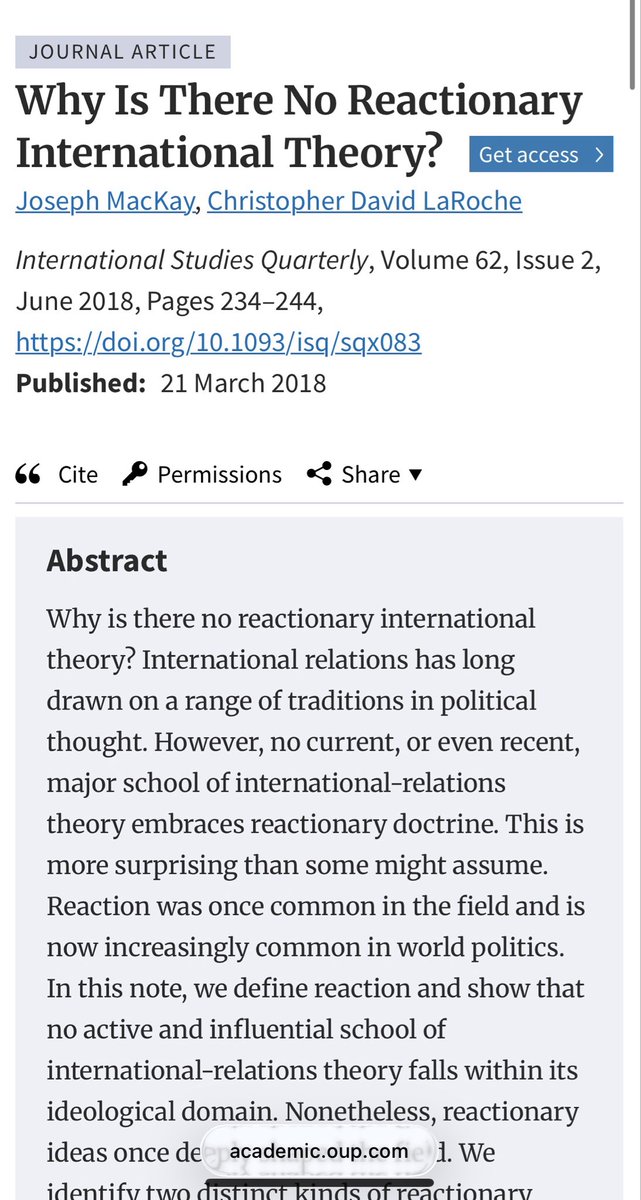
The very style of this paper answers its question. The absence of “reactionary international theory” has to do with the fact that the kinds of people to participate in scholarly argumentation about theories of international relation are not the same as the kind of people of who believe that history is “off course”