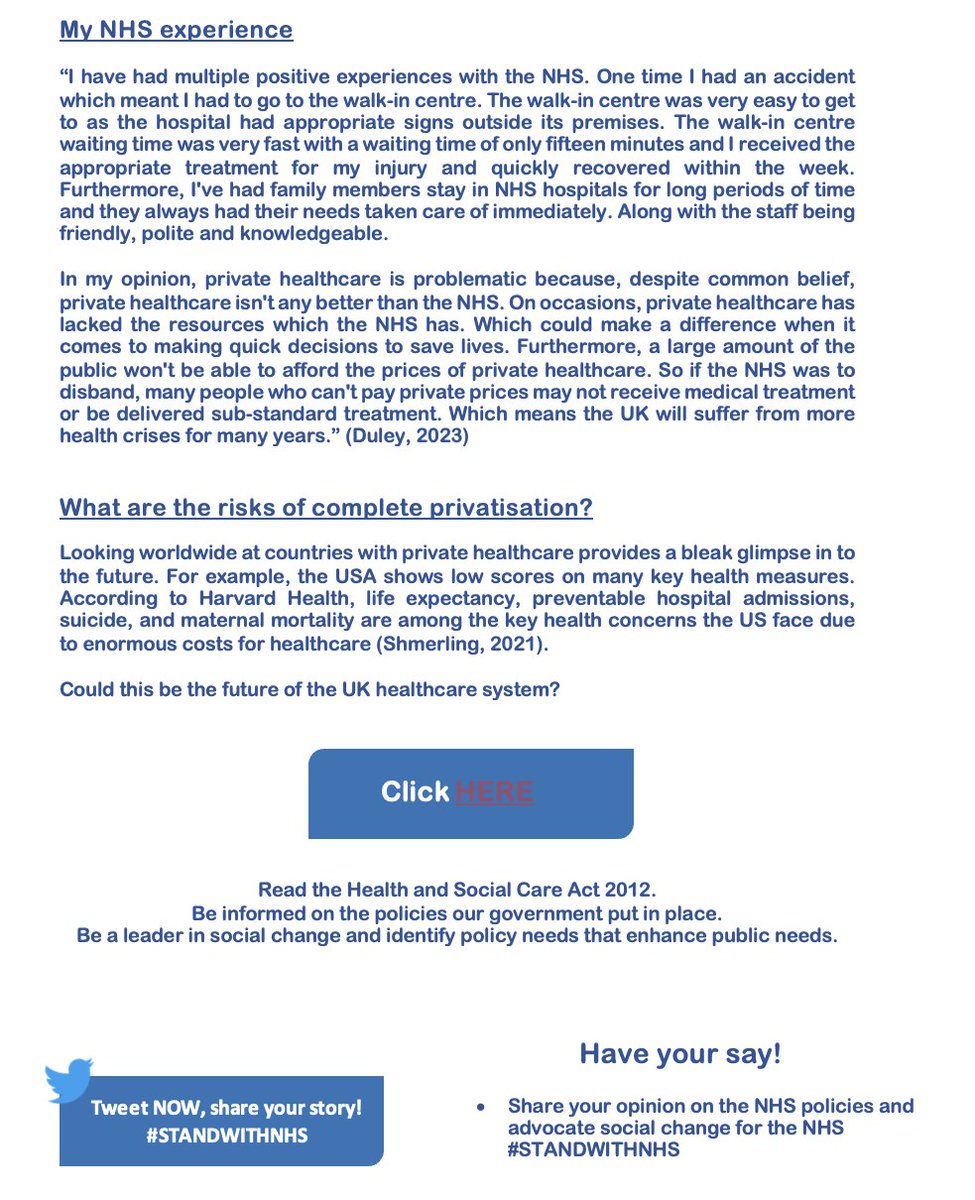
#OUB329 My groups call to action.
Help us and share your opinion on NHS policy!
Click here to read the act: https://t.co/315XORl0e6
Share your opinion using #STANDWITHNHS
#OUB329 Wk17 Reflection – #Storytelling in leadership helps to frame the message, connect with the audience to create emotional appeal and mobilise the action.
#OUB329 Wk17 Learning – #Socialchangeleadership is an umbrella term for social transformations. Leadership addresses systemic issues at any level, providing social innovation. Having perspectives from disadvantaged groups highlights how disrupting the status quo may impact.
#OUB329 Wk16 Reflection – A strong sense of purpose can provide leadership. Precarious workers can practice leadership though society may consider them to have no authority, using different forms of communication can disperse leadership.
#OUB329 Wk16 Learning – #Activistleadership promotes strong actions to influence, these can be peaceful or violent. Change is promoted through purpose. Differences in #activitstleadership are offers adaptability to groups, therefore the leadership form is accessible and flexible.
#OUB329 Wk15 Reflection – Expect resistance and consider the learnings from the changing dynamics #resistanceleadership creates. Disruption and challenge can highlight communication breakdown, leading to more effective strategy.
#OUB329 Wk15 Learning – Leadership is resisted in different ways, pushing boundaries. #Resistanceleadership highlights the power dimension of leader behaviour and how it is exerted through groups and individuals.
#OUB329 Wk14 Reflection – Issues that affect our immediate surroundings can become more complex as decisions are made at different levels. Therefore improvements may not apply to every community member, showing complexity requires collaboration to ensure best leadership practice.
#OUB329 Wk14 Learning – #Placebasedleadership strives to improve the quality of communities in a particular location. People may feel belonging based on different emotions associated.
#OUB329 Wk12 Learning – #Gametheory can be applied to everyday social interactions. Competing aims drive opportunistic behaviour, leaders of collaborative teams must manage and lead to achieve success.
#OUB329 Wk11 Reflection – Conflict is not rational, it can be emotive and personal. It stems from how relationships and expectations are managed. Flexibility brings forward different #leadershipstyles to help with complex conflict.
#OUB329 Wk10 Reflection – Understanding others viewpoints, and considering how they have been influenced will show how networked our society is. Processes that influence leadership are not easy to identify, and not all outcomes are positive or motivational.
#OUB329 Wk10 Learning – #Leadership is fundamentally #relational. Influencing and networking help direct leadership positions, regardless of hierarchy. A focus on nurturing relationships is important, yet a directive approach is necessary in certain situations.
#OUB329 Wk9 Reflection – #Collaboration builds positive relationships, promoting learning from one another. #Sharedleadership improves results for organisational boundaries - collectively people produce effective results, potentially contributing to competitive advantage.
#OUB329 Wk9 Learning – #Collaboration among people is important in responding to #turbulentsituations. #Collaborativeleadership highlights the supportive role leaders need to cultivate a team’s collective intelligence for better processes and actions to achieve the vision.
#OUB329 Wk8 Reflection – Effective leaders should be flexible with their #leadershipstyle and utilise other styles when necessary. To successfully lead a team in #turbulent or #precarious times, flexing #leadershipstyles is vital to bringing a diverse team together.
#OUB329 Wk7 Reflection – To be an #inspiring leader, your purpose and direction should be clear. Developing elements, such as motivating action and communicating a path, provide focus to achieve a vision.