Indian election commentary is loud, narrative-heavy, and often built on anecdotal bias.
But elections are won on thin margins, regional swings, and mathematical probabilities.
At The Electoral Index, we treat psephology as data science. Here is our complete 2026-2027 analytical roadmap: 👇(1/3)
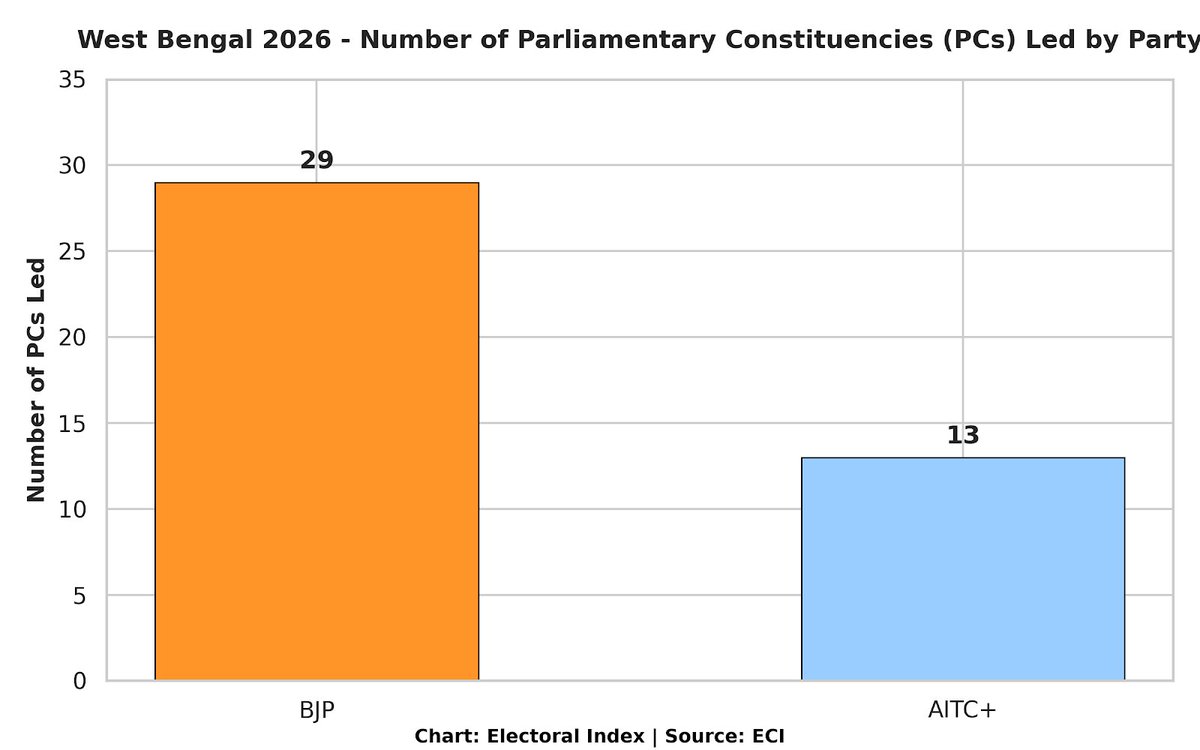
West Bengal Assembly Elections 2026 - Number of Parliamentary Constituencies (PCs) Led by Party
BJP : Leading in 29 PCs
AITC+: Leading in 13 PCs
Others : Leading in 0 PCs
Source: Election Commission of India (ECI)
#WestBengal2026#WBElections2026#ElectionData#LS2029
Strong FDI momentum for India. Inflows rose 44% to $39 billion in 2025 (per UNCTAD data), moving India to 11th globally, driven by large strategic projects from MNCs. This reflects growing investor confidence and supports expansion in manufacturing and related sectors. From an election data perspective, sustained FDI can contribute to job creation, technology inflows, and industrial growth in key states — factors that influence localized economic confidence and voter priorities around development and opportunities.
Notable expansion of India’s strategic energy infrastructure. ONGC’s new 1.75 million ton oil reserve in Mangalore adds to efforts to build buffers against global supply disruptions, alongside plans for additional storage in Odisha and Padur. Partnerships, including with ADNOC, are also supporting commercial use of reserves. These investments enhance energy security and reduce vulnerability to external shocks. From an election data perspective, stronger strategic infrastructure in critical sectors like energy supports long-term economic resilience, which can influence broader confidence in governance and development outcomes.
Useful comparison on agricultural pathways. Tamil Nadu’s progress through diversification and value addition contrasts with Uttar Pradesh’s approach of public investment, productivity gains, and support for small and marginal farmers. Both models reflect context-specific strategies that have delivered results in their respective settings. From an election data perspective, sustained agricultural improvement directly influences rural incomes and economic confidence — key factors that shape voter priorities around development, farmer welfare, and governance in states like Uttar Pradesh.
Interesting migration dynamics in Kerala. With ~40 lakh immigrants from states like UP, Bihar, and West Bengal alongside ~25 lakh emigrants to the Gulf, Kerala functions as both a destination and a source in India’s labor flows. On a population of ~4 crore, these are the highest in- and out-migration rates in the country. This creates economic linkages where remittances from Gulf employment in Kerala can indirectly support opportunities back home, while northern states like UP supply labor for Kerala’s economy.
From an election data perspective, such inter-state migration patterns influence economic conditions, job availability, and household incomes in sending regions — factors that shape voter priorities around employment and development in states like UP.
Relevant point on state-level stress. Free power schemes are contributing to financial pressure on discoms and state economies, as shown in recent data. While these policies provide immediate support to consumers, they can constrain fiscal space for other development needs. Tracking how states manage such trade-offs offers useful insights into governance priorities and their potential impact on localized economic confidence.
Interesting outcome on the LPG front. Strategic purchases during periods of global uncertainty have apparently resulted in a domestic cooking gas surplus. This can help ensure stable supply and potentially ease pressure on household energy costs.
From an election data perspective, reliable access to essential items like LPG at reasonable prices supports rural and semi-urban household budgets. These factors often influence localized economic confidence and voter priorities around cost of living and energy security in key states.
Positive update on monsoon progress. The cumulative rainfall deficit has narrowed significantly to 14% as the Southwest monsoon covers the entire country. This is a meaningful improvement from earlier concerns of a steep shortfall.
Adequate and well-distributed rainfall will be crucial for kharif sowing and rural incomes in key agrarian states. From an election data perspective, monsoon performance remains one of the most important variables shaping localized economic confidence and voter priorities around agriculture and development.
Thoughtful and cautious analysis. The current data from Paschim Uttar Pradesh does show a structural advantage for BJP due to demographics and low opposition unity. However, as you rightly point out, the real test will come in Awadh, Bundelkhand, and Poorvanchal, where local factors like anti-incumbency and farmer distress could play a bigger role.
Seat-wise tracking across different regions will be key to understanding how these dynamics evolve closer to 2027. Looking forward to more data from the other parts of the state.
Interesting push for India’s toy industry. The target of capturing 25% of the global toy market by 2032, supported by the National Action Plan, higher duties, quality standards, and manufacturing clusters in states like Uttar Pradesh and Tamil Nadu, reflects continued focus on scaling domestic manufacturing.
Progress so far — rising exports and sharply lower imports — shows policy measures can help build competitiveness. From an election data perspective, growth in such sectors can create employment opportunities (including for artisans and youth) and strengthen localized economic activity in key states, which often influences voter priorities around jobs and industrial development.
Useful stats on India’s urban economy. The top 100 cities punch well above their population weight, generating 35% of national income and 31% of consumption. This concentration reflects rapid urbanization and its role in driving growth.
Tracking how urban economic strength translates into localized confidence and voter priorities — especially alongside rural economic indicators — remains relevant for understanding electoral dynamics in key states.
@janwhyy Our demographic survey data says that we have market for both segments. At entry level of any entrepreneurship it was always a cafe but with success you move towards a coworking space to your own office.
Valid nuance on the Japan comparison. India still has ground to cover on deeper value addition. However, the 40%+ growth in electronics exports and entry into new markets reflect real progress in building manufacturing scale. This is already supporting jobs in key states. Tracking how these trends affect economic confidence and voter priorities around development remains useful.
Valid point on value addition. Much of the current growth is still assembly-driven, and deepening domestic content remains important. At the same time, the sharp rise in exports combined with nearly 700,000 direct and indirect jobs created under the PLI scheme shows real momentum in building manufacturing ecosystems. This is already supporting employment and economic activity in states with growing electronics clusters. From an election data perspective, even at this stage, the expansion is contributing to localized economic confidence and can influence voter priorities around jobs and industrial development.
Further policy support for electronics manufacturing. The government has removed import duties on key raw materials and components, including those for wireless charging modules in mobiles and displays used in auto, medical, and industrial sectors. The exemption is valid until March 2029.
These measures can help reduce input costs and improve competitiveness for manufacturers. From an election data perspective, sustained policy support for high-value manufacturing sectors like electronics supports production scaling, exports, and job creation in key states — trends that can positively influence localized economic confidence and voter priorities around development and employment.
Clear visual on state-level income progress. Several Indian states have now crossed important per capita income thresholds, reflecting meaningful gains in economic output and living standards — particularly in southern and western regions.
As more states raise per capita incomes, it often correlates with better job opportunities, infrastructure development, and overall economic confidence. These trends are worth tracking for their potential influence on voter priorities around development and growth in key electoral states.
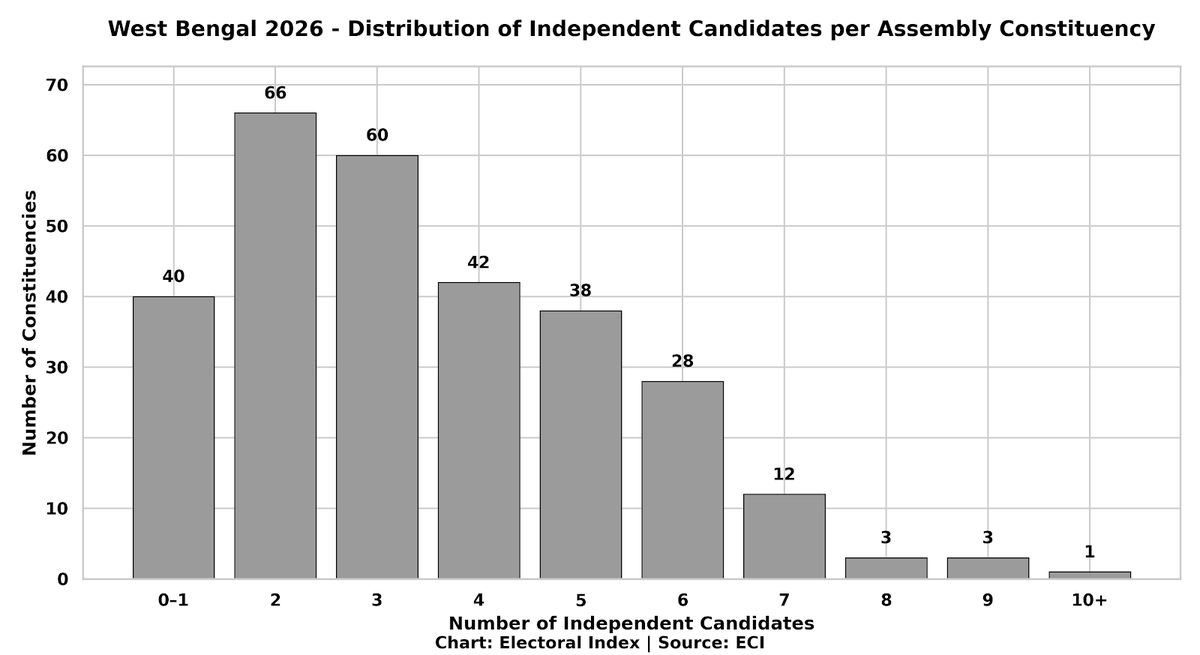
West Bengal Assembly Elections 2026 - Distribution of Independent Candidates per Assembly Constituency
Total Independent Candidates Contesting Statewide: 1,020
Constituencies with at least 1 Independent: 288 out of 293
5 Constituencies with Zero Independent Candidates:
• Sagar
• Goghat
• Chandipur
• Chandrakona
• Purbasthali Dakshin
Source: Election Commission of India (ECI)
#WestBengal2026 #WBElections2026 #ElectionData #Independents
Positive macro signal on investment flows. India has improved its global FDI ranking while also becoming the 18th largest overseas investor, with outward FDI rising sharply to $36 billion. This dual trend — attracting foreign capital while Indian companies expand abroad — reflects growing economic confidence and corporate strength.
From an election data perspective, sustained FDI momentum (both inward and outward) supports job creation, technology inflows, and industrial growth, which can influence localized economic confidence and voter priorities around development and opportunities in key states.