Team Blegg: Carl Sagan's pale blue dot is Andy Weir's egg; Goldberg is my favorite Rube. Art in the streets, crumbs in the sheets. An ant grasshopper-ing.
Remember writing letters to your friends and reading their responses? Remember your favorite books? Remember attending world class theater productions and concerts? Remember being able to carry all of these things in your pocket? Not the worst thing to cherish!
When our son Milo was seven years old, @jenalden had this brilliant idea: Every month she and I each had a Free Day. We coordinated each month about what day specifically, but they were not optional and couldn't be skipped. On our Free Day, from waking up to falling asleep, we weren't Parent or Spouse. We could do whatever we wanted and the other person took care of everything. I was life-changing! That's when I started feeling like Lawrence again (not just Dad), doing projects and hobbies and Jen started doing art again. This went on until Milo was 15, when he was independent enough that we didn't feel like we needed it anymore. (We had enough "me" hours in the week.)
In general I think there's something fairly corrosive about living in a world where all material goods are extremely cheap compared to housing and healthcare, because it feels completely futile to be frugal on the small stuff.
Chat:
The continuum appears in our best physical theories for non-arbitrary reasons. It is the mathematical setting where locality, smooth symmetry, frame invariance, conservation laws, gauge structure, and field dynamics become exact and tractable. Lorentz invariance is naturally continuous. General relativity uses differentiable manifolds and curvature. Quantum field theory relies on smooth fields, continuous groups, and renormalization flows. Gauge theories are most cleanly expressed through connections and curvature over spacetime. None of this proves that the continuum is ontologically fundamental, but it explains why eliminating it is so hard: a discrete or finite model must recover the whole package without leaving behind observable lattice artifacts, preferred frames, broken symmetries, or ad hoc continuum limits.
The real tension is not “continuum versus mechanism” in some simple way. The continuum gives physics exact invariance; discrete models give an intuitive finite mechanism. The hard problem is getting both at once. A successful non-continuum theory would need to show not merely that local update rules can generate complex patterns, but that they recover Lorentz invariance, gauge symmetry, QFT, GR, black hole thermodynamics, and the right renormalization behavior in the relevant limits. Until then, the continuum remains less like a failure of imagination and more like the mathematical habitat where our deepest physical constraints currently know how to live.
traveling with a baby is so fun. you know how good it feels to see your beloved cat having a really good time with a laser pointer, or your dog going nuts at the beach? it’s like that but infinitely better because babies are way better than pets.
yesterday i got to watch my baby try every component of ramen, and the ramen chef personally gave him a tiny ramen bowl with seaweed sheets in it. adorable. we took him to an immersive art exhibit and watching him watch the lights was as good as watching them myself. even riding the metro suddenly feels new and interesting.
all the ppl delaying parenthood so they can do things like travel first have it all wrong. it feels like saying you wanna get all of your breakfast in bed days out of the way before meeting your spouse.
Imagine a forest. Every organism has a niche: the fungi network linking roots, decomposers turning dead stuff back into soil, beavers incidentally creating habitats for other species. Every organism pursues its agenda, but those whose agendas serve the broader web of life tend to find their niche reinforced by it. And that web of life needs the full diversity of roles to stay healthy.
I think culture works the same way. There's an ecology of roles: the host, the initiator, the clown/provocateur, the den mom, etc.
However, a lot of people are operating on the (false IMO) premise that they are atomized individuals who don't exist in a cultural web of life. We ask "what's my passion" or "what maximizes my status" rather than "what niches do I naturally fulfill?"
For me, "clarifying my ecological role" meant asking: what are the cultural ecosystems that I care about always asking me to do? What role do I tend to end up in?
Once I started asking, a lot of decisions got simpler. The roles I've always landed in – across companies, movements, and friend networks – are ones like "superconnector/cross-pollinator," "clown," and "social world-builder."
for years, society was limited to only 16 syrup squares per waffle but with recent combinatorial optimization breakthroughs our research department has achieved previously unheard of densities of waffle syrup
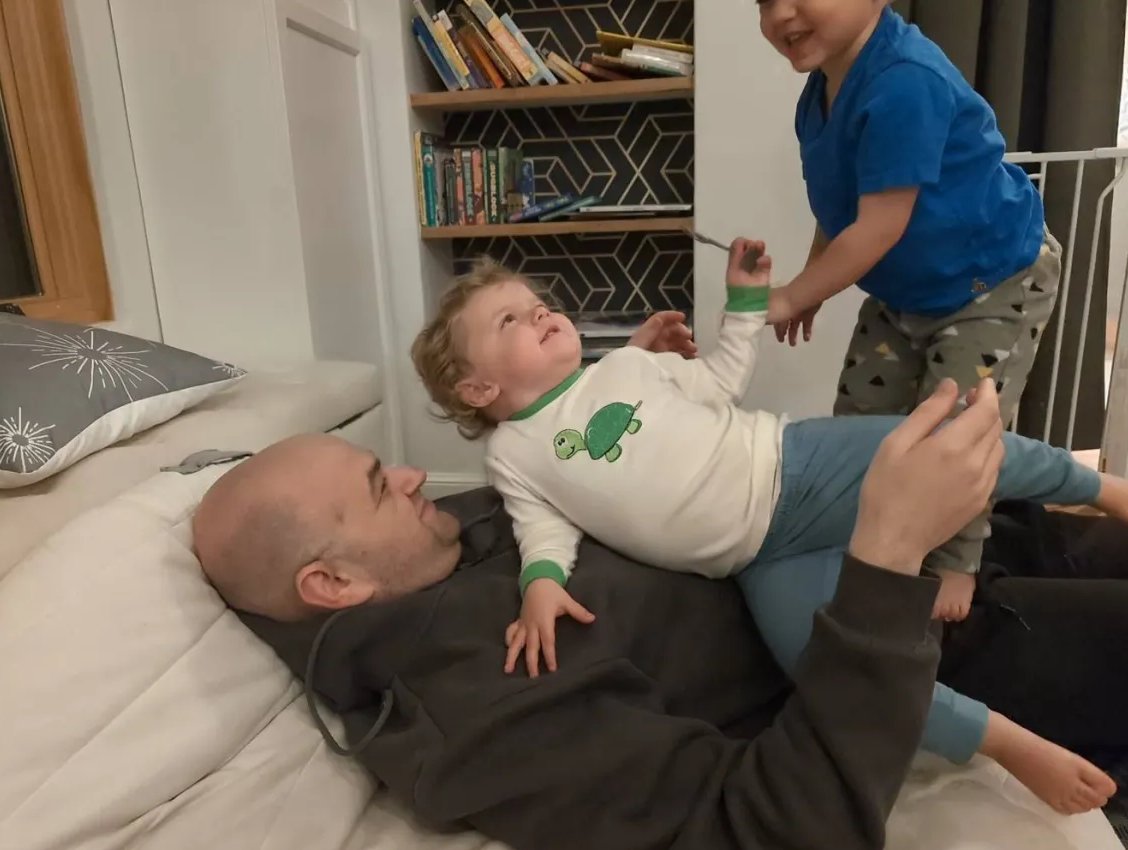
I finally got my first Grok "Today's News" item, about people complaining that I'm "letting my kids walk all over me".
Fact check: PARTLY TRUE - my son manages to walk on me sometimes, but my daughter doesn't have the balance for it.
(more serious response below)
Rob Wiblin's use of Claude here to advance the discussion is a super interesting conversational move, and I think it's praiseworthy.
- Dwarkesh and Trammell post about ASI income inequality
- Garry Tan QTs with brief pushback
- Wiblin responds, essentially, "wow!"
- To Wiblin's surprise, Tan replies briefly
- Wiblin thanks Tan for the reply and sets out his argument at length
- Tan replies: OK but consider this 26-page paper
- Instead of reading the entire 26-page paper, Wiblin throws it into the current best frontier AI and shares its assessment that it isn't germane.
I think a lot of people are going to be like, how dare you! Why are you passing this on to Claude instead of reading it yourself? But I think Wiblin's response is entirely fair, and a very useful affordance from LLMs. The expectation that Tan can just quickly tweet a link to a 26-page paper, and then Wiblin has to finish reading it to respond even if it isn't really germane, is a kind of failure mode of online debate. It's reasonable to say "I glanced, and I'm not sure it's relevant", but Wiblin goes the extra mile, and asks Claude to assess its relevance in detail. It seems like an especially thorough - and in fact especially polite - way to say "I'm sorry but I'm going to need you to briefly set out the argument for what this says and how it relates to our ongoing discussion", and one that creates better conversational incentives.
writing our wedding vows! it feels like the possibility space here is enormous. if anyone wants to share their vows i’d love read them and get inspired.