You heard all about AI accelerating simulations (maybe from me?), but do you know...
How can AI tell you what is in the Universe?
Our new series of work from #SimBIG team led by @changhoon_hahn published recently by @NatureAstronomy did just that!
Interesting things we did:
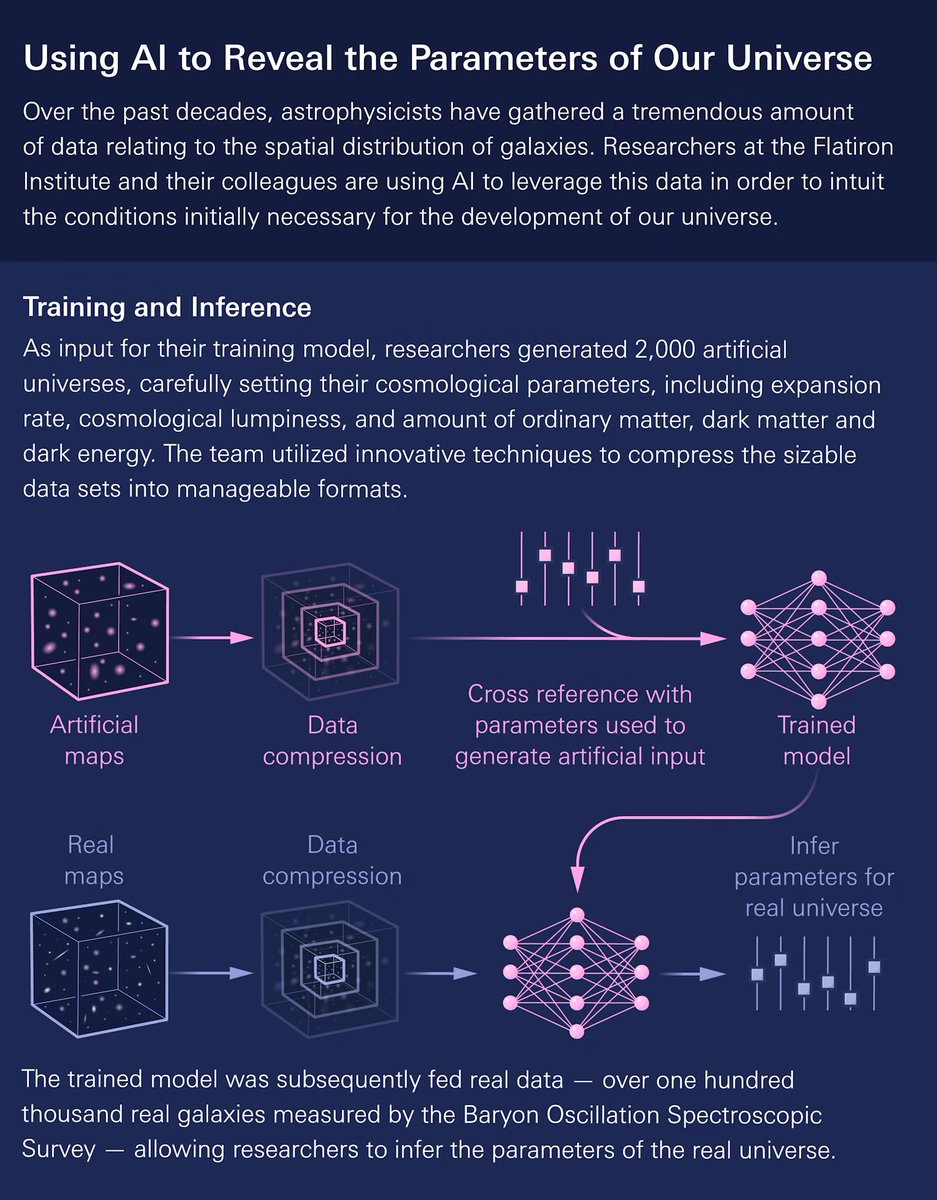
👉 This is the first time one simulates the Universe observed via a spectroscopic telescope (@sdssurveys) well enough to compare it to the actual Universe!
We simulated 20,000 of these universes!
👉 For each simulated universe, it gives you summary statistics (x) and the fundamental properties of the simulation (y). We then train an AI using these 20,000 pairs of (x,y) to calculate the posterior P (y | x ).
👉 Now you can give this AI observed summary statistics (x') from the real observed Universe and here come the fundamental parameters of the Universe with appropriate errors💫
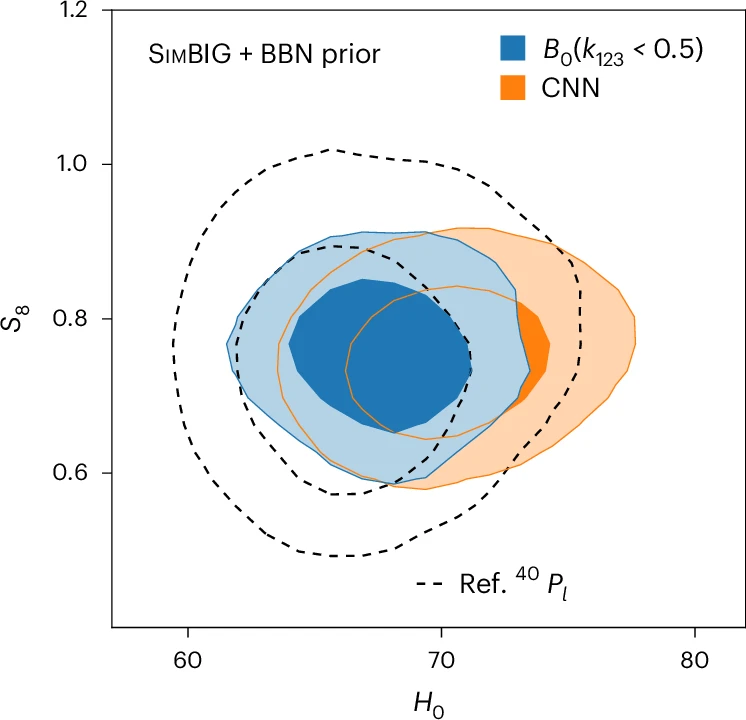
By extracting non-Gaussian cosmological information on galaxy clustering at non-linear scales, a framework for cosmic inference (SimBIG) provides precise constraints for testing cosmological models. @ChanghoonHahn@cosmo_shirley@DavidSpergel et al.: https://t.co/lXiOSKc8T8
During the last few weeks, we tackled the challenging problem of forecasting space radiation. We made the first steps toward the development of a forecasting tool to alert astronauts of incoming harmful radiation!
We've been working on probabilistic sequence models of the radiation environment to introduce a new class of forecasting tools for human space flight, dealing with with very large datasets (TB to PB) of high-res solar images, x-ray/proton fluxes, radiation data from many sources.
Working on foundation models for scientific problems? Consider submitting your paper to the 1st Workshop on Foundation Models for Science (FM4Science) #neurips2024 in Vancouver!
Abstract DDL: Aug. 27, 2024 AOE
OpenReview: https://t.co/VN9XAfDels
Workshop: https://t.co/avmUoXyYz0
✨The emptiness of cosmic voids is full of information that will help us unveil the mysteries of our Universe!
Grateful to be part of this cosmic journey🛰️🔭
Welcome to the dazzling edge of darkness!🤩
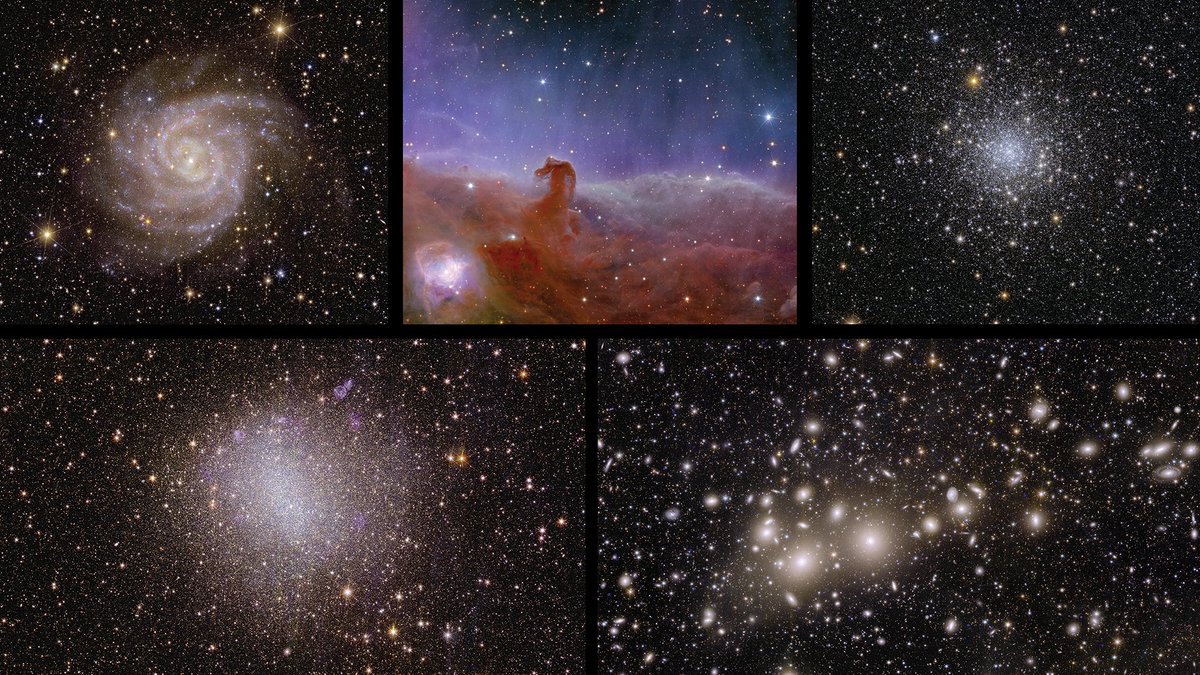
The first images from #ESAEuclid are here:
razor-sharp, wide & looking far into the distant Universe. A trifecta never before achieved.
Explore these 5⃣ cosmic portraits that show Euclid's full potential https://t.co/xK65khZmyq and👇
💭The method estimates the [OIII]-Hbeta interloper fraction (relevant for @NASARoman), but it can be used to detect other types of interlopers, and in general a subset of objects having a spatial pattern different from the main sample.
w/ @paco_astro and Will Percival
🔍Worried about the presence of interlopers in your galaxy catalog?
📢We developed a new method based on GNNs to infer the interloper fraction in a catalog using likelihood-free inference.
📄 Check out our new paper: https://t.co/jKbI8Vw5l1
People often ask if AI will take over the Universe 🤪...
That I don't know, but how about...
Could AI discover what is in the Universe?
With our new approach, the answer is YES!
Led by @changhoon_hahn
Papers:
https://t.co/qj4l2vergM
and
https://t.co/VkmTiwIAMc