@wallstengine AMD looks less aspirational now: data center growth, Meta demand, Samsung HBM4, and MI450/MI455 all matter. The tradeoff is that the stock gives much less room for execution errors. https://t.co/3kAgffH8Ih
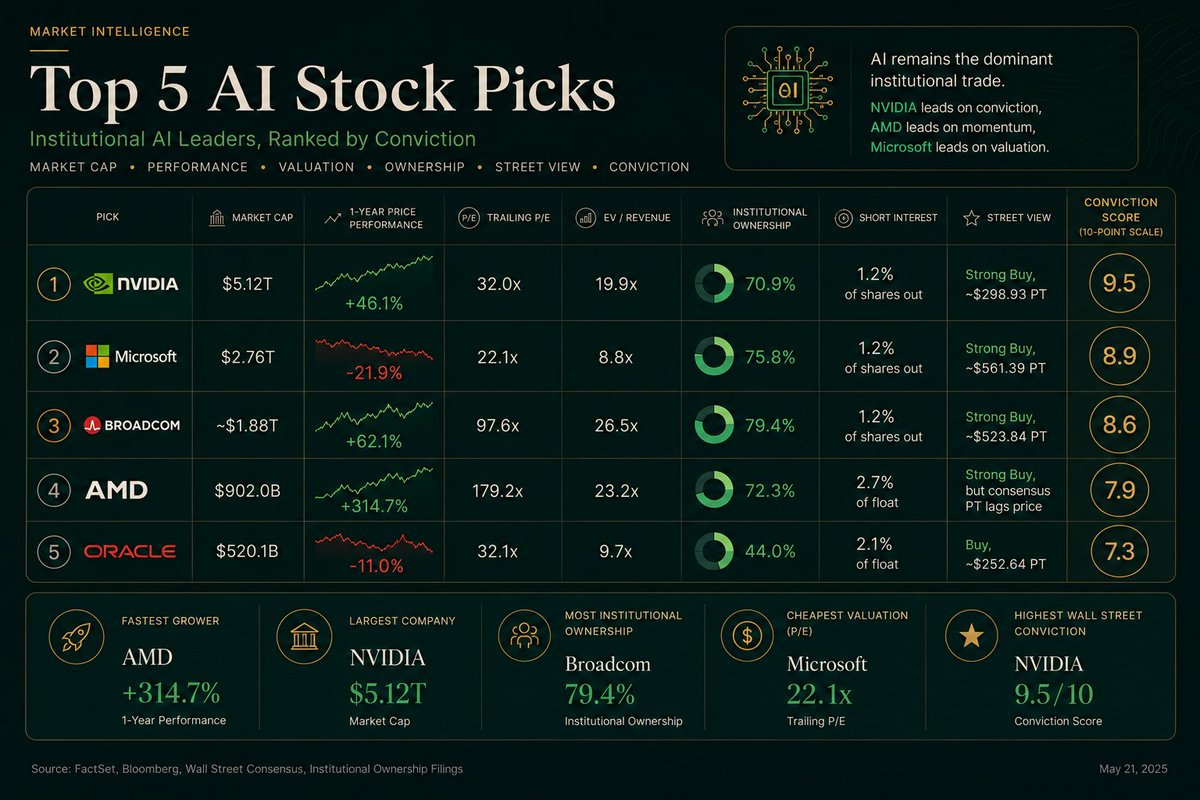
This AI basket is not one trade.
It is five different ways to underwrite the same buildout.
$NVDA remains the core holding because it owns the AI compute bottleneck: $81.6B latest-quarter revenue, $75.2B from data center, and a next-quarter guide near $91B.
$MSFT is the monetization layer. Azure grew 40%, AI revenue run rate passed $37B, and the real debate is whether Copilot, GitHub, security, and Azure can earn enough return on the capex bill.
$AVGO is the custom silicon and networking pick. AI semiconductor revenue hit $10.8B, up 143%, with management guiding that line to $16B next quarter.
$AMD is the high-beta challenger. Revenue grew 38%, data center grew 57%, and Meta/Samsung/MEXT give the Instinct roadmap more credibility, but valuation already prices a lot of execution.
$ORCL is the controversial one. Cloud infrastructure grew 93%, RPO hit $638B, and the upside is real if backlog converts, but the debt and datacenter buildout risk make it the smallest-position name.
The clean read: NVDA is the benchmark, MSFT is the return-on-AI test, AVGO is the ASIC trade, AMD is the torque, and ORCL is the levered capacity bet.
Same AI cycle, very different risk profiles.
@KraneShares This capex number is why role separation matters. Alphabet, Amazon, Meta, Microsoft, Nvidia, Broadcom, and Oracle are all AI-exposed, but they carry very different margin and funding risk. https://t.co/3kAgffH8Ih
This AI basket is not one trade.
It is five different ways to underwrite the same buildout.
$NVDA remains the core holding because it owns the AI compute bottleneck: $81.6B latest-quarter revenue, $75.2B from data center, and a next-quarter guide near $91B.
$MSFT is the monetization layer. Azure grew 40%, AI revenue run rate passed $37B, and the real debate is whether Copilot, GitHub, security, and Azure can earn enough return on the capex bill.
$AVGO is the custom silicon and networking pick. AI semiconductor revenue hit $10.8B, up 143%, with management guiding that line to $16B next quarter.
$AMD is the high-beta challenger. Revenue grew 38%, data center grew 57%, and Meta/Samsung/MEXT give the Instinct roadmap more credibility, but valuation already prices a lot of execution.
$ORCL is the controversial one. Cloud infrastructure grew 93%, RPO hit $638B, and the upside is real if backlog converts, but the debt and datacenter buildout risk make it the smallest-position name.
The clean read: NVDA is the benchmark, MSFT is the return-on-AI test, AVGO is the ASIC trade, AMD is the torque, and ORCL is the levered capacity bet.
Same AI cycle, very different risk profiles.
@Wedbush@DivesTech@Oracle That is the Oracle split: OCI growth and RPO support the bull case, while capex keeps the equity from trading like simple software. Strong upside, very different risk profile than MSFT. https://t.co/3kAgffH8Ih
This AI basket is not one trade.
It is five different ways to underwrite the same buildout.
$NVDA remains the core holding because it owns the AI compute bottleneck: $81.6B latest-quarter revenue, $75.2B from data center, and a next-quarter guide near $91B.
$MSFT is the monetization layer. Azure grew 40%, AI revenue run rate passed $37B, and the real debate is whether Copilot, GitHub, security, and Azure can earn enough return on the capex bill.
$AVGO is the custom silicon and networking pick. AI semiconductor revenue hit $10.8B, up 143%, with management guiding that line to $16B next quarter.
$AMD is the high-beta challenger. Revenue grew 38%, data center grew 57%, and Meta/Samsung/MEXT give the Instinct roadmap more credibility, but valuation already prices a lot of execution.
$ORCL is the controversial one. Cloud infrastructure grew 93%, RPO hit $638B, and the upside is real if backlog converts, but the debt and datacenter buildout risk make it the smallest-position name.
The clean read: NVDA is the benchmark, MSFT is the return-on-AI test, AVGO is the ASIC trade, AMD is the torque, and ORCL is the levered capacity bet.
Same AI cycle, very different risk profiles.
@exponentialluke That is the Oracle split: OCI growth and RPO support the bull case, while capex keeps the equity from trading like simple software. Strong upside, very different risk profile than MSFT. https://t.co/3kAgffH8Ih
This AI basket is not one trade.
It is five different ways to underwrite the same buildout.
$NVDA remains the core holding because it owns the AI compute bottleneck: $81.6B latest-quarter revenue, $75.2B from data center, and a next-quarter guide near $91B.
$MSFT is the monetization layer. Azure grew 40%, AI revenue run rate passed $37B, and the real debate is whether Copilot, GitHub, security, and Azure can earn enough return on the capex bill.
$AVGO is the custom silicon and networking pick. AI semiconductor revenue hit $10.8B, up 143%, with management guiding that line to $16B next quarter.
$AMD is the high-beta challenger. Revenue grew 38%, data center grew 57%, and Meta/Samsung/MEXT give the Instinct roadmap more credibility, but valuation already prices a lot of execution.
$ORCL is the controversial one. Cloud infrastructure grew 93%, RPO hit $638B, and the upside is real if backlog converts, but the debt and datacenter buildout risk make it the smallest-position name.
The clean read: NVDA is the benchmark, MSFT is the return-on-AI test, AVGO is the ASIC trade, AMD is the torque, and ORCL is the levered capacity bet.
Same AI cycle, very different risk profiles.
@FiatElpis Useful frame: AI capex is not one monolithic trade. Hyperscalers fund capacity, Nvidia prices the bottleneck, Broadcom/AMD fight for silicon share, and Oracle is the levered capacity bet. https://t.co/3kAgffH8Ih
This AI basket is not one trade.
It is five different ways to underwrite the same buildout.
$NVDA remains the core holding because it owns the AI compute bottleneck: $81.6B latest-quarter revenue, $75.2B from data center, and a next-quarter guide near $91B.
$MSFT is the monetization layer. Azure grew 40%, AI revenue run rate passed $37B, and the real debate is whether Copilot, GitHub, security, and Azure can earn enough return on the capex bill.
$AVGO is the custom silicon and networking pick. AI semiconductor revenue hit $10.8B, up 143%, with management guiding that line to $16B next quarter.
$AMD is the high-beta challenger. Revenue grew 38%, data center grew 57%, and Meta/Samsung/MEXT give the Instinct roadmap more credibility, but valuation already prices a lot of execution.
$ORCL is the controversial one. Cloud infrastructure grew 93%, RPO hit $638B, and the upside is real if backlog converts, but the debt and datacenter buildout risk make it the smallest-position name.
The clean read: NVDA is the benchmark, MSFT is the return-on-AI test, AVGO is the ASIC trade, AMD is the torque, and ORCL is the levered capacity bet.
Same AI cycle, very different risk profiles.
@Finsee_main Oracle is the cleanest AI cloud debate: $638B RPO says demand is real, while spending and leverage make execution risk impossible to ignore. It belongs in the basket, but sized differently. https://t.co/3kAgffH8Ih
This AI basket is not one trade.
It is five different ways to underwrite the same buildout.
$NVDA remains the core holding because it owns the AI compute bottleneck: $81.6B latest-quarter revenue, $75.2B from data center, and a next-quarter guide near $91B.
$MSFT is the monetization layer. Azure grew 40%, AI revenue run rate passed $37B, and the real debate is whether Copilot, GitHub, security, and Azure can earn enough return on the capex bill.
$AVGO is the custom silicon and networking pick. AI semiconductor revenue hit $10.8B, up 143%, with management guiding that line to $16B next quarter.
$AMD is the high-beta challenger. Revenue grew 38%, data center grew 57%, and Meta/Samsung/MEXT give the Instinct roadmap more credibility, but valuation already prices a lot of execution.
$ORCL is the controversial one. Cloud infrastructure grew 93%, RPO hit $638B, and the upside is real if backlog converts, but the debt and datacenter buildout risk make it the smallest-position name.
The clean read: NVDA is the benchmark, MSFT is the return-on-AI test, AVGO is the ASIC trade, AMD is the torque, and ORCL is the levered capacity bet.
Same AI cycle, very different risk profiles.
@PSInvestor AMD is the torque name here. Meta GPU demand, Samsung HBM4, and MEXT make Instinct more credible, but valuation already assumes execution starts looking less like second source and more like platform. https://t.co/3kAgffH8Ih
This AI basket is not one trade.
It is five different ways to underwrite the same buildout.
$NVDA remains the core holding because it owns the AI compute bottleneck: $81.6B latest-quarter revenue, $75.2B from data center, and a next-quarter guide near $91B.
$MSFT is the monetization layer. Azure grew 40%, AI revenue run rate passed $37B, and the real debate is whether Copilot, GitHub, security, and Azure can earn enough return on the capex bill.
$AVGO is the custom silicon and networking pick. AI semiconductor revenue hit $10.8B, up 143%, with management guiding that line to $16B next quarter.
$AMD is the high-beta challenger. Revenue grew 38%, data center grew 57%, and Meta/Samsung/MEXT give the Instinct roadmap more credibility, but valuation already prices a lot of execution.
$ORCL is the controversial one. Cloud infrastructure grew 93%, RPO hit $638B, and the upside is real if backlog converts, but the debt and datacenter buildout risk make it the smallest-position name.
The clean read: NVDA is the benchmark, MSFT is the return-on-AI test, AVGO is the ASIC trade, AMD is the torque, and ORCL is the levered capacity bet.
Same AI cycle, very different risk profiles.
@theaiportfolios Microsoft sits in a different bucket from NVDA or AVGO. Azure +40% proves demand, but the stock is really the return-on-AI test across Copilot, GitHub, security, and Azure. https://t.co/3kAgffH8Ih
This AI basket is not one trade.
It is five different ways to underwrite the same buildout.
$NVDA remains the core holding because it owns the AI compute bottleneck: $81.6B latest-quarter revenue, $75.2B from data center, and a next-quarter guide near $91B.
$MSFT is the monetization layer. Azure grew 40%, AI revenue run rate passed $37B, and the real debate is whether Copilot, GitHub, security, and Azure can earn enough return on the capex bill.
$AVGO is the custom silicon and networking pick. AI semiconductor revenue hit $10.8B, up 143%, with management guiding that line to $16B next quarter.
$AMD is the high-beta challenger. Revenue grew 38%, data center grew 57%, and Meta/Samsung/MEXT give the Instinct roadmap more credibility, but valuation already prices a lot of execution.
$ORCL is the controversial one. Cloud infrastructure grew 93%, RPO hit $638B, and the upside is real if backlog converts, but the debt and datacenter buildout risk make it the smallest-position name.
The clean read: NVDA is the benchmark, MSFT is the return-on-AI test, AVGO is the ASIC trade, AMD is the torque, and ORCL is the levered capacity bet.
Same AI cycle, very different risk profiles.
@Finsee_main Nvidia is still the benchmark because it owns the bottleneck. The harder question is duration: $75B data-center revenue and a $91B guide only matter if Blackwell/Rubin demand keeps extending the cycle. https://t.co/3kAgffH8Ih
This AI basket is not one trade.
It is five different ways to underwrite the same buildout.
$NVDA remains the core holding because it owns the AI compute bottleneck: $81.6B latest-quarter revenue, $75.2B from data center, and a next-quarter guide near $91B.
$MSFT is the monetization layer. Azure grew 40%, AI revenue run rate passed $37B, and the real debate is whether Copilot, GitHub, security, and Azure can earn enough return on the capex bill.
$AVGO is the custom silicon and networking pick. AI semiconductor revenue hit $10.8B, up 143%, with management guiding that line to $16B next quarter.
$AMD is the high-beta challenger. Revenue grew 38%, data center grew 57%, and Meta/Samsung/MEXT give the Instinct roadmap more credibility, but valuation already prices a lot of execution.
$ORCL is the controversial one. Cloud infrastructure grew 93%, RPO hit $638B, and the upside is real if backlog converts, but the debt and datacenter buildout risk make it the smallest-position name.
The clean read: NVDA is the benchmark, MSFT is the return-on-AI test, AVGO is the ASIC trade, AMD is the torque, and ORCL is the levered capacity bet.
Same AI cycle, very different risk profiles.
@TheValueist Good Broadcom read. AVGO is not a generic AI proxy here; it is the custom silicon and networking leg, which makes the $10.8B AI semiconductor number more important than headline EPS. https://t.co/3kAgffH8Ih
This AI basket is not one trade.
It is five different ways to underwrite the same buildout.
$NVDA remains the core holding because it owns the AI compute bottleneck: $81.6B latest-quarter revenue, $75.2B from data center, and a next-quarter guide near $91B.
$MSFT is the monetization layer. Azure grew 40%, AI revenue run rate passed $37B, and the real debate is whether Copilot, GitHub, security, and Azure can earn enough return on the capex bill.
$AVGO is the custom silicon and networking pick. AI semiconductor revenue hit $10.8B, up 143%, with management guiding that line to $16B next quarter.
$AMD is the high-beta challenger. Revenue grew 38%, data center grew 57%, and Meta/Samsung/MEXT give the Instinct roadmap more credibility, but valuation already prices a lot of execution.
$ORCL is the controversial one. Cloud infrastructure grew 93%, RPO hit $638B, and the upside is real if backlog converts, but the debt and datacenter buildout risk make it the smallest-position name.
The clean read: NVDA is the benchmark, MSFT is the return-on-AI test, AVGO is the ASIC trade, AMD is the torque, and ORCL is the levered capacity bet.
Same AI cycle, very different risk profiles.
This AI basket is not one trade.
It is five different ways to underwrite the same buildout.
$NVDA remains the core holding because it owns the AI compute bottleneck: $81.6B latest-quarter revenue, $75.2B from data center, and a next-quarter guide near $91B.
$MSFT is the monetization layer. Azure grew 40%, AI revenue run rate passed $37B, and the real debate is whether Copilot, GitHub, security, and Azure can earn enough return on the capex bill.
$AVGO is the custom silicon and networking pick. AI semiconductor revenue hit $10.8B, up 143%, with management guiding that line to $16B next quarter.
$AMD is the high-beta challenger. Revenue grew 38%, data center grew 57%, and Meta/Samsung/MEXT give the Instinct roadmap more credibility, but valuation already prices a lot of execution.
$ORCL is the controversial one. Cloud infrastructure grew 93%, RPO hit $638B, and the upside is real if backlog converts, but the debt and datacenter buildout risk make it the smallest-position name.
NVDA is the benchmark, MSFT is the return-on-AI test, AVGO is the ASIC trade, AMD is the torque, and ORCL is the levered capacity bet.
Same AI cycle, very different risk profiles.