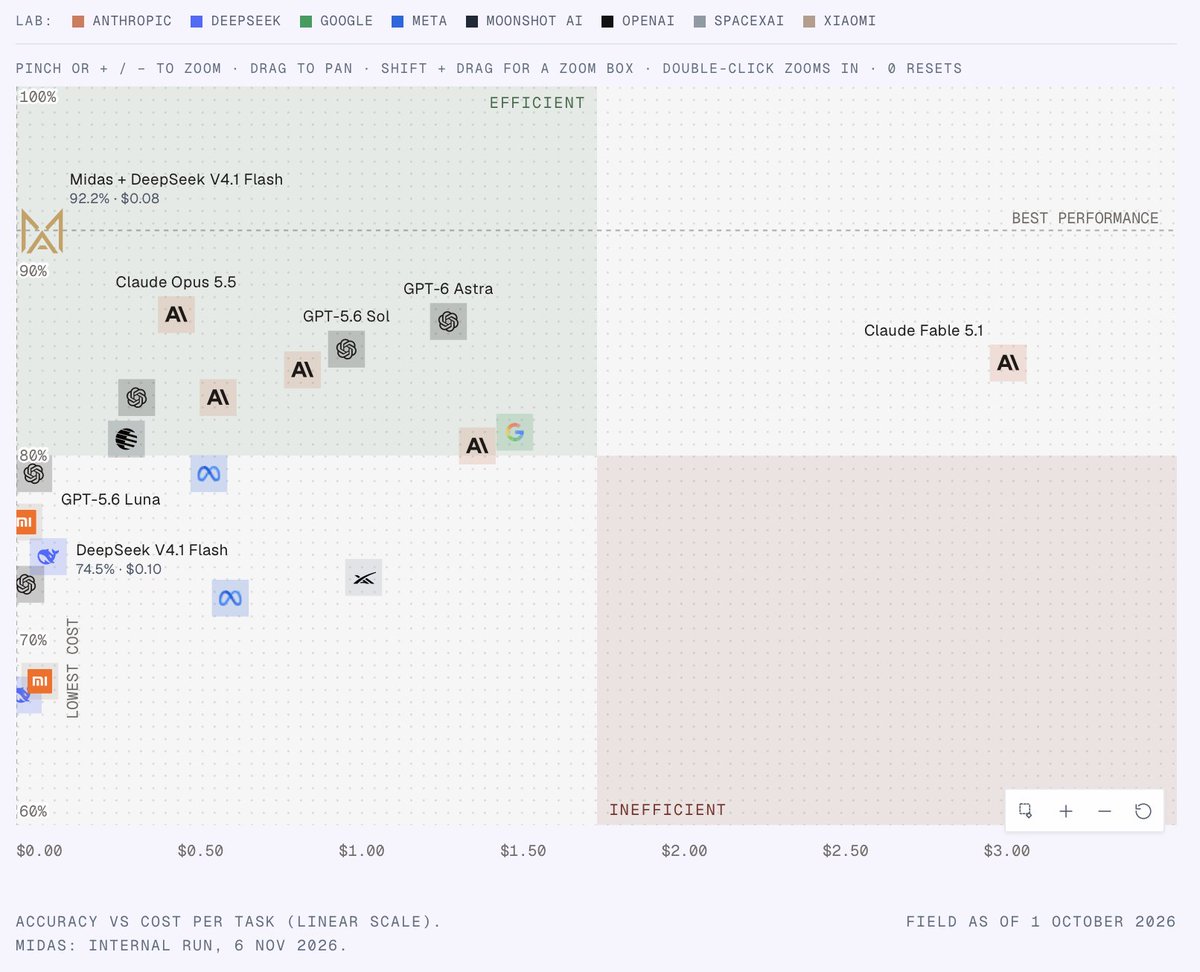
We achieved SOTA on Terminal Bench 2.1 using a DeepSeek v4.1 Flash model.
92.2% at $0.08 cost per task.
Previously Opus 5.5 was the leader at 87.6% at $0.50 cost per task (https://t.co/tQq0k10lvK).
Now the obvious question is how did we do it? How can you possibly improve a Flash model to beat frontier models like Opus, Fable, and Astra?
The truth is, we over-obsess about models when they are only half of the equation. The other half is the code that wraps around the model. In fact all of the most revolutionary products (Instinct, Muse, Claude Code, OpenClaw, etc.) are all just harnesses optimizations.
Rather than try to build a new model or fine-tune, we built a harness that would make:
Flash Models —> Frontier Results
Frontier Models —> Beyond Frontier Results
Did I mention it’s also ~6x faster than Claude Code?
And we’re now live. Go Check it out!
https://t.co/5Mnbe0INvj
We achieved SOTA on Terminal Bench 2.1 using a DeepSeek v4.1 Flash model.
92.2% at $0.08 cost per task.
Previously Opus 5.5 was the leader at 87.6% at $0.50 cost per task (https://t.co/tQq0k10lvK).
Now the obvious question is how did we do it? How can you possibly improve a Flash model to beat frontier models like Opus, Fable, and Astra?
The truth is, we over-obsess about models when they are only half of the equation. The other half is the code that wraps around the model. In fact all of the most revolutionary products (Instinct, Muse, Claude Code, OpenClaw, etc.) are all just harnesses optimizations.
Rather than try to build a new model or fine-tune, we built a harness that would make:
Flash Models —> Frontier Results
Frontier Models —> Beyond Frontier Results
Did I mention it’s also ~6x faster than Claude Code?
And we’re now live. Go Check it out!
https://t.co/5Mnbe0INvj
At a very high level, it's a number of optimizations pertaining to things like context management (improving inputs and guidance of models to improve outputs), improving tool calling, token efficiency, recursive self improvement at a user level so it "grows with you", and then lots of optimizing for speed so you can build faster.
Thank you everyone for the support!
Since this post reached 50k views, next 50 people whose first deposit is >$10 get 50% bonus credits
(Up to $50 bonus credits)
Sign up with this link: https://t.co/6mVgO0XDQn
or
In Dashboard, go to Billing
Code: LAUNCH50
$10 deposit = $15 in credits
...
$100 deposit = $150 in credits
Thank you everyone for the support!
Since this post reached 50k views, next 50 people whose first deposit is >$10 get 50% bonus credits
(Up to $50 bonus credits)
Sign up with this link: https://t.co/6mVgO0XDQn
or
In Dashboard, go to Billing
Code: LAUNCH50
$10 deposit = $15 in credits
...
$100 deposit = $150 in credits
We achieved SOTA on Terminal Bench 2.1 using a DeepSeek v4.1 Flash model.
92.2% at $0.08 cost per task.
Previously Opus 5.5 was the leader at 87.6% at $0.50 cost per task (https://t.co/tQq0k10lvK).
Now the obvious question is how did we do it? How can you possibly improve a Flash model to beat frontier models like Opus, Fable, and Astra?
The truth is, we over-obsess about models when they are only half of the equation. The other half is the code that wraps around the model. In fact all of the most revolutionary products (Instinct, Muse, Claude Code, OpenClaw, etc.) are all just harnesses optimizations.
Rather than try to build a new model or fine-tune, we built a harness that would make:
Flash Models —> Frontier Results
Frontier Models —> Beyond Frontier Results
Did I mention it’s also ~6x faster than Claude Code?
And we’re now live. Go Check it out!
https://t.co/5Mnbe0INvj
Different approach. OMP is designed to be super customizable. Midas handles all of that for you in the background by shaping itself into the best harness for you specifically. Some of our users used OMP before and totally abandoned it after a day with Midas.
You can still port over all of your skills and MCPs with /sync
Midas is going to auto route everything so it's not only using DS (this was just a demonstration to show how much we could do with a flash model). It's going to try to use the cheapest model that delivers the correct result (which based on this test and real world use case is almost always).
My best advice would be to not overthink it and if you have skills built already, just port those in, ask Midas if it needs more and let it rip.
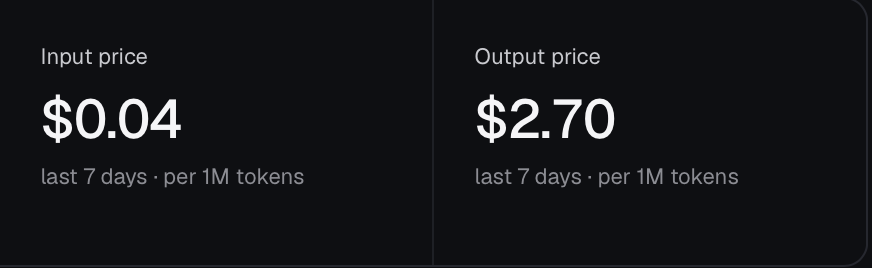
@LiteSoul No BYOK since the harness decides its own routing via auto mode. Most users are getting ~$0.04 input/1m after 99%+ cache and <$3.00 output/1m across the stack. These are my personal numbers
The result was achieved with a fresh, out of the box harness with all of the standard tools that it comes with.
As you use it, Midas will automatically at a local level adapt itself around you to learn your coding style, the way you prompt, work, etc. so it can best serve you.
This is all going to happen automatically but if you want to port skills, MCPs, etc. then just do /sync
@hemantsarthak This is just the first bench we ran. It’s using the production harness so we’re going to run more. Our users love it so far. If you’re skeptical, deposit $5 and see for yourself.
We also achieved SOTA on @CommandCodeAI's Frontier Token Efficiency eval.
This benchmark measures read and shell tool calling token-efficiency and we crushed.
Read more:
https://t.co/lXPXqbKFI1
(Yes we will run TB4 in the next couple weeks)
Since this post went viral, next 50 people whose first deposit is >$10 get 50% bonus credits up to $50.
$10 deposit = $15 in credits
...
$100 deposit = $150 in credits
In Dashboard, go to Billing
Code: LAUNCH50
We also achieved SOTA on @CommandCodeAI's Frontier Token Efficiency eval.
This benchmark measures read and shell tool calling token-efficiency and we crushed.
Read more:
https://t.co/lXPXqbKFI1
(Yes we will run TB4 in the next couple weeks)
Since this post went viral, next 50 people whose first deposit is >$10 get 50% bonus credits up to $50.
$10 deposit = $15 in credits
...
$100 deposit = $150 in credits
In Dashboard, go to Billing
Code: LAUNCH50