Bitcoin is holding around $65K, but the fuel for further growth is running low.
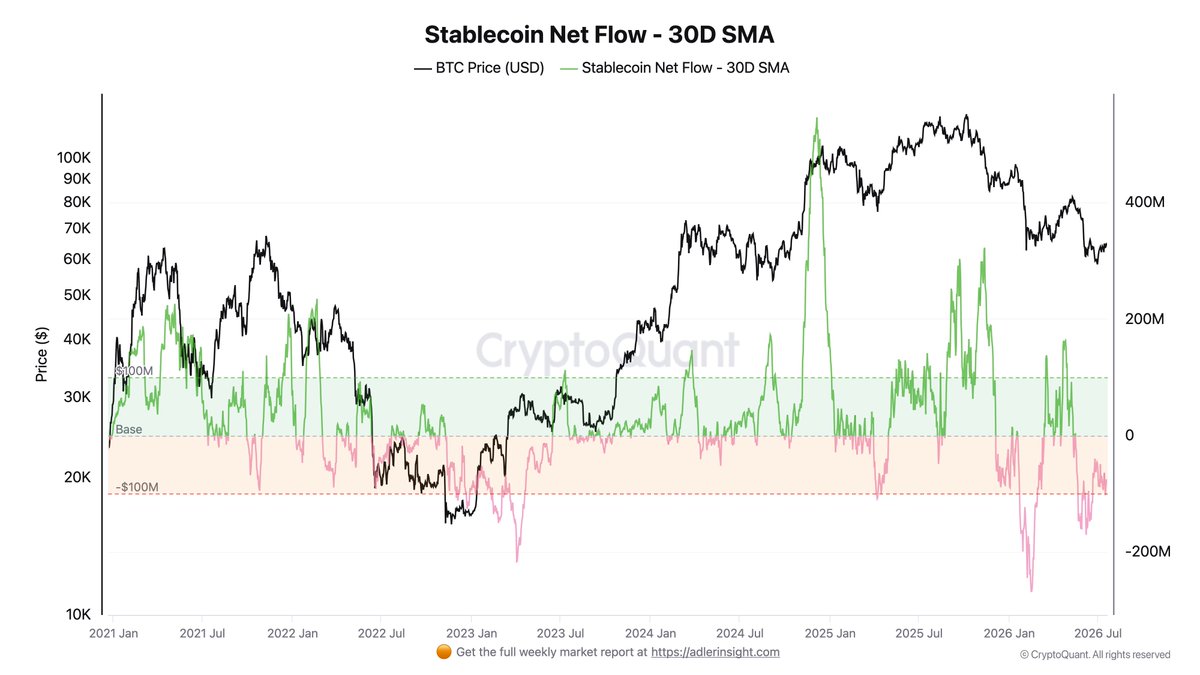
Stablecoins have been leaving exchanges for 35 straight days, while BTC is not moving into accumulation.
What needs to change for demand to return - I break it down in Morning Brief #217👇
https://t.co/icyKN0DTCq
🔴 The market is struggling in terms of liquidity.
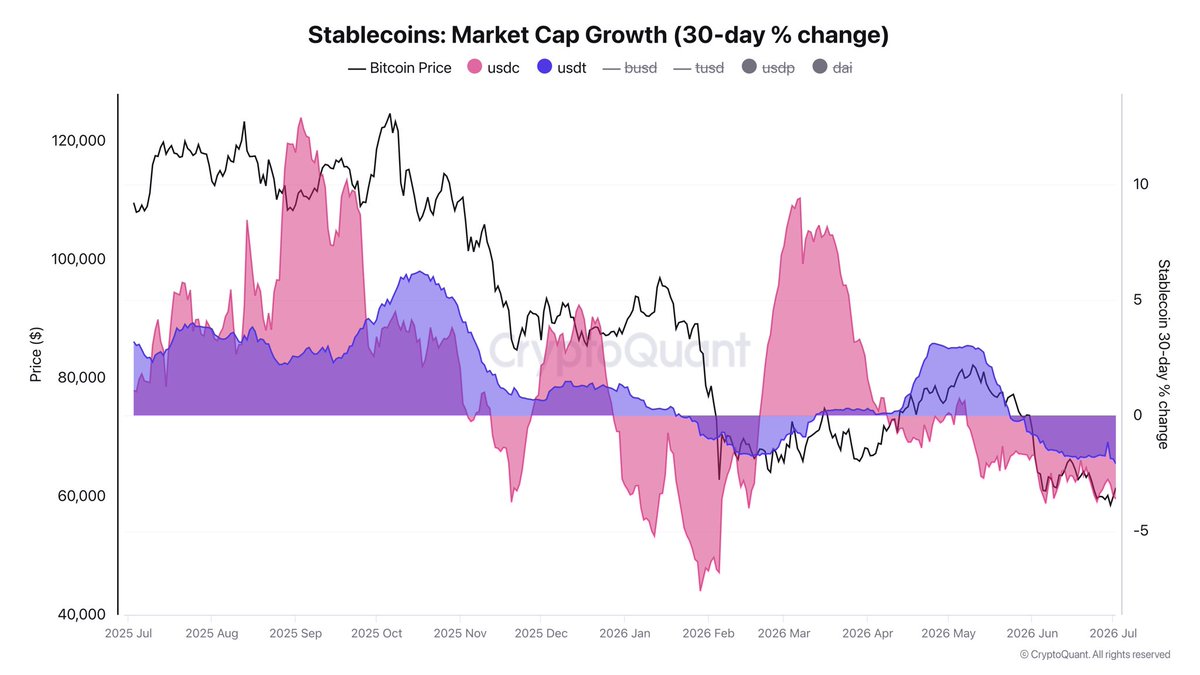
📉 USDC and USDT market cap are down -3.6% and -2% respectively over the past 30 days.
Overall, we can see that this slowdown has now been in place since November 2025.
This decrease is explained by the fact that more capital has left the crypto market than liquidity has entered it.
—💡 To understand this properly, stablecoins are notably issued when demand increases, whereas when demand weakens, issuers burn this unnecessary surplus, which allows us to gauge demand and liquidity flows. —
For now, we remain in an environment where liquidity is increasingly constrained.
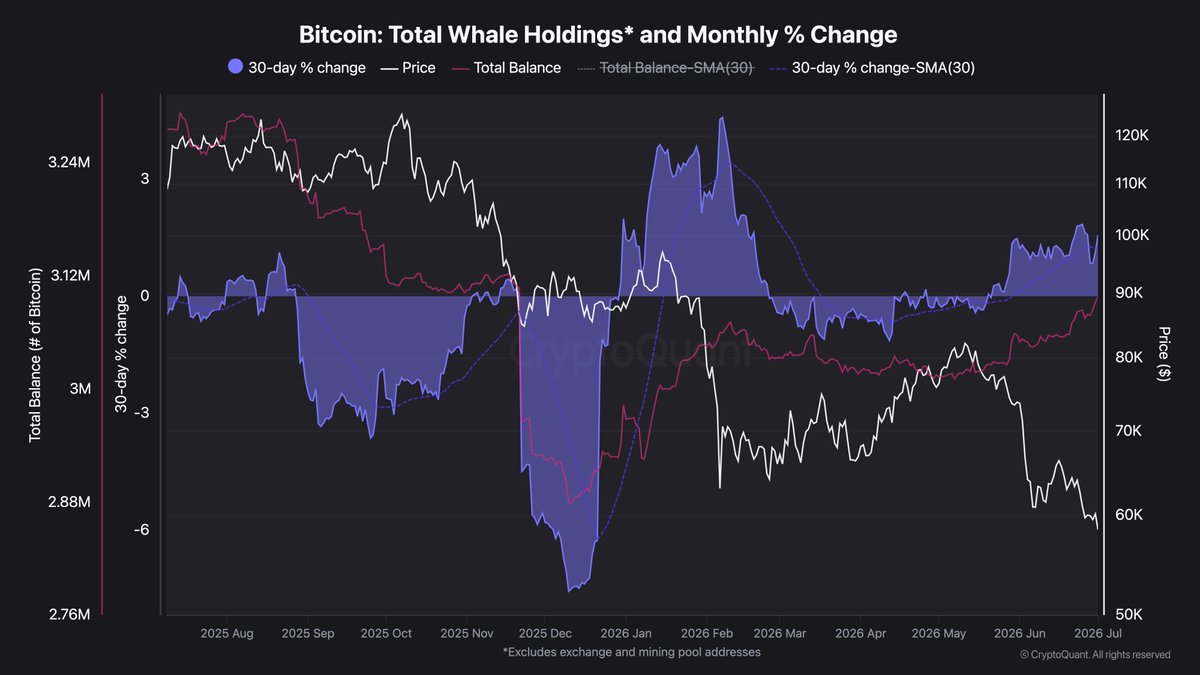
❌ I see this type of post everywhere claiming that whales accumulated over 270,000 BTC in 14 days.
In reality it was a glitch, here's the updated chart.
That said, it remains true that whale-held supply has slowly increased this year.
💥 In December 2025, their share of supply had fallen to 2.88M BTC.
7 months later, with BTC having gone from around $90,000 to $60,000, they now hold 3.09M BTC.
The 30 day % change is also up, showing 1.57%.
👉 Their accumulation has accelerated slightly over the past few days as BTC dropped below $60,000.
This level appears to be defended by whales.
Apple $AAPL is in negotiations to buy memory chips from two Chinese 🇨🇳 semiconductor makers on a Pentagon blacklist to help reduce the impact of a global memory shortage - Bloomberg
The Total Altcoin Market Cap has already confirmed a breakdown from its 2.5+ year range.
There was an attempt at breaking back into it two weeks ago but this has ended up in a bearish retest.
It now finds itself in between two major horizontal levels with the breakout level from November 2023 right below.
BREAKING: Global gold-backed ETFs posted -38.3 tonnes in outflows last week, the largest weekly outflow since September 2022.
This was led by North America, at -23.6 tonnes, followed by Asia, at -8.7 tonnes, and Europe, at -5.9 tonnes.
In Dollar terms, these funds posted -$4.7 billion in withdrawals, the largest weekly outflow on record.
The largest US gold-backed ETF, $GLD, alone saw -$2.0 billion in outflows, the 4th-largest this year.
So far in June, $GLD has recorded -$3.2 billion in withdrawals, on track for its 2nd-worst month since February 2021, after a record -$8.5 billion in March.
Gold market sentiment remains highly volatile.