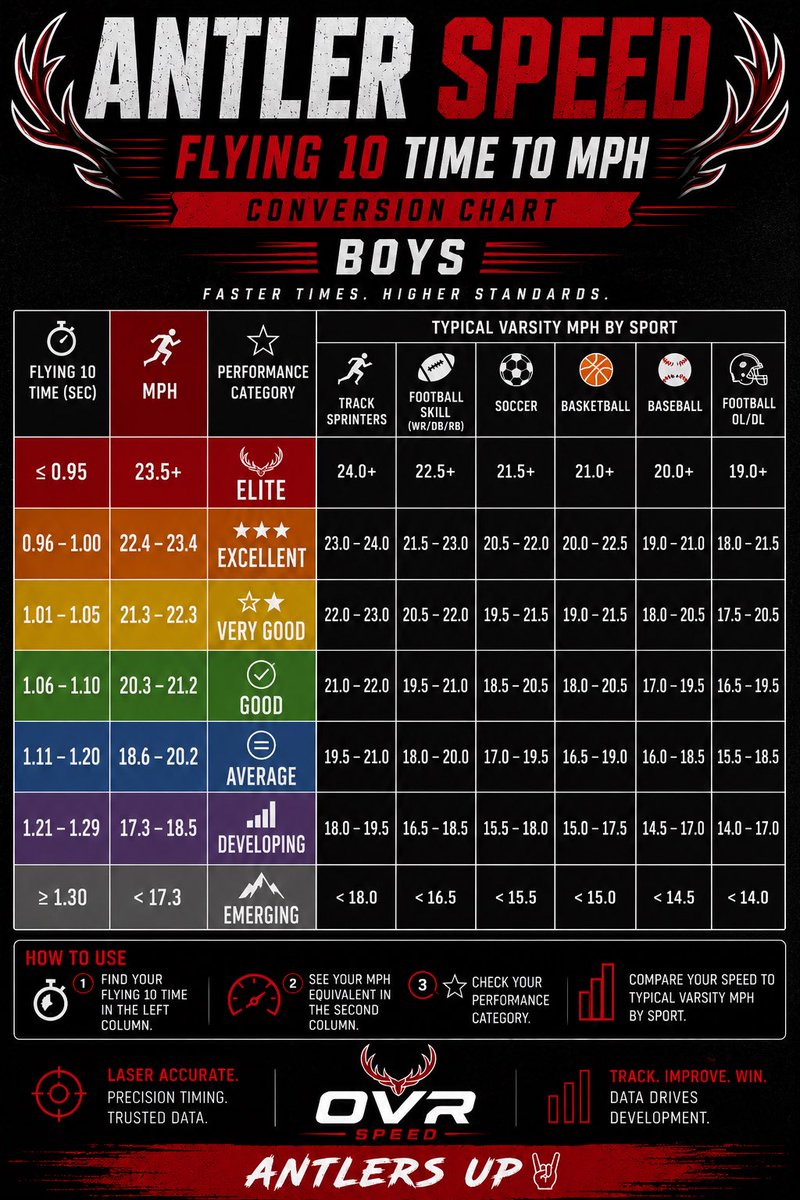
🚨 NEW: ANTLER SPEED 🚨
We are excited to roll out our Flying 10 MPH Conversion Charts for both boys and girls athletes.
⚡ Laser Timed ⚡ MPH Conversion ⚡ Performance Standards ⚡ Sport Benchmarks
What gets measured gets improved. #AntlersUp
If you want your athlete to gain weight they're going to need to eat more kcal, protein, carbs, and drink more fluid.
A 6'0 185 lb. athlete is going to need 6,000+ kcal, 200 g protein, 500 g CHO , 90 g+ of fat daily to gain muscle if they are training > 2 hours per day 7 days a week. (Often little rest days in those that reach out to us).
✔️First track your kcal and know how much you are eating. Then add in another 300-500 kcal daily. Focus on being consistent.
✔️Gaining weight takes time. Too many try to eat too much too quick and either quit or end up gaining fat and not muscle.
👇Get the weight gain guide or one of our other resources to help you to improve your nutrition.
https://t.co/X867TJr6j8
Shoutout to Liam Houston for the progress being made across all testing areas. Since his first testing entry, Liam has improved his bench by 10%, squat back over 400 lbs, deadlift by 7.45%, increased his vertical 1.2 inches, and ran a 4.75 laser 5-10-5.
Antlers Up 🤘🆙
Another spring lifter was Cam Severson. Since his first testing entry, Cam has increased his bench by 10.20%, improved his vertical jump by 1.4 inches, and recorded a 90-inch broad jump. Proud of the consistent work being put in each day.
Antlers Up 🤘🆙
One of the lifters of the spring session goes to Caedenn Moore. Since his first testing, Caedenn has increased his bench by 13% and squat by 10%, improved his vertical by 1.6 inches, and ran a 4.65 shuttle on the laser system. Proud of the work he puts in each day. 🤘🆙
STOP BLAMING LIFTING FOR INJURIES, IT REDUCES THEM
If I had a dollar for every time a sports coach, mislead parent or naive athlete blamed lifting for an injury, I could retire
I think it’s because people incorrectly associate loading with injuries, but more often than not, the strength training not only does not cause the injury, it actually helps reduce them
What usually DOES cause injuries lies in overuse & way too much volume. Practicing almost every day, playing on multiple teams or all year without breaks or just flat out stupid conditioning at practice
For example: the little league pitcher who’s arm hurts because they throw innings in games nonstop. The football player who is run into the ground at practice & has hip or hammy issues
Tone that down a bit and equip your body with the armor it needs. Consistent, quality strength training to build a robust engine designed to better withstand the stresses of sport
& while you’re at it, maybe turn those stresses down a bit!
Coaches & parents: Stop cutting weights in-season “to save the athletes.”
You’re actually increasing their injury risk.
A 2018 study showed that continuing
strength training in-season is one of the single best ways to reduce injuries
Save this entire thread
Here’s why it matters and exactly how to do it right👇
1991 Chicago Bulls lifting on game day 😤
Back when most thought it was crazy.
The Bulls knew better: morning weights kept them strong, physical, and fresh through the long season + playoffs.
MJ & Scottie didn’t skip it.
Neither should you.
In-season lifting = non-negotiable
You’re talented… but you’re quiet.
And that’s the problem.
No voice = no leadership
No sound = no power
No energy = no impact
Everybody wants to be “nice”
Everybody wants to “do their thing”
That’s not how teams win.
Teams talk.
Teams connect.
Teams bring ENERGY every rep.
🗣️ You MUST lift in-season… you wanted context, so let’s talk about it!
🔑 Read the below… change how you look at in-season training
1️⃣ “I don’t want to be sore.” Understand context. Understand protocol that can be taken in a GOOD program by a GOOD coach who can have you work in a way that gets or maintains results without frying you!! Sub-maximal strength work, isometrics, limited sprint volume. All work
2️⃣ “I don’t have time. I have games or practices 5x per week.” Please keep your two off days as off days. Big hack? Do speed or jump work before games or practices to prime you to be ready to go! Do sub max strength work after games or practices. You’ll already be warmed up AND odds are the sub max lifting will be less intense than sport so it’ll actually be a cool down of sorts
3️⃣ “Why lift after games or practices?” It’s simple. While you may think you’re better off not doing too much on one day, it’s actually better to stack higher intensities on the same days so you can use days you’re off from your sport to be COMPLETE rest days
4️⃣ “I’ll get hurt from doing too much.” Again, moderation & quality programming are keys here. A good program will actually HELP you stay resilient, avoid burnout & counter the high amounts of reps you’re getting in your sport as a way to stay strong & healthy
5️⃣ “Why can’t I just wait until the off-season?” Of course you can. But let me ask you this. The in-season is probably the biggest chunk of time you have in your year. Can you really afford to NOT train for several months? You’ll start your off-season just building back to what you were vs. Improving. Then you’ll lose it all again come in-season 🤦♂️
🔑 Read the above… change how you look at in-season training
Lifter of the week goes to Brady Mataele for the way he attacked the entire winter training block. Showing up, putting in the work, and continuing to improve.
#Antlersup 🤘🆙
Most athletes are told to ‘take longer strides’. This usually hurts more than it helps.
But stride length isn’t something you force. It’s something that happens when you apply more force into the ground.
Weyand et al. (2000) found that faster sprinters didn’t achieve higher