@jayvanbavel This could be an opportunity to right-size PhD programs toward fields with actual demand, and push universities to be more honest with applicants about career outcomes.
Are women more attracted to men with resources?
It depends.
Romantic preferences for people with economic resources are stronger for the sex that is poorer and individuals who are poorer.
When women earn more money, this preference goes away. This suggests that economic preferences are cultural, rather than evolutionary.
However, romantic preferences based on physical attractiveness and age are largely unaffected.
https://t.co/CVVqOTfKzP
@newstart_2024 Interest doesn't appear in a vacuum. The gender gap in tech isn't raw biology or raw discrimination. It's decades of cultural messaging that quietly told women their minds weren't built for this. And then we mistake the outcome for the cause.
@Alexfeinberg Research consistently shows that gender-diverse teams outperform homogeneous ones on innovation. The ‘competency hierarchy’ argument also assumes existing hierarchies are already purely meritocratic, which research on evaluation bias shows they’re not.
@InezFeltscher The traditional family model was itself historically subsidized through tax structures, zoning laws, and social norms that assumed and enforced it.
@SarahTheHaider It’s also about an exchange that historically kept women as the lower class, trading youth for resources, fame, or protection. Women can now have those things themselves and should choose partners their own age, not ones they’ll end up caring for.
One of the worst strategies I can think of is the right-wing one, which emphasizes traditional maternity - quit your job, stay home, rely on a husband, have as many babies as possible. France, for example, has one of the highest birthrates in the EU - and one of the highest female labor force participation rates. France has a very in-demand childcare system, and it's not just the creches you've heard about; it also subsidizes the kind of in-home one-on-one care that a lot of parents prefer for babies. It also just gives parents money for each child.
@CarolynGorman_ If lots of women “choose” to stay home and support their partner’s careers, while very few men do the same, then that’s not just a series of personal decisions, it’s a societal pattern. And she is right to fight it.
@emlwaters It saddens me that women’s workforce participation is still actively contested as a right in public debate, whereas nobody is seriously arguing men shouldn’t be allowed to work.
"sex differences in ideal partner preferences for resources are environmentally contingent, implying that traditional heterosexual preferences for hypergyny may erode with women’s economic advancement, despite public concerns to the contrary"
https://t.co/bYMtdZt70a
This poll captures nuance that manosphere discourse misses.
Men prefer a doctor spouse to a waitress by a wide margin. Status clearly matters to men.
But women prefer a doctor spouse even more strongly.
Both are true.
Manosphere see the stronger female preference & erroneously conclude men don’t care about status.
I don’t consider our experiment the final word, but I’m tentatively optimistic, as our experimental results are mostly consistent with real-world data.
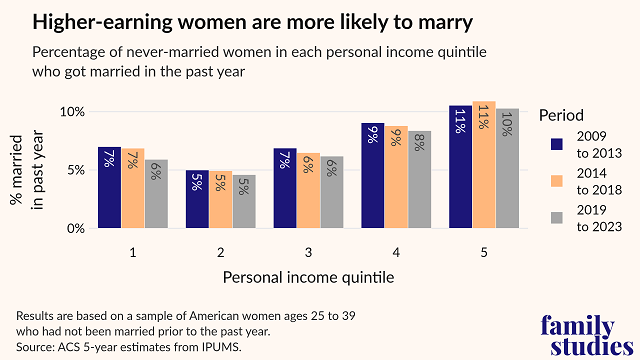
E.g., successful women don’t seem to be struggling to pair, despite widespread concern on their behalf. (12/15)
Old demographic story: when women work, fertility falls.
New evidence: that relationship has weakened or even reversed in many rich countries.
Places where women can combine careers and family often have higher fertility.
https://t.co/KX3ljV2yNZ
A new article in Nature Medicine found that social connections were a surprisingly powerful predictor of a long life.
Living with a partner was roughly as beneficial as exercise. Regular visits with family or having someone to confide in also appeared to be associated with lower mortality. Loneliness also affects mental wellbeing—another factor in longevity.
Happy Valentine's Day!
https://t.co/MlEKbB8V2d
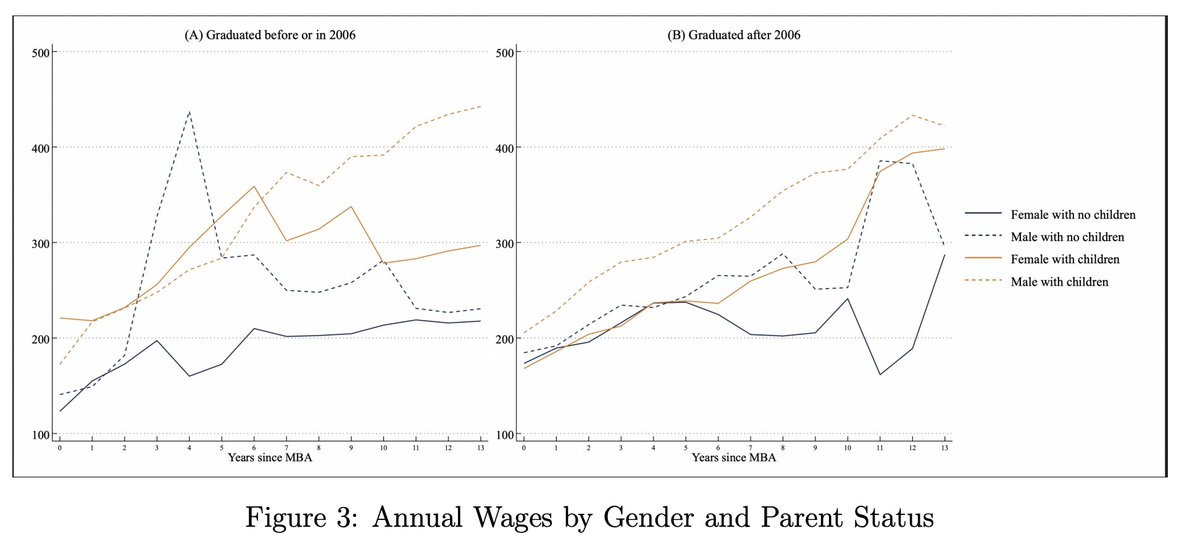
A big new paper released this week on gender, parenthood, and income complicates some things I thought I knew about the economy
The story I was familiar with from several years ago is that the gender wage gap had stopped narrowing and the economy continued to severely punish working moms.
This paper finds:
1. The gender wage gap shrank by about 33 to 50% in the last two decades—although a male-female gap still very much exists.
2. Work from home has reduced the motherhood penalty, especially in "greedy work" careers with long hours
3. Data now shows that among workers with MBAs, dads earn the most and moms seem to out-earn men without children. (A parent premium! Pictured below)
4. Incomes are converging among men and women with advanced degrees, as researchers see dads working fewer hours and moms working longer hours
"When both partners WFH at least one day per week, our results suggest that total lifetime fertility is greater by 0.2 children in our global sample (0.18 in our US sample), as compared to couples where neither partner engages in any WFH." https://t.co/hBsnQilmMP
@_alice_evans I get the solitude point, but abolishing the commute changes how people spend time, not just how much they’re alone.
Less commuting means more shared time, more flexibility, and real room for both parents to parent. That lowers the cost of having kids, not raises it.
@_alice_evans I get the solitude point, but abolishing the commute changes how people spend time, not just how much they’re alone.
Less commuting means more shared time, more flexibility, and real room for both parents to parent. That lowers the cost of having kids, not raises it.