Embassy of #Cuba to the US, reopened on July 20th, 2015, when diplomatic relations between both countries were reestablished. @EmbaCubaEEUU tweets in Spanish.
@NTXcomrade@CubaMINREX@PresidenciaCuba Cuba has consistently defended the principle of sovereignty and non-interference. The United States has maintained a naval base at Guantánamo Bay on Cuban territory against the will of the Cuban people for more than a century. Territorial integrity applies to every country.
Cuba does not threaten the United States.
It does not host foreign military bases, does not sponsor attacks on American soil, and has repeatedly offered dialogue based on mutual respect and non-interference.
What it does face is a six-decade blockade that, according to the latest official report, cost $8.083 billion in damages between March 2025 and February 2026 alone.
The world has rejected this policy for 34 consecutive years at the UN. The majority remains clear even after intense lobbying.
#CubaIsNotAThreat
Cuba provides free universal healthcare and education, with infant mortality and literacy rates comparable to developed countries, despite a U.S. blockade that has cost the economy more than $150 billion and restricted access to medicines, equipment, and spare parts for decades.
The UN has condemned the blockade every year since 1992.
For over 60 years the U.S. blockade has limited Cuba’s ability to import medical supplies, equipment, and food. The UN has voted overwhelmingly against it every year since 1992, with nearly the entire membership calling for its end. The policy continues to affect the daily lives of Cuban families.
The blockade is the policy that has restricted ordinary Cubans’ access to fuel, medicines, and spare parts for more than 60 years.
Cuba’s 2026 report to the UN records that, in the most recent period, childhood and youth cancer survival fell from 85% to 65% and infant mortality rose to 9.9 per 1,000 live births—after years of holding near 4.
Those are the documented consequences for civilians.
#CubaIsNotAThreat #EndTheBlockade
The figures we share are not about any individual or political claim. It restricts the country’s ability to buy fuel, raw materials, spare parts, and medical supplies on the open market and raises the cost of whatever can still be obtained.
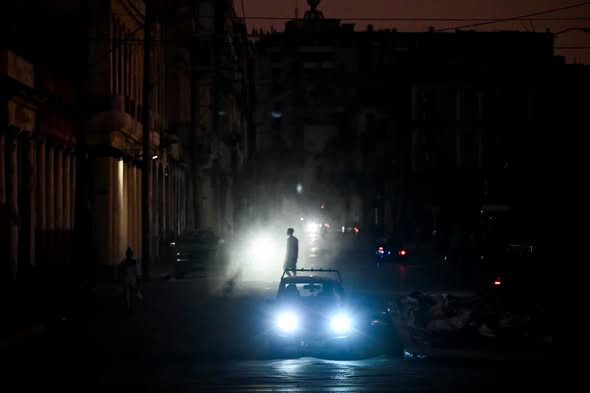
That is why Cuba’s 2026 report to the UN links the current energy restrictions to average blackouts of more than 20 hours and to roughly 1,400 MW of generating capacity that cannot run for lack of fuel. Those outages affect water pumps, hospital equipment, and food refrigeration.
The UN Special Rapporteur on unilateral coercive measures, after visiting the island, described the overall effect as devastating for the population, particularly the most vulnerable, and noted that existing exemptions are often slow and ineffective.
The policy has been in place since 1962. The human consequences are still being measured.
$8 billion in damages in one year. That’s the cost of the U.S. blockade to Cuba between March 2025 and February 2026 alone, a record figure.
Last week, the Treasury Department added new sanctions on Cuban oil tankers, shipping companies, and expanded measures to electronics, manufacturing, marine, and technology sectors.
These steps deepen an energy siege that already leaves hospitals without reliable power and families facing blackouts.
The blockade is not targeted at a government. It is collective punishment that hits ordinary people every day.
#CubaIsNotAThreat #EndTheBlockade
The documented impact of the U.S. blockade is on the daily lives of ordinary Cubans, not abstract politics.
Cuba’s 2026 report to the UN records $8.083 billion in economic damage in one year (March 2025–Feb 2026). That includes roughly 100,000 people waiting for surgery (12,000 of them children), 300 of 395 essential medicines unavailable, childhood cancer survival falling from 85% to 65%, and average blackouts exceeding 20 hours after intensified energy restrictions.
These figures come from Cuba’s official report submitted in the context of the annual UN General Assembly resolution. The UN Special Rapporteur on unilateral coercive measures has separately described their effect as devastating for the population, especially the most vulnerable.
Disclaimer, American embargo of Cuba is a crime against humanity. The Geneva Conventions: Article 33 of the Fourth Geneva Convention (GC IV) explicitly mandates that "No protected person may be punished for an offence he or she has not personally committed. Collective penalties and likewise all measures of intimidation or of terrorism are prohibited." [1]
Cuba’s official 2026 report to the UN documents a record $8.083 billion in economic damage in the year to February 2026. In the energy sector, that includes roughly 1,400 MW of available capacity sitting idle solely for lack of fuel and average blackouts exceeding 20 hours nationwide after the January 2026 measures that further restricted oil supplies.
Aging plants and deferred maintenance are real. So is the blockade’s long-standing restriction on fuel, spare parts, and financing.
$8.083 billion. That is the documented economic damage the U.S. blockade caused Cuba in just one year (March 2025–Feb 2026)—a record 7% higher than the previous period, according to official report to the UN.
Behind the number: medicines, fuel, food, and spare parts that never arrive. Cumulative damage now stands at $178.7 billion.
In Beijing, Foreign Minister Wang Yi said China will firmly support Cuba’s sovereignty and legitimate rights, and oppose sanctions, the blockade and external interference.
China and Cuba continue high-level diplomatic engagement. 🇨🇺🇨🇳
Foreign Minister Bruno Rodríguez Parrilla is visiting China from November 10–13 as a special envoy of Cuba's Party and Government. The visit comes at an important time for political and economic ties between the two countries.